For 20 years, ISD has delivered field-leading threat detection, analysis and real-world strategies to combat terrorism, extremism and authoritarianism - in all their ideological forms.

Home / Insights / Page 7

ISD NEWSLETTERS

ISD Insights is our monthly newsletter which delivers all the latest research and analysis directly to your inbox. To sign up for Insights, please complete the form below.

Insights No. 83

The attack at Berlin’s Christopher Street Day celebrations underscored two persistent threats: Islamist extremism and the targeting of LGBTQ+ communities. In a rapid reaction analysis, ISD examines what the attack, a vehicle ramming that killed one person and injured 29 others, reveals about the enduring appeal of Islamic State ideology among young people, the role of online propaganda in radicalisation and how extremist networks exploit attacks to amplify their message.

It also highlights a broader international wave of anti-LGBTQ+ violence from extremists across the spectrum. This includes a significant rise in attacks on Pride events in Germany, especially from the far right. Finally, the analysis raises difficult questions about whether authorities have the tools to identify and effectively manage individuals at risk of violence.

In the days following the incident, ISD Germany analysts brought their expertise directly into the public conversation. Their commentary examined not only the attack, but what it tells us about the evolving threat from Islamist extremism — and the challenges of preventing the next one. ISD provided analysis across Deutsche Welleradio3 (rbb)Hamburger Abendblatt and Deutschlandfunk Nova, among others.

Other stories in this newsletter include:

None of this work would be possible without your support. Thank you for being part of it.

View newsletter

ISD Snapshot: Iran

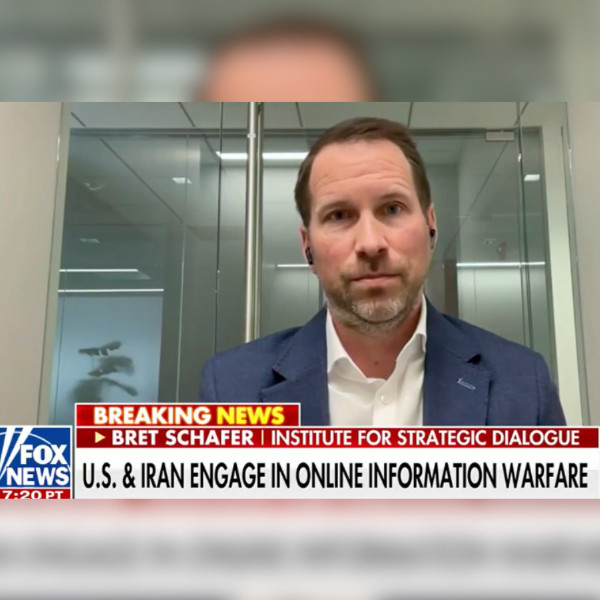
The war with Iran is having a profound geopolitical impact. Tehran has long engaged in aggressive cyber and information warfare — but new tactics (from wildly popular AI-generated parody videos to “violence-as-a-service” recruitment models) reveal the emergence of a threat environment where state actors, extremists and criminal networks increasingly overlap.

This newsletter features commentary ISD’s Moustafa Ayad, Research Chair in Global Islamism and Counter-Terrorism, and Bret Schafer, Senior Director of Policy & Research, Information-Operations, summarising the last three months of ISD’s investigations and research relating to the conflict as covered by the New York Timesthe Wall Street Journal and CBS News.

View newsletter

Insights No. 82

Since the start of the Iran war, ISD’s research teams have focused on how state and non-state actors have exploited the conflict to push their own agendas. Our work has analysed co-ordinated information operations involving Iran, Russia and their non-state proxies, including the use of manipulated media, AI-generated imagery, and co-ordinated amplification through overt and covert social media networks.

ISD has disseminated rapid response insights to a broad range of stakeholders including law enforcement and community partners, policymakers, mayors and national security journalists, resulting in a broad swathe of commentary and analysis  including the New York Times, the Associated Press, Fox News,  Agence France-Presse, the Washington PostPolitico and Tech Policy Press. Congressional offices from both parties in Washington have sought briefings from ISD’s experts.

The war’s ramifications extend well beyond the region. The US has faced four acts of terrorism in Texas, New York, Virginia and Michigan – two with a clear connection to the Islamic State (IS) – in the past two month. While only one appears connected to the ongoing war as of this Insight, the multidimensional nature of the threat landscape is something ISD research and threat assessment and detection teams are well attuned to addressing.

In this month’s newsletter, we focus on ISD’s information operations and counterterrorism work. This includes Iranian and Russian propaganda operations, the persistent online presence of the Islamic State (IS), the scourge of online youth radicalisation in the US, the targeting of holiday celebrations in terror plots and the surge in violent threats against public officials

None of this work would be possible without your support. Thank you for being part of it. 

Also in this newsletter.

  • Axis of amplification: Regime media, proxies and Western supporters respond to Iranian protests
  • Islamic State group activity in the US in 2025
  • Coordinating Through Chaos: The State of the Islamic State Online in 2026
  • ‘Tick tock traitor:’ The rise of violent rhetoric targeting US public officials
  • Bondi Beach: The hallmarks of an Islamic State attack 
  • ISD staff featured in across global media outlets including Politico, Fox News, CBS News, the Guardian, Euronews, and more.

ISD Snapshot: Munich Security Conference

The Munich Security Conference (MSC) remains one of the most closely scrutinized moments on the geopolitical calendar, serving as a bellwether for the strategic direction, resolve and priorities of Western democracies. Its 62nd edition, which convened under the theme “Under Destruction” from February 13–15, 2026, proved no exception. 

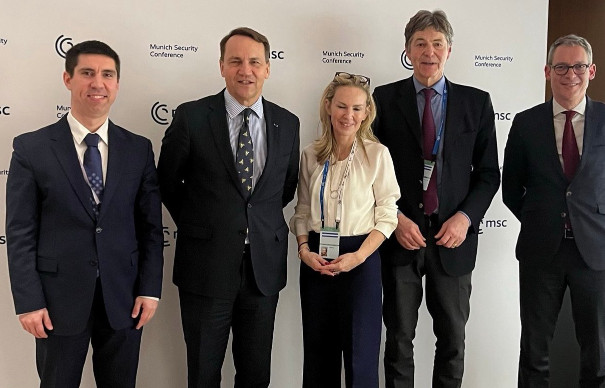
ISD was represented at this year’s MSC by CEO Sasha Havlicek and David Salvo, Managing Director for Transatlantic Policy and Programming, where they convened a high-level panel of government leaders to focus attention on one of the central challenges democracies face today: cognitive and hybrid warfare and how to raise the costs on authoritarian actors waging these wars. Titled “How We Win in the Hybrid and Cognitive Domains,” ISD’s panel featured Radek Sikorski, the Minister of Foreign Affairs of Poland; Mihai Popșoi, the Minister of Foreign Affairs of Moldova; Ambassador David Cvach, Permanent Representative of France to NATO and was moderated by Arndt Freytag von Loringhoven, former NATO Assistant Secretary General for Intelligence and ISD-Germany Advisory Board member. 

Insights No. 81

In this edition of Insights we examine how generative artificial intelligence (AI), while bringing exciting innovation, is contributing to new forms of harm. These include manipulated, non-consensual sexual imagery and abuse.

We spotlight the audience ISD CEO Sasha Havlicek and ISD UK board member Baroness Joanna Shields OBE had with Pope Leo XIV in Rome as part of a Vatican convening of experts on protecting children in the age of AI. In his address, the Pope warned that children and adolescents are particularly vulnerable to manipulation through AI algorithms and called on governments to design and implement policies to protect them and ensure ethical AI development.

He also called for wider efforts in digital literacy. ISD will take this momentum forward with a major new line of AI research on companion chat bots and their particular risk to children, and through our established digital literacy and policy work.

Sasha also attended a variety of other conferences across November, including in RomeBrussels and Montreal on topics including the future of democracy and tech governance.

Also in this newsletter:

Insights No. 80

This edition of Insights looks at the Islamist extremist attack on Manchester’s synagogue, the UK’s first antisemitic murder in decades. The horrific tragedy reveals how antisemitism has become increasingly normalised online and was exploited by a wide range of extremist actors to spread conspiracy theories, justify violence and amplify both antisemitic anti-Muslim narratives.

Also in this newsletter:

  • An analysis of sanctioned US neo-Nazi terrorist group The Base, which has established unique tactics including offering cryptocurrencies to prospective attackers.
  • An ISD investigation found that Russian state media continues to slip through sanctions three years since the start of the full-scale invasion of Ukraine.
  • False flags spread faster than ever today, with conspiracy theories about shootings in the US and military action in the Middle East outpacing Community Notes on X.
  • In the Sahel, Mali, Burkina Faso and Niger have formed an alliance of anti-Western, pro-Russian states. Influencers targeting these countries echo common Kremlin lines, often combining longstanding anti-French grievances with Soviet-era anti-colonial propaganda.

Insights No. 79

The online threat landscape in 2025 is more complex—and more dangerous—than ever. Extremist content continues to move fluidly from digital platforms into the real world, undermining democracy and human rights. At ISD, we’re tracking and exposing the tactics, trends, and technologies fueling these threats—from AI-generated deepfakes and the radicalization of youth, to foreign interference campaigns and domestic extremism.

In this month’s newsletter, we explore emerging challenges posed by threats such as nihilistic violence emerging from violent online communities, which has led to school shootings and attacks internationally. Although nihilistic violence resembles extremism in its impact and online aesthetics, its lack of coherent ideological motivations makes it challenging for existing counter-terror infrastructure to combat.

Also in this newsletter:

Insights No. 78

The online threat landscape in 2025 is more complex—and more dangerous—than ever. Extremist content continues to move fluidly from digital platforms into the real world, undermining democracy and human rights. At ISD, we’re tracking and exposing the tactics, trends, and technologies fueling these threats—from AI-generated deepfakes and the radicalization of youth, to foreign interference campaigns and domestic extremism.

In this issue of Insights, we examined youth radicalization following Netflix’s hit series Adolescence. Our research delved into the 764 network which is behind a wave of extortion, violence and ideological manipulation of young men. We also examined the wide variety of gender-based violence, ranging from hoaxes about a “national rape day, sexual violence on TikTok and a surge in misogynistic content trivializing domestic violence and encouraging stalking.

Also in this newsletter:

  • A spotlight on antisemitism and the concrete steps to combat it,
  • How Islamic State (IS) group continues to thrive online,
  • Russia’s use of deepfakes to target Ukrainian refugees,
  • New research into the ways that TikTok’s recommender systems perpetuate harmful stereotypes,
  • The use of Amharic language to bypass TikTok’s hate speech filters.

Insights No. 77

One year after the Hamas attacks on Israel on 7 October, misinformation and disinformation continue to distort the picture of what is happening in the Israel-Gaza conflict. Credible reporting from a range of news outlets has been regularly misrepresented to stir up hatred and demonise different groups. Now, the stakes are even higher with conflict spilling over the borders into Lebanon and Iran.

It is critical that social media platforms do more to help combat the spread of misinformation and disinformation. An important first step would be for them to set up dedicated teams and develop policies so that trusted flaggers – those with relevant expertise to judge harmful content – including journalists, can report content which misrepresents their work. This would allow content to be properly labelled and contextualised, limiting the effectiveness of attempts to divide and enrage communities and stoke the conflict.

ISD research continues to provide data-driven insights into this wide-reaching mis- and disinformation and conspiracy theory content swirling around the conflict. Read ISD’s latest analysis and recommendations here. This work was supported by the European Media and Information Fund.

Also in this newsletter:

  • The Irish Channel: Investigating an Irish Misinformation Hub, Political Connections and AI Hallucinations
  • Hurricane Helene brews up storm of online falsehoods and threats
  • Lincoln Media’s effort to shape public opinion ahead of the US Elections
  • Alleged Patriot Front offshoot may be front for neo-Nazi accelerationists
  • Failed ‘Groyper War’ paves the way for other bad actors
  • Neo-Nazi accelerationists seek refuge amid looming Telegram crackdown
  • Content glorifying Hitler surges online amid growing historical revisionism
  • Analysing the surge in anti-migrant harassment and violence in Ireland
  • Event: CEO Sasha Havlicek and ISD experts return next week to the Eradicate Hate Summit
  • Isabelle Frances-Wright and Ellen Jacobs join podcast to discuss platform preparedness for the upcoming US election
  • ISD staff featured in the Washington Post, the New York Times, the Wall Street Journal, the Huffington Post and more

Insights No. 76

TikTok, the short form video giant, has soared in popularity since 2018. Originally known for lip syncing and dancing teens, more than one in ten Americans now treat it as a news platform. However, TikTok also hosts egregious and harmful content. ISD’s groundbreaking 2021 study found hate going viral, including 2 million views for a video featuring anti-Asian hate fuelled by COVID-19.

Now, in an updated study analysing trends in hate speech and extremist content, ISD analysts have reviewed how TikTok moderates this material. Two newly published reports cover white supremacist content and anti-migrant & anti-refugee content on TikTok, and we found that extremist content is still not being removed effectively. Worse, our analysis found that some of this harmful content is receiving more views than it did in 2021.You can read more about the methodology of this work here.

Taking into account these findings, ISD analysts have developed a series of policy recommendations to help improve platform safety. These include improving moderator training and resources, more effectively stopping repeat offenders who create new accounts, and providing greater transparency through data access and data on moderation decisions.

Also in this newsletter:

  • US Election Platform Preparedness: Comparative Analysis
  • Platforms fail to label and remove AI-generated and manipulated election content
  • A data-driven analysis of UK riot-related far-right Telegram networks
  • From message boards to TikTok: al-Qaeda’s two decades of internet exploitation
  • Analysing the Alternative für Deutschland (AfD) campaign in Saxony and Thuringia
  • Event: CEO Sasha Havlicek at the World Economic Forum
  • ISD staff featured in the Irish Independent, Deutsche Welle, the New Republic and more

1239 Next