Digital Dispatches
February 27, 2026
ISD UK
Foreign Information Manipulation and Interference
Axis of amplification: Regime media, proxies and Western supporters respond to Iranian protests
Nationwide protests in Iran which began in December 2025 quickly became one of the greatest threats ever to face the Islamic Republic. In response, the government has perpetrated mass killings (with some estimates of casualties in the hundreds of thousands) and large-scale arrests. A digital shutdown began in early January with major ongoing restrictions to internet access. Tehran, regional proxies and a range of the regime’s international supporters also accused the US and Israel of driving the protests or related violence.
This Dispatch summarises responses to the protests by state and non-state supporters of the regime between 28 December 2025 and 17 January 2026. These included efforts to contrast protests in Iran to anti-ICE protests in the US, accusations that Israel was manipulating the US into striking Iran, and claims that journalists and NGOs reporting high civilian casualties in Iran were part of a CIA psychological operation. The distinct but overlapping responses from the regime’s supporters shows the interconnectivity of the information ecosystems they inhabit, including how Iranian state messaging reaches far-left, far-right, and conspiracy theorist Western audiences.
Key findings
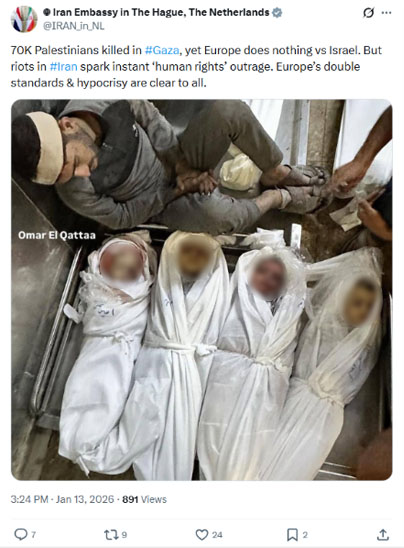
- Iranian state messengers framed protests as “riots” instigated by the US and Israeli agents. They also accused the US of hypocrisy over fatal shootings at domestic protests and human rights violations in Gaza.
- These accounts largely avoided mentioning the protests in English until the internet shutdown on 8 January, suggesting an effort to downplay the events.
- Iran’s regional proxies, who self-describe as the ‘Resistance Axis’, offered a range of responses. Kata’ib Hezbollah threatened explicit retaliation against US intervention, while Hamas failed to comment on the protests.
- Russian state messaging amplified claims of foreign interference. By contrast, China’s messaging sought to position itself as an arbiter for peace.
- Western far-righti pro-regime accounts blamed Israel for the violence. Content often included antisemitic tropes such as claims that Israel was covertly manipulating the US into the conflict.
- Western far-leftii pro-regime accounts usually blamed either Israel or the US. Accounts which centred Israel’s role often drew on antisemitic narratives, while those which centred the US drew more on ‘anti-imperialist’ narratives.
- Some Western conspiracy theorist accounts promoted narratives in line with Iranian state messaging, or far-left and far-right narratives.
Methodology
ISD analysts used an existing list of attributable Iranian, Russian and Iranian state media and diplomatic accounts created by the Alliance for Securing Democracy (ASD) for its Hamilton 2.0 dashboard, now housed under ISD-US following the January 2026 merger. We collected data from X, Facebook and Instagram accounts between 28 December 2025 and 17 January 2026 using monitoring and analysis tool Junkipedia.
In total, we found nearly 800 English-language posts from Iranian-linked accounts, more than 200 posts from Russian-linked accounts and more than 300 from Chinese-linked accounts. Some posts in other languages with similar translations to our English-language queries may have been picked up due to language translation issues.
Analysts also employed pre-existing seed lists and search queries for non-state actors across platforms to identify examples of their messaging during the monitored period. This included far-right and far-left accounts.
Official Iranian state actors frame protests as “foreign-backed riots” to delegitimise them
Iranian authorities and state media characterised protests as violent “riots” led by “terrorists”. English-language posts from these accounts used the term “riots” roughly six times as often as they did “protests”. In a post on X, Iran’s Supreme Leader Ayatollah Khamenei threatened that “the rioter must be put in his place”. Other state-affiliated accounts amplified content that claimed to show “rioters” and “terrorists” vandalising mosques, destroying public property and attacking security forces.
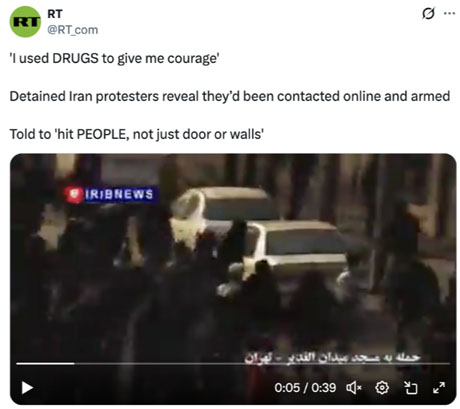
This narrative was reinforced by accusations linking the United States and Israel to the unrest. On January 9, Khamenei accused protesters of working for US President Donald Trump while Iranian President Masoud Pezeshkian told state broadcaster IRIB the US and Israel were exploiting protests “to escalate the unrest”. Iran’s Ministry of Intelligence claimed it intercepted a “large shipment of electronic equipment” intended for “espionage and sabotage” and released footage allegedly showing “Mossad-backed agents” arming protesters.
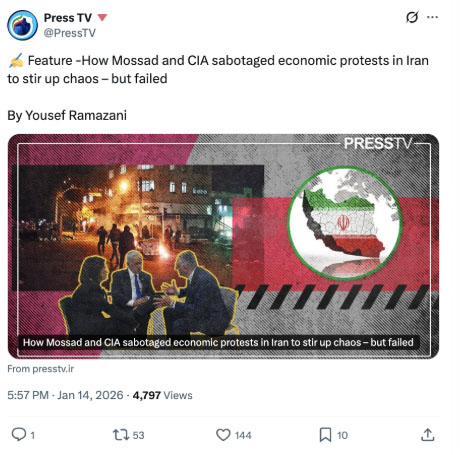
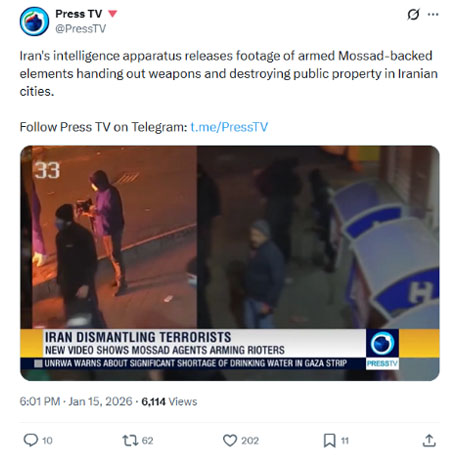
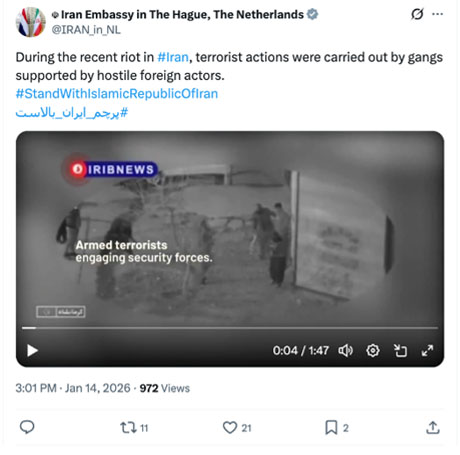
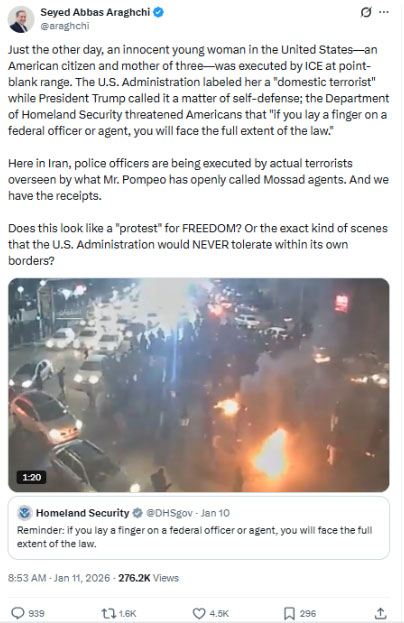
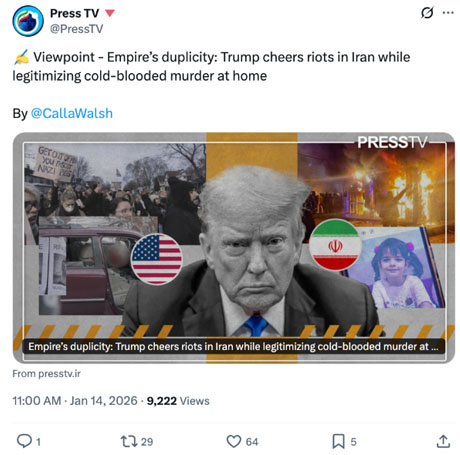
Iranian state messengers used the protests to accuse the West of hypocrisy. In a statement posted on X, Iran’s Foreign Minister Seyed Abbas Araghchi accused the US of hypocrisy for condemning Tehran’s crackdown after the killing of Renee Good by Immigration and Custom Enforcement (ICE) agents in Minneapolis, Minnesota. Iranian state-owned news outlet Press TV similarly scorned Trump for “cheering” the protests in Iran while “legitimising cold-blooded murder at home”.
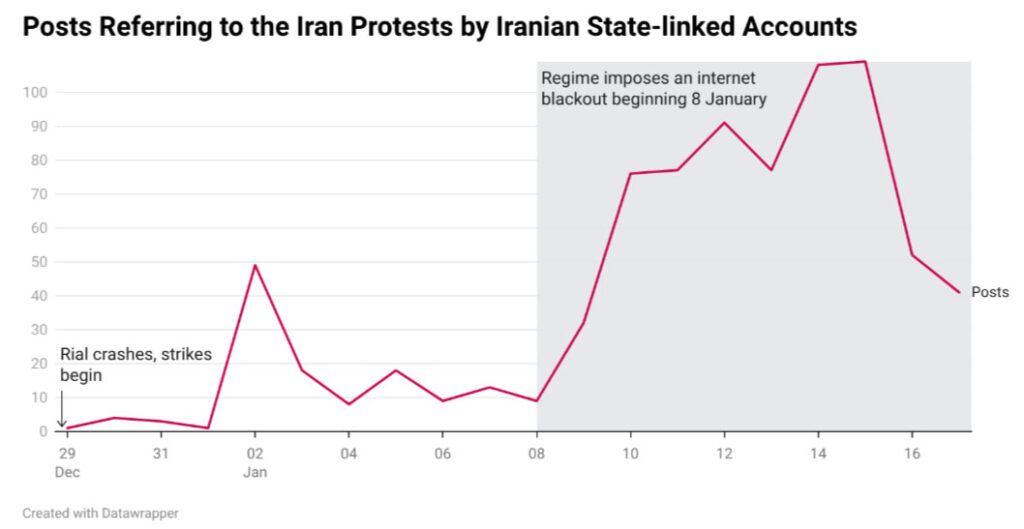
English-language Iranian accounts were largely silent until 8 January, almost 2 weeks after the start of the protests and the day when Iranian authorities shut down the Internet and began their crackdown. This suggests that Iranian state messengers at first sought to avoid drawing international attention to the unrest, only addressing it when the international response had grown too large to ignore.
Iranian regional proxies
Though Iranian proxy groupsiii largely echoed Tehran’s official messaging on the protests, they were significant variations between them.
Kata’ib Hezbollah
Iran-backed Iraqi Shia group Kata’ib Hezbollah (designated as a terror group by the US, the UAE and others) is reported to have helped Iran repress protesters. Leader Abu Hussein al-Hamidawi explicitly warned the US against war with Iran: “It is a fire that, once ignited, will not be extinguished until your noses are rubbed in the dust”. He later called on “mujahideen brothers in the east and west of the earth” and others to “prepare for a full-scale war” to defend Iran.
Hezbollah
Iran-backed Lebanese Shia militant group and political party Hezbollah – partially designated as a terror group by the EU and fully by the US and others – also echoed Iranian state narratives but did not promise retaliation. Hezbollah-affiliated news outlets like al-Manar admitted the economic cause of the protests but blamed it on US sanctions, claiming subsequent violence was the work of “foreign agents and armed groups”.
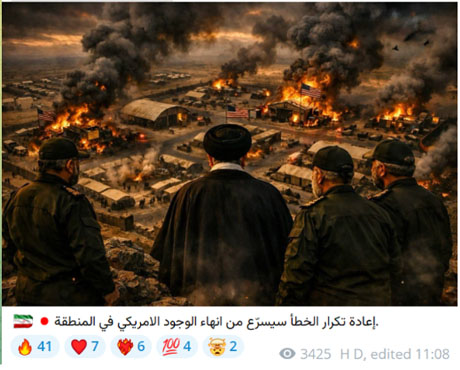
Official Hezbollah messaging avoided explicit military threats. Leader Naim Qassem praised Iran’s support for the ‘resistance’ in a TV speech on 17 January, claiming the US and Israel were attempting to “punish and weaken” Iran. However, he said that a decision to intervene would be made “in due course”. By contrast, pro-Hezbollah channels posted AI-generated imagesiv threatening retaliation against US military bases.
The Houthis
The Yemen-based Houthis (officially Ansar Allah), designated as a terror group by the US and others, released a clip apparently threatening strikes against the US as its naval vessels moved into regional waters.
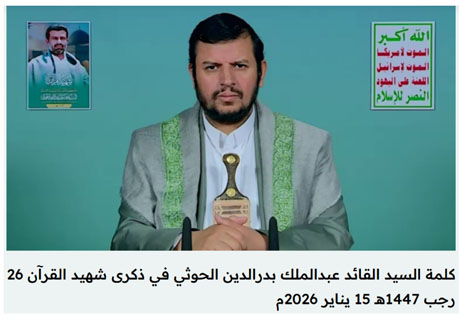
In a televised speech on 15 Januaryv, Houthi ‘Leader of the Revolution’ Abdul Malik Badr al-Deen al-Houthi characterised the protests as US and Israeli-directed. He alleged that US tactics against the Islamic people were to manufacture crises through sanctions before creating disturbances using “criminal gangs” which he contrasted with alleged “million-strong” pro-regime demonstrations.
Hamas
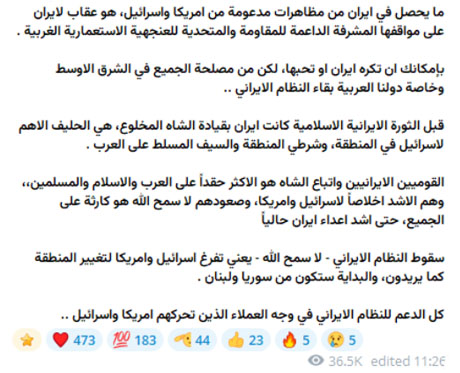
By contrast, Iran-backed Palestinian militant group Hamas (designated as a terror group by the US, the EU and others) posted little to no official content related to the protests. Discussions of the protests in pro-Hamas channels either characterised the protests as a US-Israeli operation, or pointed to Iran’s geopolitical role in fighting US and Israeli interests.
In one Telegram channel, the author captioned images of dead Iranian protesters as “Mossad’s dead”vi. In another, a user called on all Arabs and Muslims to back the Iranian regime regardless of personal antipathy to Iran. They warned that the return of the Shah and Iranian nationalists would allow the US and Israel to reshape the region.
Russia
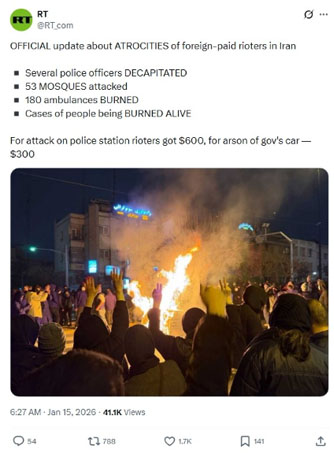
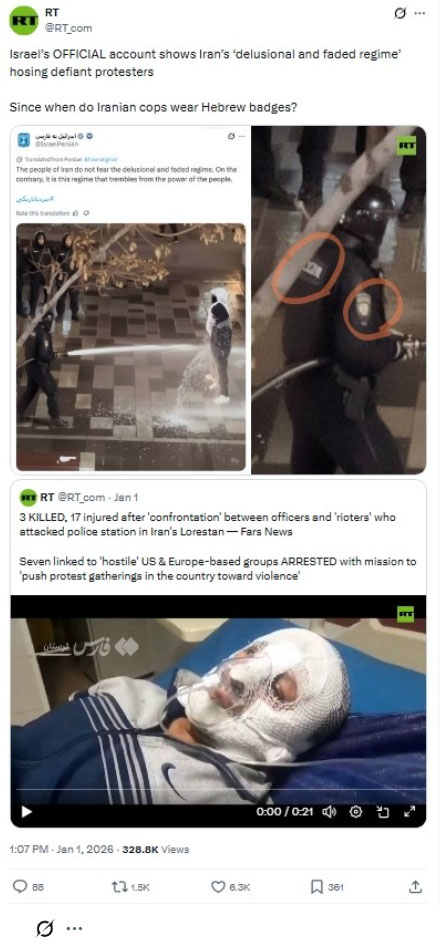
Russian messaging about the unrest in Iran strongly supported Tehran. State-linked accounts, RT in particular, echoed the Iranian state’s official narrative of ‘foreign-backed riots’. Addressing the UN Security Council, Russia’s Permanent Representative to UN Vasily Nebenzya claimed the protests are an “example of how colour revolutionvii methods are being applied in practice”. RT also published an analysis alleging the US and Israel have co-opted the protests for regime change. RT and other Kremlin-linked outlets additionally reposted content aimed at casting protesters as savage “terrorists”. Various RT posts on X claimed foreign governments had paid protesters to commit “ISIS-STYLE ATROCITIES” and suggested Israel had fabricated “evidence” depicting Iran’s human rights violations.
China
While China’s coverage was mostly factual, state messengers leveraged the protests to present the US as a global threat while presenting themselves as arbiters of peace. After Donald Trump threatened strong military action against Tehran over the crackdown on protests, China’s Ministry of Foreign Affairs made a public statement sharply condemning interference in other countries’ affairs, urging all parties to take steps that support peace and stability in the Middle East.
Some Chinese state media outlets used Trump’s threats as further evidence that the US has adopted a hostile foreign policy strategy. Like Iranian messengers, CGTN America compared the demonstrations in Iran to the protests in Minneapolis, mockingly saying: “Trump: Protests in Iran good, but not in US”.
Western far-right and conspiracy theorist pro-regime accounts allege Israel manipulating the US into striking Iran
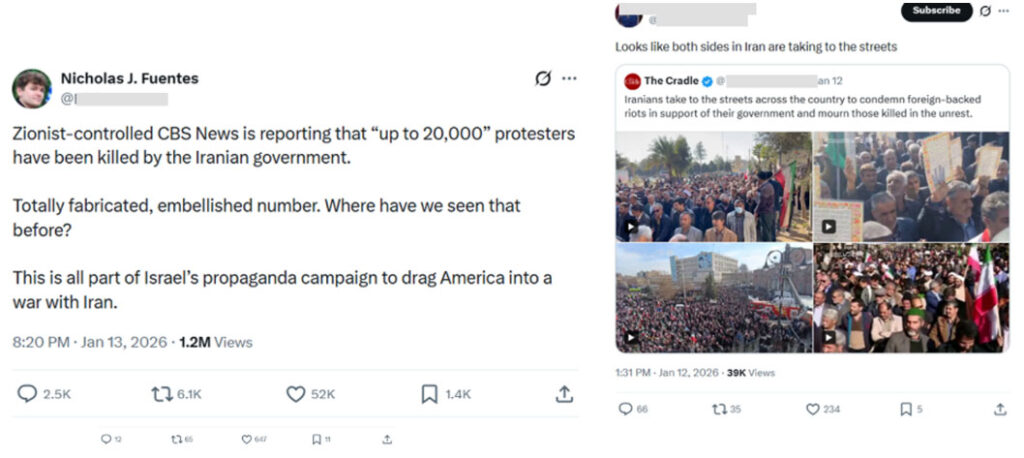
Western far-right and conspiracy theorist accounts which supported the Iranian regime broadly claimed that Israel sought to convince the US to attack Iran by lying about Iranian state repression or instigating violence. This frequently crossed the line into overt antisemitism. US-based Groyper leader Nick Fuentes claimed reports of up to 20,000 deaths were “part of Israel’s propaganda campaign to drag America into a war with Iran”. Manosphere streamer ‘Sneako’, who was filmed raising his hand to the song ‘Heil Hitler’ alongside other high profile manosphere figures in January 2026, shared an image of Iranian pro-state rallies captioned “Iran without Mossad”. Similarly, Candace Owens, a US conservative influencer known for promoting conspiracy theories whose content has been amplified by Iran-owned news outlet Press TVviii, said media coverage of Iranian state repression was a “Jewish psyop” to manufacture consent for an Israeli land grab.
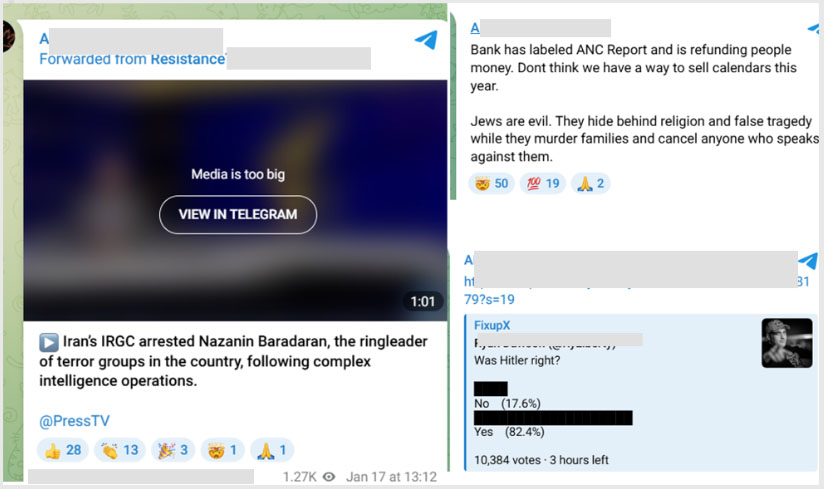
Pro-regime far-right and conspiracy theorist accounts shared content from Iranian state-owned news outlets and ‘Resistance Axis’ channels to support the state’s line and reinforce their own antisemitic narratives. A far-right antisemitic conspiracy theorist channel shared a clipix from Press TV, reposted from a pro-‘Resistance Axis’ Telegram channel. The video reported that security services had arrested “ringleaders” and suggested the protests were instigated from abroad. Other posts from the same channel express pro-Hitler and antisemitic sentiment, illustrating how Western far-right accounts exploit Iranian state media and ‘Resistance Axis’ sources to construct broader antisemitic narratives.
These cases also illustrate the rapid information pipeline from Iranian state media through to Iran-aligned Islamist groups and the Western far right. In another example, one high profile far-right influencer shared a link from anti-Western, conspiracy theoristx news outlet The Cradle which called the protests “foreign-backed riots”. The influencer’s caption, “Looks like both sides in Iran are taking to the streets”x, suggested that the pro-regime rallies had popular support comparable to anti-regime protests.
Western far-left and conspiracy theorist pro-regime accounts echo Iranian state narratives, target left-wing regime critics.
Far-left and conspiracy theorist pro-regime accounts differed in emphasis: some centred on the role of the US as an imperialist actor, while others framed Israel as manipulating the US into conflict (mirroring right-wing conspiracy theorist claims). They often highlighted Iran’s perceived ‘anti-imperialist’ role in supporting Hamas and other ‘Resistance Axis’ groups.
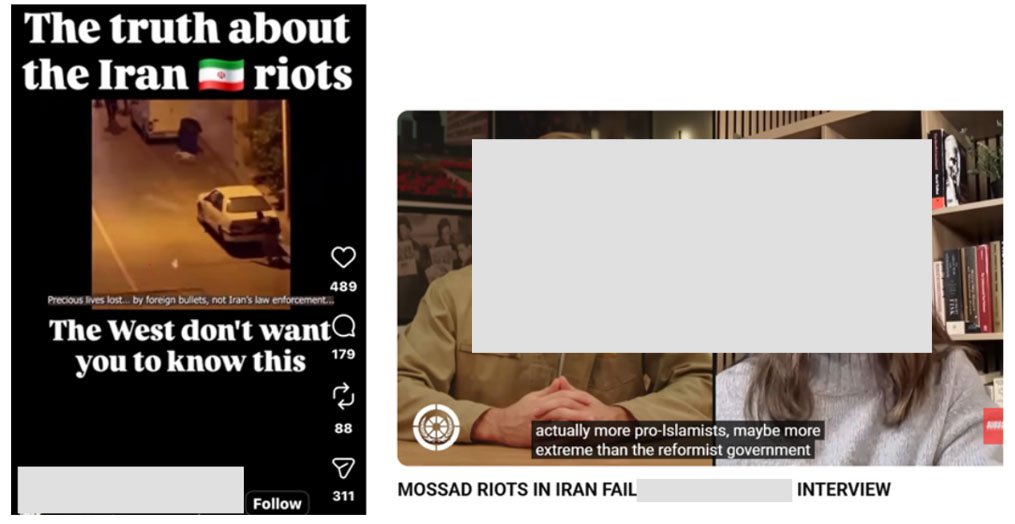
Far-left and conspiracy theorist pro-regime accounts repeated Iranian state messaging that protest-related violence was US- and Israel-directed regime change. A video shared by several Western, primarily far-left, accounts on Instagram on 20 January claimed that peaceful protesters were killed by “foreign bullets” and described protests as a “US-Israeli terrorist attack” to manufacture consent for a Western military attack. The video had originally been posted by an Iranian right-wing news outlet. It was subsequently shared by the Iranian foreign minister in a post now removed from X. In a YouTube video posted on 12 January, a left-wing American journalist formerly employed by Russian state media claimed that protests were driven by Islamists more extreme than the Iranian government. This is in line with the conspiracy theory that Western countries funds Islamist extremist groups such as Islamic State (IS) group.
Some accounts cast Israel as the main driver of the protests, downplaying the US’ role. Grayzone founder Max Blumenthal repeated the Iranian state line of “Mossad-supported… riots” which he claimed were designed to convince a “gullible” Trump into striking Iran “on Israel’s behalf”xi. This narrative promotes the antisemitic trope that Israel is the main reason for US involvement in recent wars, also promoted by far-right accounts.
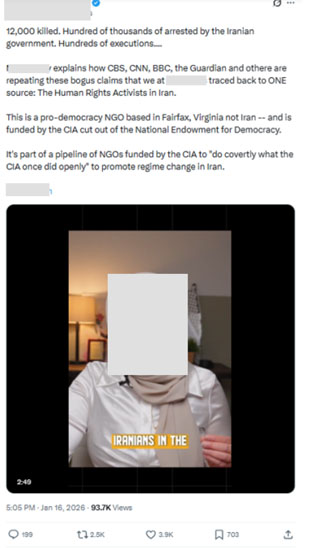
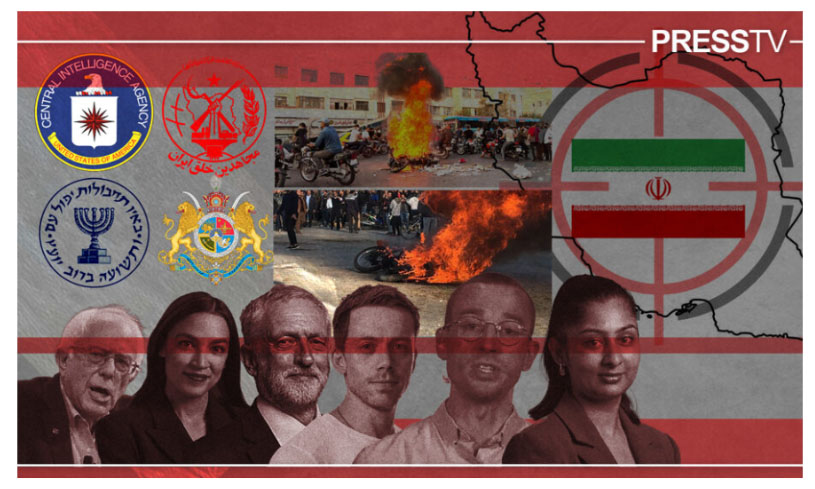
Far-left and conspiracy theorist pro-regime accounts also sought to downplay casualties by claiming that news outlets and NGOs which were critical of Tehran were propaganda arms for Washington or Tel Aviv. Reports of casualties have been contested since the digital shutdown began with some estimates surpassing 36,500 dead as of 6 February which more than 6,000 are verified. Undermining critical journalists and human rights groups is a key tactic of the Iranian state and its supporters to discount criticism against systematic human rights abuses.
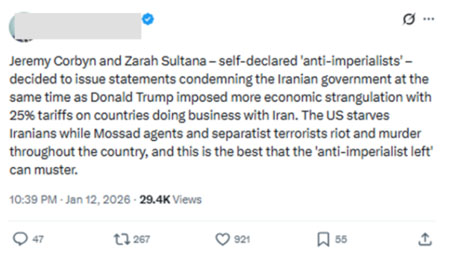
Left-wing journalists and politicians who commented critically on Iranian state repression of the protests faced significant criticism. In a post on X, a delegate of the UK’s left-wing Your Party condemned its leaders for their criticism of Iranian state repression, pointing instead to “separatist terrorism”, “Mossad agents” and US sanctions. Often, Western left-wing pro-regime accounts claimed that criticism of the Iranian regime was incompatible with ‘anti-imperialist’ identity, or worse, indicative of an ‘imperialist’ or ‘Zionist’ mindset.
On 24 January, left-wing academic David Miller, who is employed by Iranian state-owned media, wrotexii that criticisms of Iran as theocratic, repressive or fascist were typical Islamophobia and “racist beliefs”. Condemnation by influential figures, some of whom are linked to the Iranian state, raise the cost for left-wing journalists and politicians speaking against or reporting on alleged Iranian state crimes.
Conclusion
The Iranian regime pursued a twofold response to the nationwide protests that broke out in December last year: stalling the free flow of information, both within, and in and out of the country through significant Internet restrictionsxiii, and manipulating the online discourse surrounding the protests, mostly by re-characterizing them as “foreign-backed riots”. Iran’s response followed a pattern frequently taken by authoritarian countries to control information but was reinforced by other state and non-state actors who amplified their narratives. In this case, state messaging aimed to undermine and deflect international criticism (and critics) of extreme repression likely amounting to crimes against humanity, which was amplified by Russia, regional proxy groups and Western extremists and conspiracy theorists.
The trend of hostile states exploiting extremists and conspiracy theorists to promote their narratives, including targeted hate and disinformation, is set to remain a prominent feature of the online threat landscape. It can be countered by a range of evidence-based tools while still safeguarding democratic norms which protect free speech and healthy debate.
End notes
i In line with academic and far right expert Cas Mudde, ISD defines the far right as groups and individuals exhibiting at least three of the following five features: nationalism, racism, xenophobia, anti-democracy or strong state advocacy. Far right is an umbrella term, which encapsulates both the ‘radical right’ and the ‘extreme right’. According to Mudde, the radical right and the extreme right both ‘believe that inequalities between people are natural and positive’, but they hold different positions on democracy. While the radical right is opposed to certain aspects of liberal democracy (e.g. minority rights, independent institutions) it is not in principle against democracy, but favours a majoritarian democracy led by the in-group it identifies with. Extreme-right actors on the other hand are in principle opposed to democracy as a form of governance, instead favouring authoritarian rule. According to ISD’s working definition, far-right extremism refers to a form of nationalism that is characterised by its reference to racial, ethnic or cultural supremacy.
ii There is no broadly agreed definition of the far-left, and the scholarship on radical or far-left actions and groups in contemporary Western societies is much less developed than research on the far-right. Following Mudde and political researcher Luke March, and resonating with the differentiation of the far-right, ISD proposes making a distinction between left-wing radicalism and extremism, where the latter groups are, again, anti-democratic, and the former advocate fundamental political and economic changes without being anti-democratic per se. Radical left groups, actions or networks are typically rooted in Marxist, socialist or anarchist ideologies, and pursue an anti-capitalist, anti-imperialist and radically egalitarian, anti-fascist agenda, typically with an internationalist outlook. Radical left groups can sometimes be identified by the use of certain symbolism (e.g. Antifa flag, three arrows). In general, far-left groups may or may not see violence, especially against their political opponents (e.g. perceived representatives of fascism and capitalism), as a legitimate tool to pursue their political agenda.
iii Iran’s regional policy involves a network of proxy actors which it supports, including Hamas in Gaza, Hezbollah in Lebanon, the Popular Mobilisation Forces (PMF) in Iraq and the Houthis in Yemen. It uses these actors as deterrence against directly attacking Iran and as a weapon to strike the US and Israel.
iv Source: Telegram, 13 January 2026.
v Source: Official Houthi website, 15 January 2026.
vi Source: Telegram, 13 January 2026.
vii ‘Colour Revolutions’ refer to a series of pro-democracy protest movements in post-Soviet states that led to changes of government. The Russian state frequently accuses Western governments of engineering such movements and uses this claim to discredit pro-democracy protests that challenge its interests – for example, the Maidan protests in Ukraine.
viii Source: Telegram, 17 January 2026.
x The Cradle news desk typically promotes conspiracy theories which support pro-Kremlin, pro-Iran narratives. They have, for example, claimed that snipers who killed protesters during the protest movement in Ukraine in 2014 and in the Arab Spring in 2011 were in fact ‘false flag’ operatives sent by the US, rather than state repression (23 January 2026). They also attempted to shift the blame to Ukraine (23 February 2023) for the massacre of Ukrainian civilians in Bucha when it was occupied by Russia after the full-scale invasion in 2022. Another Cradle article (16 January 2024) suggested that the US spurred an Islamic State (IS) group resurgence to fight Iran and its regional proxies.
xi Source: X, 12 January 2026.
xii Source: X, 12 January 2026.
xiii The Iranian people remain restricted from access to the internet the state uses for its messaging while regime elite retain connectivity in a two-tier system. According to security technologist Bruce Schenier, Iran’s internet restrictions allow the regime to create “a zone of impunity where atrocities can be committed without immediate consequence”, consequently, he called for the international community to begin to “treat connectivity as a humanitarian imperative”, in line with UN messaging. In response to the Iranian protest massacres, a coalition of civil society groups launched a campaign for direct-to-cell (D2C) satellite connectivity, which would allow crisis-affected people to access the internet in underserved areas or bypass authoritarian shutdowns. The technology exists, but requires action by the international community and partnership between government, private sector companies and development agencies to achieve ‘humanitarian connectivity’.