Digital Dispatches
July 22, 2025
ISD-US
Foreign Information Manipulation and Interference, Hybrid Extremism and Nihilistic Violence, Terrorism and Extremism
The rise of false flag conspiracy theories in moments of crises
Executive summary
False flag conspiracy theories predate the internet by decades, but the speed and volume at which they now spread is unprecedented, with claims increasing on X (formerly Twitter) by more than 1,100 percent over the past five years. This surge reflects deeper shifts in the information ecosystem. While antisemitic tropes are central to many of these narratives, their traction also stems from a broader collapse in public trust in mainstream media, public institutions and official accounts.
Their spread has been amplified by the growing ecosystem of self-anointed “news influencers” who increasingly serve as primary sources and have gained larger audiences by leveraging algorithms that favor sensationalism over accuracy. By presenting their false flag conspiracy theories as interpretations or commentary rather than verifiable claims, these narratives exploit the deprecation of platform fact checking initiatives and nascent open source systems. False flag narratives distort facts, promote fear and provide a conspiratorial lens through which audiences interpret global crises, undermining trust in institutions.
This trend has intensified in the past months: false flag claims increasing by almost 350 percent between April and June compared to the two previous months. This surge followed attacks in Washington, DC and Boulder, Colorado, as well as Israeli airstrikes on Iranian facilities. This follows a historical pattern in which claims about false flags emerge during moments of crises (such as 9/11 and the 7 October attacks). Many of these older false flag conspiracy theories were also referred back to during contemporary events.
Key findings
- There were 1m mentions of “false flag” on X between April 26 and June 26, 2025, a nearly 350 percent increase compared to the prior two-months.
- Over the past five years, false flag claims have increased by more than 1100 percent on X.
- There were spikes in false flag conspiracy theories after the May 21 shooting in Washington DC and the attack in Boulder, Colorado. The top 10 posts related to each attack received around 23m views in total.
- False flag conspiracy theories surged again after the June 13 Israeli airstrikes on Iran and the following escalation. The top 10 high-engagement posts garnered over 22 million views.
- Many of these false flag posts linked these attacks to broader geopolitical narratives, often accusing Israel of orchestrating them. They also drew on longstanding false flag claims about events including 9/11, the October 7 attacks and the 1994 Israeli embassy bombing in London.
- None of the high-visibility false flag posts we identified received Community Notes.
Methodology
We first manually collected relevant posts about false flags from X made between May 21 and June 27, 2025 based on their engagement levels, prioritizing those with the highest view counts to capture the most widely circulated claims. In parallel, social media monitoring tool Brandwatch was used to track broader volume trends, quantify the overall increase in mentions of “false flag” during the analysis period and contextualize this within patterns observed over the past five years.
Conspiratorial responses to violence: The Washington, DC and Boulder attacks
False flag conspiracy theories surged following two violent incidents in the US (in Washington, DC on May 21 and in Boulder, Colorado on June 1). Both attacks were reportedly motivated by anti-Israel sentiment. In their aftermath, thousands of posts claimed the attacks were staged, coordinated or politically timed. Many used analyses resembling open-source intelligence (OSINT) and recycled conspiracy theories to cast doubt on the events.
Figure 1. Volume of false flag mentions on X since June 2020-June 2025.
DC attack sparks surge in false flag claims
On May 21, a 30-year-old man from Chicago, Illinois, shot and killed two Israeli embassy staffers leaving the Capital Jewish Museum. According to bystanders and security camera footage, the shooter entered the museum after the shooting and shouted “Free, free, Palestine!” as he was detained by museum security.
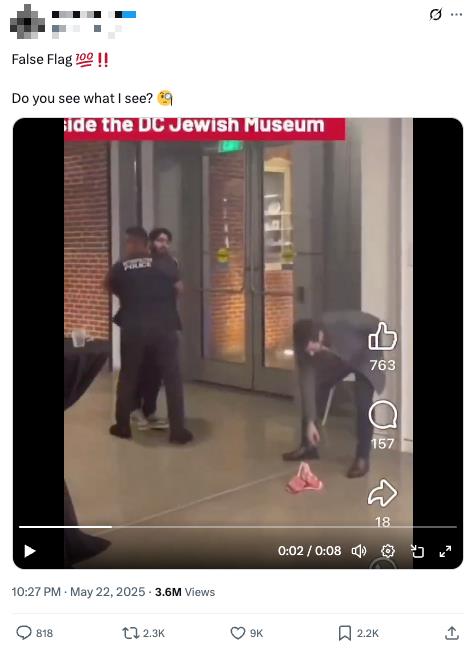
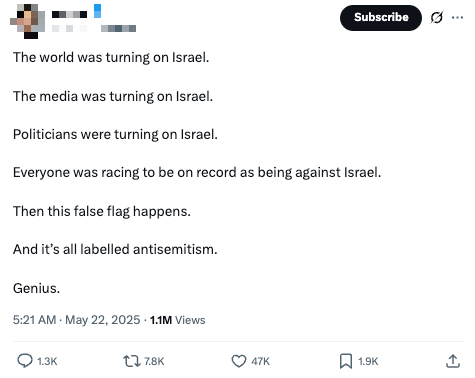
Within hours, hundreds of X accounts across the political spectrum began spreading false flag conspiracy theories. The top 10 posts with the highest engagement received almost 20 million views. These included claims that the shooting had been staged by the Israeli government to divert attention from Israeli military actions in Gaza, to undermine pro-Palestinian activism or to manufacture support for a war with Iran.
Some posts used details of the crime scene to promote claims that the attack had been staged, such as the attacker’s calm demeanor in post-attack footage or the presence of a keffiyeh at the scene. Other posts cast doubt on the shooter’s identity pointing to his “Jewish” name and past affiliations. They also questioned the victims, arguing that a Messianic Jew was deliberately selected to generate sympathy among US Christians. Many posts focused on the geopolitical context of the attack, arguing that it was strategically timed to shift focus away from recent diplomatic tensions involving Israel and to rebuild international support at a moment of historically low global approval.
Bad actors revive false flag conspiracy theories after Colorado attack
On June 1, fewer than two weeks after the shooting in Washington, DC, a Colorado resident used improvised incendiary devices to attack participants in a march held to support Israeli hostages in Gaza. The attack injured 13 people, with one dying of severe injuries weeks later. According to the FBI, the attacker shouted “free, free Palestine” and declared his intent to “kill all Zionist people” indicating motivations tied to anti-Israel sentiment and related to the broader Israel-Hamas conflict.
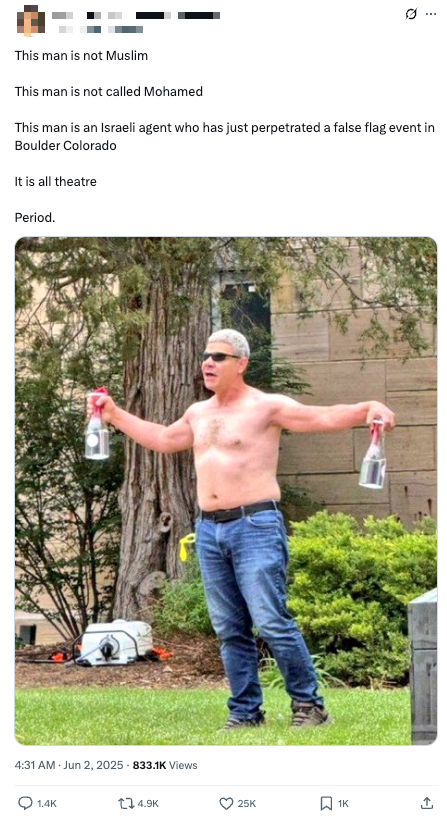
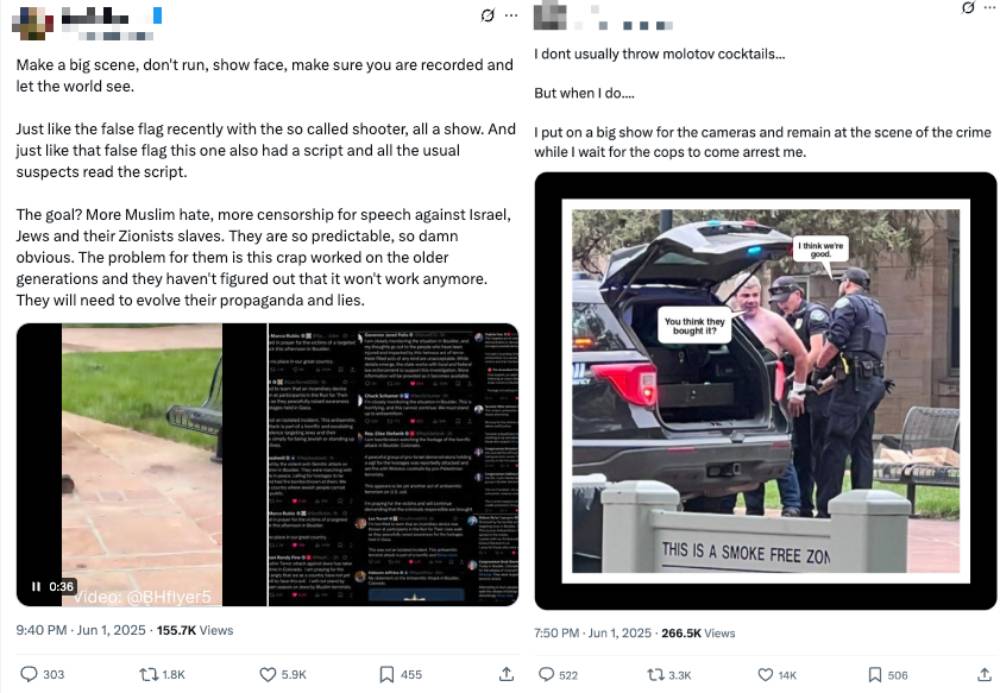
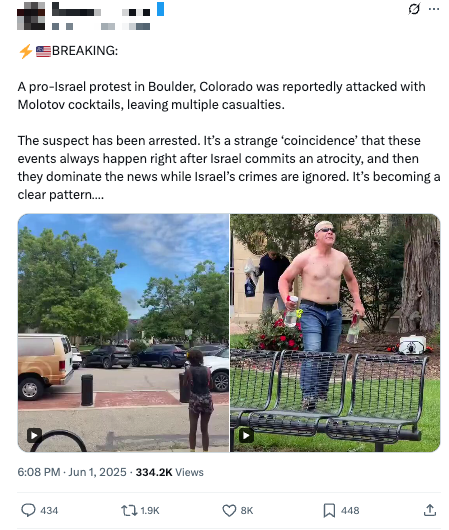
Once again, false flag claims quickly spiked on X after the attack, many which mirrored the claims spreading in the aftermath of the Washington, DC shooting or even referred back to it. The top 10 high-engagement posts received a total of more than three million views within 24 hours of the attack, according to Brandwatch. Users framed the attack as a follow-up operation to the Washington, DC shooting, claiming the first operation “failed” to generate sufficient media coverage or sympathy. These posts questioned the attacker’s Egyptian nationality, claiming he was an Israeli agent. They also insisted the event was “staged for the cameras” to manipulate public opinion and rally support for a potential war against Iran.
Recycling past false flag conspiracies
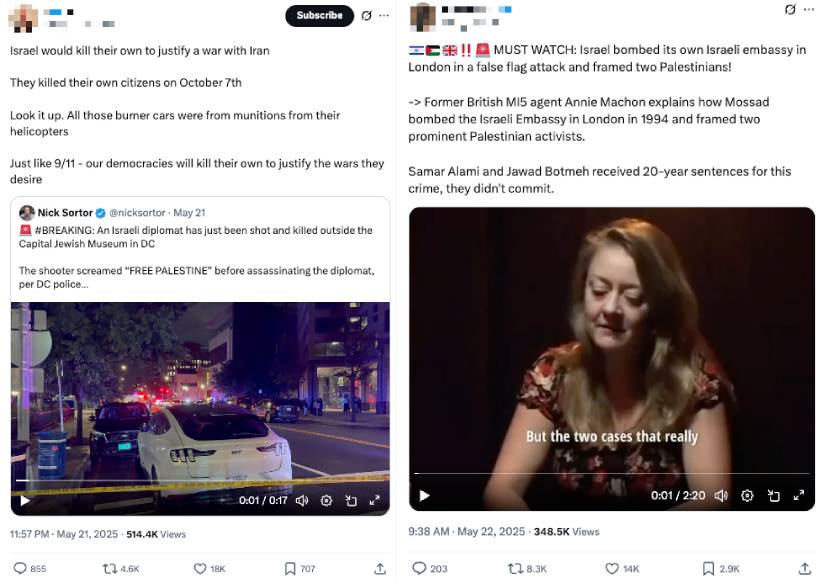
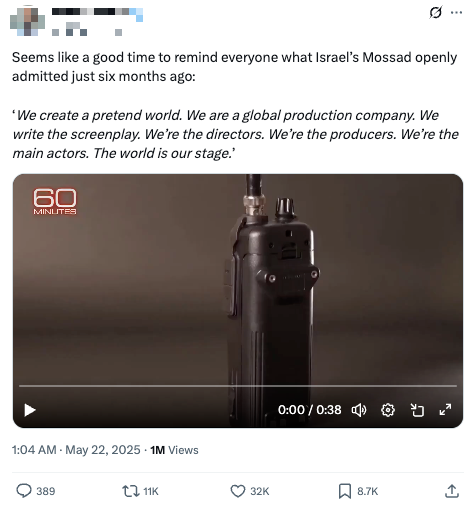
Amidst the rise in false flag claims tied to the attacks, long-standing conspiracy theories about past events also reemerged. Numerous posts resurfaced conspiracy theories about other events such as 9/11, the 1994 Israeli Embassy bombing in London, the assassination of President John F. Kennedy, and the Hamas-led October 7 attack, claiming these were part of a historical pattern of Israeli-orchestrated false flag operations. Central to many of these posts was the assertion that Israeli ‘kills its own’ to advance its geopolitical agenda.
To advance these claims, several users circulated a clip from a December 2024 interview from 60 Minutes featuring retired Mossad agents. One agent stated: “The world is our stage”. The clip and the phrase were widely circulated to bolster claims that Israel openly embraces the use of deception and staged violence.
Conspiratorial framing of geopolitical uncertainty: false flag claims and Israel-Iran tensions
False flag conspiracy theories spiked again in the aftermath of the June 13 Israeli airstrikes on Iran’s nuclear and military facilities and the subsequent escalation of tensions. Thousands of posts pushed claims that a staged attack was imminent, designed to draw the United States into open war with Iran. The 10 posts with the highest engagement received over 22 million views. While most of these claims suggested Israel would orchestrate the operation, others pointed to potential US involvement. This included conspiracy theories about past events like the attack on the US naval base at Pearl Harbor to argue that the US has a history of staging attacks as a pretext for war.
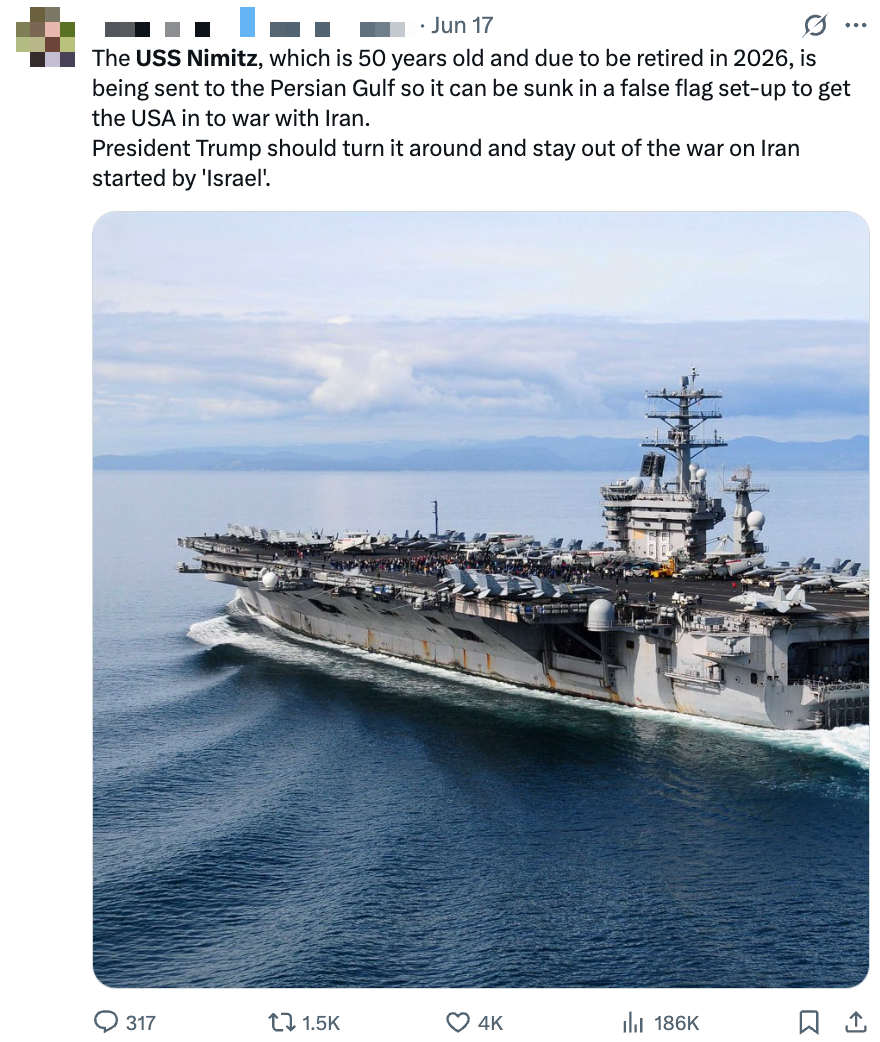
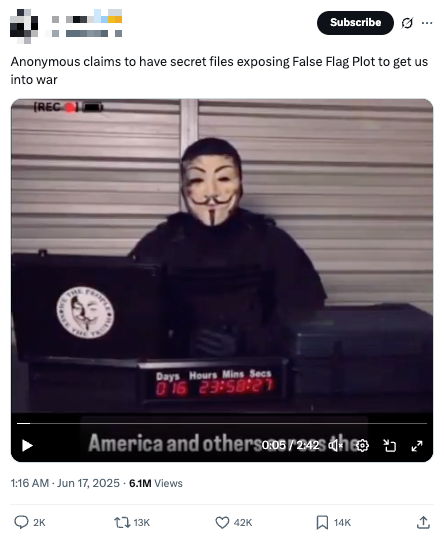
One viral claim centered on the deployment of the USS Nimitz to the Middle East, claiming that the ship was positioned deliberately to be targeted in a staged provocation. In another instance, a likely false video claiming to show a member of hacktivist group Anonymous exposing a false flag plot to drag the US into war quickly gained millions of views on X and spread across Instagram and TikTok.
Claims about an imminent false flag operation continued to rise after the United States launched strikes on three Iranian nuclear facilities on June 21.
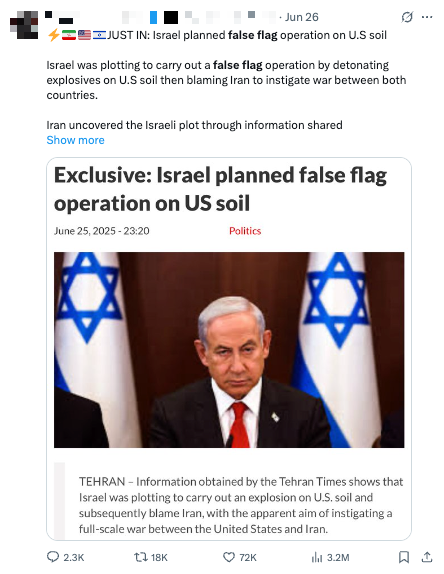
On June 26, Iranian state-affiliated outlet Tehran Times published an article claiming Israel was planning a false flag operation on US soil and that Iran had warned American officials in time to prevent the explosion. The piece quickly gained traction on X, where users presented it as evidence that their earlier warnings about a manufactured attack were accurate.
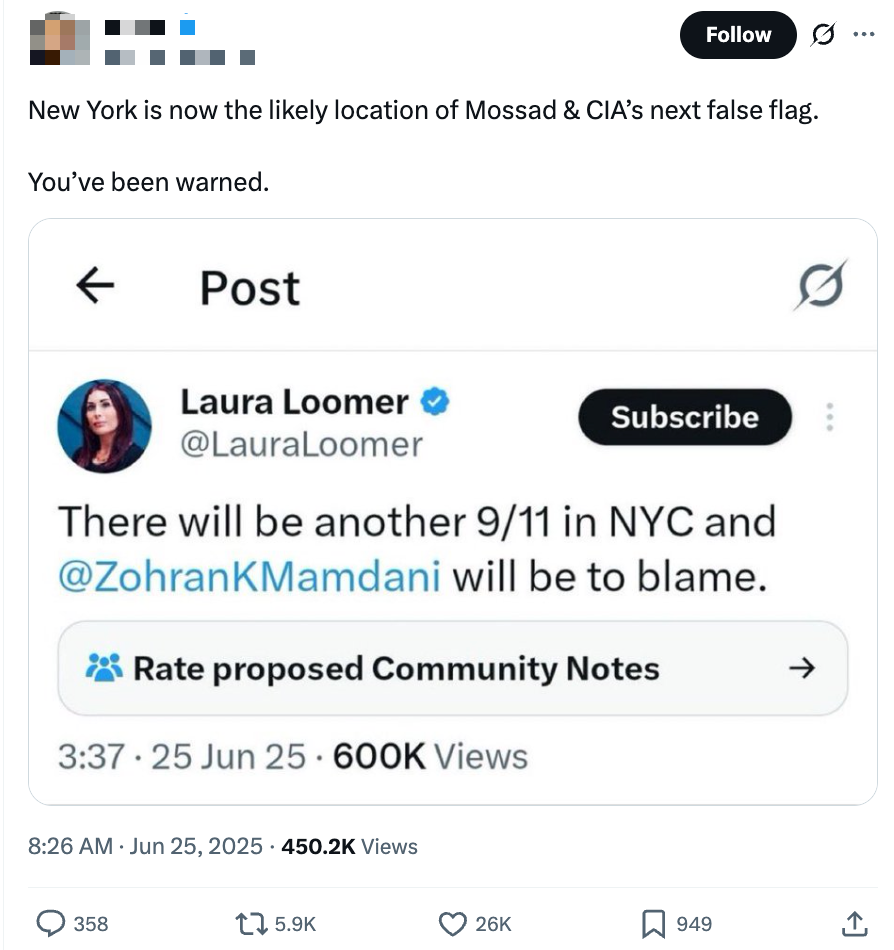
Other posts seized on warnings from far-right influencers about potential Iranian attacks on US soil to bolster their false flag claims, often citing these warnings as proof that a staged attack was imminent. For example, users frequently amplified activist Laura Loomer’s claims that a 9/11-style attack would occur in New York City, using this as evidence that a false flag operation would be carried out there.
Community Notes fail to keep up during information crises
While these false flag claims spread widely in the aftermath of these events, the feature designed to curb their spread on X (Community notes) failed to keep up. Despite the volume and visibility of posts promoting false flag conspiracy theories, none of the identified posts received a note. This gap highlights the tool’s ongoing shortcomings during high-volume information crises when rapid response is most needed.
Although Community Notes was introduced as a tool to democratize fact-checking and rebuild user trust, its performance in these moments has remained slow and inconsistent. Notably, Meta began testing a similar Community Notes feature on Facebook, Instagram and Threads in March 2025 while ending its third-party fact-checking programme in the US. Although this work focused on X, a brief search on Meta platforms shows many of the same false flag claims posted by other individual users and administrators of groups.
In the absence of timely fact-checking, many users are turning to AI-powered large language models, such as Grok, to independently verify some of these claims. However, the reliability and effectiveness of this approach remain untested and inconsistent, placing the burden of verification on individual users rather than the platforms. As seen in previous crises, AI chatbots’ abilities to respond to rapidly changing and politically sensitive topics can be limited.
Conclusion
The recent rise in false flag conspiracies falls at the center of two accelerating online trends: the weaponization of high-volume information crises, particularly by online news opinion commentators, and historical revisionism. In the chaotic aftermath of violent or geopolitical events, bad actors online rush in to fill the void, disguising false claims in the form of open-source intelligence. What began as an interrogation of the facts around the Washington, DC and Colorado attacks evolved into a larger attempt to also rewrite the past.
This is part of a broader trend dismissing established historical evidence and replacing it with baseless counternarratives. ISD has previously documented how bad actors online have attempted to rewrite the public perception of figures such Osama bin Laden and Adolf Hitler by casting doubt on widely accepted facts to present them in a more sympathetic or even heroic light.
These false flag conspiracy theories resonate in moments of confusion, fear and uncertainty because they respond to three underlying psychological needs commonly identified in studies of conspiracy theories.
- They offer a sense of understanding by providing a clear narrative for complex and often frightening events, especially when official accounts may be delayed or uncertain.
- They help individuals regain a sense of control and security by attributing chaos to intentional and specific actors (such as the state of Israel).
- They reinforce a social sense of in-group identity, positioning believers in opposition to a distrusted out-group and building bonds within communities that share this skeptical and adversarial worldview.
But the impact of false flag conspiracy theories is extremely deleterious to the body politic. These narratives erode trust in official sources, public institutions and the broader information ecosystem. They dangerously downplay the severity of hateful acts of violence, dismissing, and at times even justifying, the harm endured by victims and their communities.
In the media
ISD Contributors