Digital Dispatches
October 23, 2025

ISD UK
Emerging Technologies, Misogyny
The ecosystem of nonconsensual intimate deepfake tools online
23 October 2025
By: Chiara Puglielli and Anne Craanen
Executive summary
This Dispatch explores an ecosystem of users on adult discussion forums, search engines, 4chan and X (formerly Twitter) which promotes and sells access to tools for creating “deepfakes”—sexualised or explicit images overwhelmingly of women and, increasingly, minors. Synthetic intimate image abuse (SIIA) has received years of media attention and public outcry, but sites promoting these tools continue to receive millions of monthly visits.
Tackling this issue on a larger scale than individual posts, tools and users is necessary for an ecosystem which maintains massive and enduring reach despite moderation efforts. Rather, this Dispatch envisions an approach that considers the life cycle of SIIA media, aiming to mitigate harm not after it is distributed, but at the point when tools to create it are first sought. Understanding the accessibility of SIIA-creation tools is key to effectively limiting widespread and high-impact harms.
As of May, our analysis found 31 active SIIA tools easily discoverable on X, 4chan and common search engines. These tools can create realistic, explicit deepfakes from a single photo with the potential for social exclusion, job discrimination, and debilitating emotional stress for victims–especially those in public positions—and in some cases has led to death by suicide. Even when tools are removed, new versions are quickly uploaded (often trading off the notoriety of now defunct products).
This Dispatch concludes with an analysis of proposed European and North American policies to combat SIIA tools. It recommends greater content-removal efforts on large platforms such as X and 4chan, and the removal of websites which host SIIA tools from search results. It also considers the banning of nudification apps in the first place.
Key findings
- SIIA tool hosting sites have proliferated despite legal and social efforts against them. An analysis of 31 unique websites found that they received between 375 and almost 4 million unique visits in May 2025, with a combined traffic of almost 21 million monthly visits.
- X is a key platform for distributing and discussing SIIA tools. Between June 2020 and July 2025, there were almost 290,000 mentions of these tools on X. This accounted for 70 percent of all mentions across seven platforms and a range of forums, blogs and review sites.
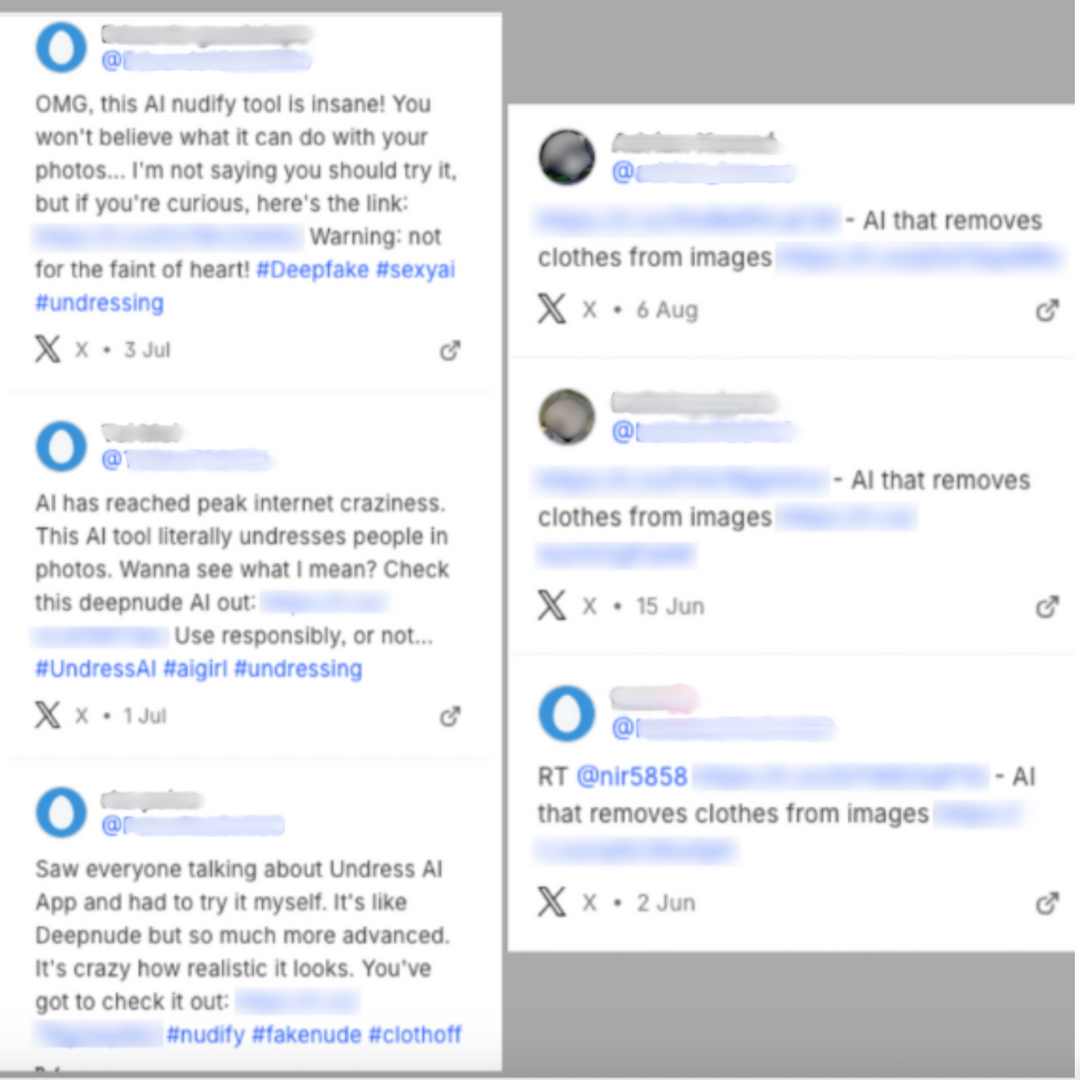
- Suspected automated advertising accounted for a major spike in mentions in mid-2023. The text or hashtags of these advertisements frequently use the names of popular, now-defunct tools to drive traffic from users searching for defunct apps.
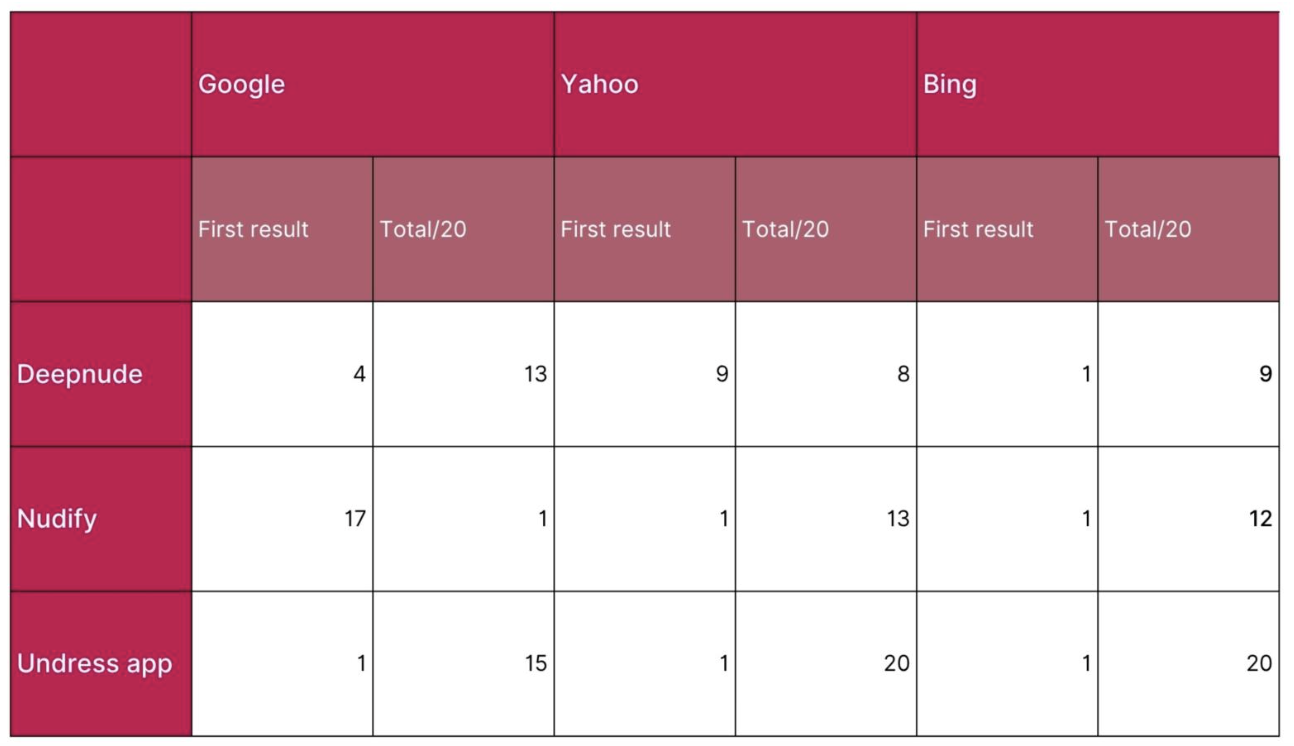
- SIIA tools are easily discoverable on search engines using common terminology. Searches on Google, Yahoo and Bing all yielded at least one result leading the user to SIIA technology within the first 20 results when searching for “deepnude”, “nudify” and “undress app”. In the case of Bing, the first results for all three searches were SIIA tools.
Background
There are various terms for SIIA, including the Non-Consensual Sharing of Intimate Imagery (NCSII), Image Based Sexual Abuse (IBSA), Non-Consensual Intimate Imagery and Manipulated Material, and (artificial) deepfakes. Prior ISD research places SIIA in a broader context of evolving Technology-Facilitated Gender-Based Violence (TFGBV). TFGBV operates on a continuum of violence, linking different extremist ideologies and harmful groups under common misogynistic beliefs, as well as being a starting point for emboldening offline violence. Its harms can be individual, such as intense psychological and material damages caused to victims, who can experience post-traumatic stress disorder (PTSD) symptoms as a result of TFGBV and may be unable to work.[1] However, TFGBV also causes broader harms across society by exacerbating structural gender inequality, such as through the discouragement of women from entering spaces or professions which put them at greater risk of being victimised. Women’s safety and participation in society is incredibly threatened by this pervasive form of harm.[2]
TFGBV particularly affects the participation of women in public roles, including in political society. ISD research analysing the behaviour of users on TikTok towards candidates in the 2024 French legislative elections and the 2024 EU parliament elections found that women candidates in both elections faced significant levels of TFGBV, such as calls for violence and cyber harassment. ISD found that TFGBV against women parliamentarians in Europe caused one third of them to feel a reduction in their freedom of expression, and 21 percent did not want to run for re-election as a result.
In line with other forms of TFGBV, SIIA causes significant psychological and material harm to victims from the moment it is posted as well as far into their futures, a kind of harm which is uniquely facilitated by SIIA-creation technologies as well as the current systems, designs and incentives of social media and other image-sharing platforms. The accessibility of SIIA tools requires the simple visual presence of women online to create massively distressing content, and the moderation processes which place the onus of repeatedly reporting harmful content on users—and in all likelihood victims-survivors—allow this content to stay online for long enough to be widely shared and possibly affect the victims professional or personal reputation. This provides yet another avenue for chilling women’s participation in society, providing a visual escalation of the “everyday” threats of sexual violence and harassment faced by women online.
Beyond women and girls, it is important to highlight that LGBTQ+ communities are also targeted, as well as men and boys. Whereas particularly to men and boys, the risk of direct targeting is lower than it is for women. However, they do face a unique set of harms that may affect their mental health, expectations and experience of healthy relationships, as well as psychological effects. In an upcoming ISD publication together with Movember, we outline the risk to men and boys and the intersection with online misogyny. While we highlight how LGTBQ+ communities are also disproportionally affected by TFGBV, this article focusses mostly on women and girls given that research previously has shown how 90% of deepfakes are non-consensual, with an overwhelming majority are of women and girls.
Methods
Identifying sites and current traffic
To identify SIIA tools, we used SimilarWeb to expand from ISD’s known tools and locate websites which shared content, audience, keywords and referrals with known SIIA tool-hosting sites utilising its “similar sites” function. This allowed us to generate a seed list of websites which host or allow downloads for tools which can create SIIA. We also used SimilarWeb to find recent monthly traffic from May 2025 for each SIIA-tool-hosting site identified. This research found 31 unique websites, with monthly traffic ranging from 375 monthly visits to 4 million, and a combined traffic of 20.7 million monthly visits.
We observed commonalities in the domain names of these tools: among the 31 SIIA tools which we studied, 13 contained “undress” in their domain names, four contained “deep” in reference to DeepNude (a popular SIIA app released in 2019), and two mentioned “nudify” or “nudifier”. This, along with knowledge of terminology for SIIA tools from popular reporting on SIIA harms, was used to develop generalisable SIIA terms for testing across search engines.
Mapping mentions
Using the social media monitoring tool Brandwatch, we completed a keyword search for mentions of the 31 websites/tools across X, Reddit, Bluesky, YouTube, Tumblr, public pages on Instagram and Facebook, forums, blogs and review sites. We found 410,592 total mentions of the keywords between 9 June 2020 and 3 July 2025, and used Brandwatch’s ability to separate mentions by source in order to find which sources hosted the highest volumes of mentions.
Search engine accessibility
Using a new account on Google chrome located in the UK, we completed SIIA-related keyword searches on Google, Yahoo and Bing for “deepnude”, “nudify” and “undress app,” terms chosen due to their mentions in major reporting on SIIA technology, and their frequent appearance in the domain names of SIIA tools. Among the 31 SIIA tools which we studied, 13 contained “undress” in their domain names, 4 contained “deep” in reference to DeepNude (a popular SIIA app released in 2019), and 2 mentioned “nudify” or “nudifier”. We used this data to identify the result ranking of the first SIIA tool in our list, and the number of these tools in the top 20 results.
SIIA tool accessibility through search
ISD found significant variations between search engines in the accessibility of SIIA tools. Bing had the highest rates of accessibility: in searches for the three keywords (deepnude, nudify and undress app), the top result in each case was an SIIA tool; in a search for undress app, every result linked to a tool.
Results for Yahoo and Google were more mixed although both had at least one search in which a listed tool was the top result. All queries on all search engines had at least one result leading the user to SIIA technology within the first 20 results.
BrandWatch analysis identified that beyond search engines, X was a major driver of users to SIIA tools. Of 410,592 total mentions between June 2020 and July 2025, 289,660 were on X, accounting for more than 70 percent of all activity.
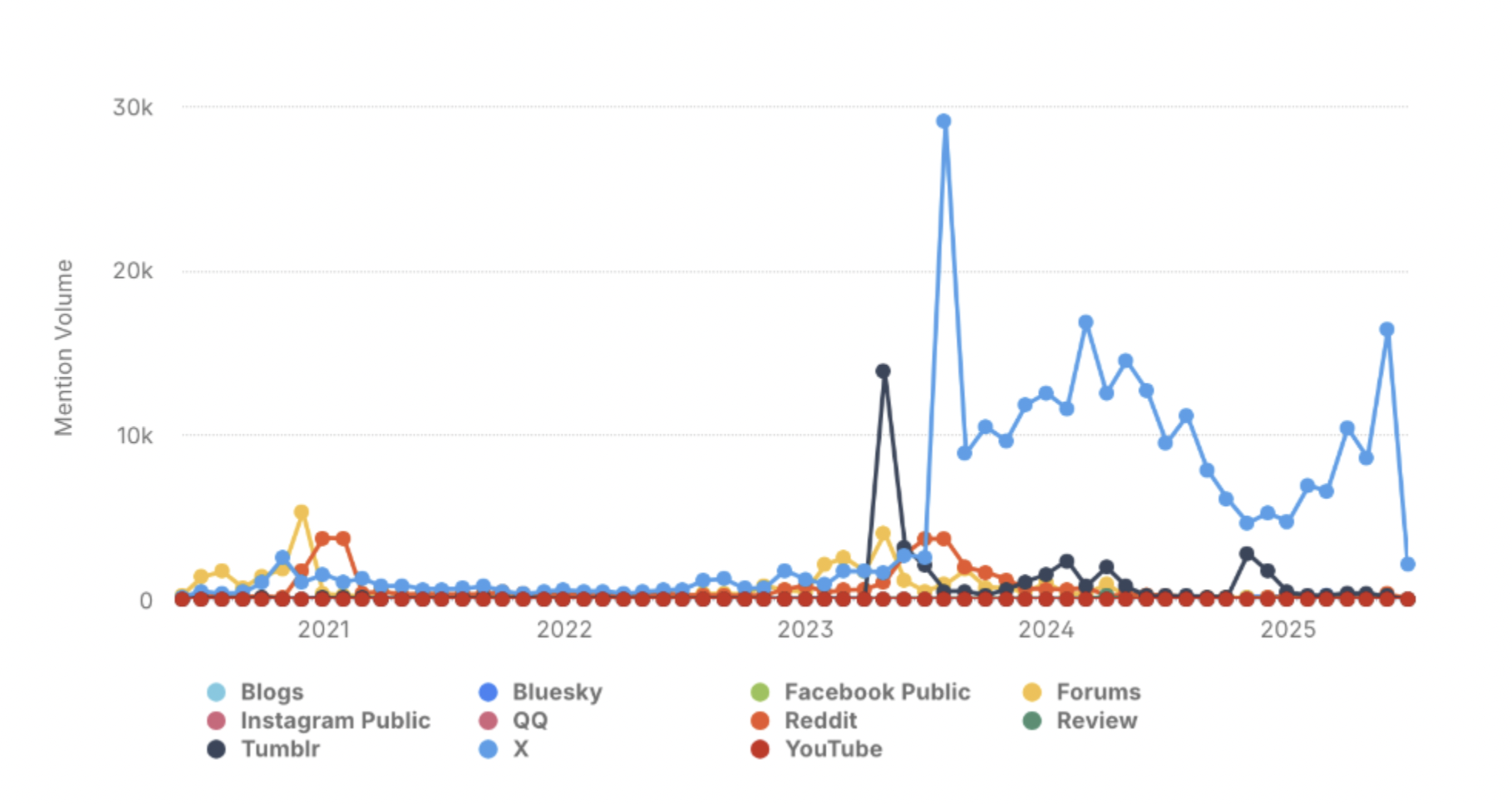
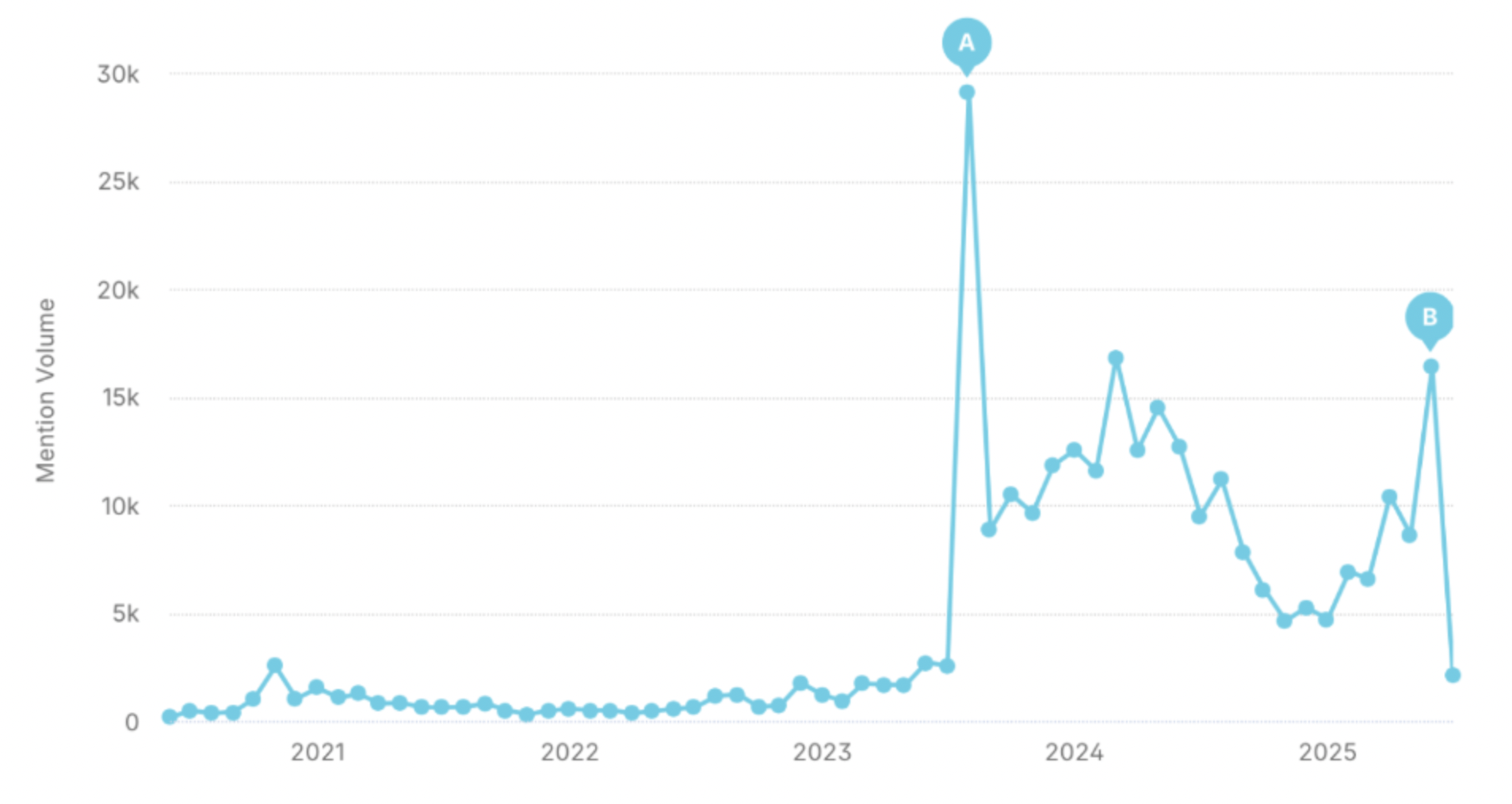
Analysis of peaks in X mentions is suggestive of automated activity based on the uniformity of username formats, and both original posts and mass reposts mentioning tools. The spike at point A reflects 29,126 mentions for approximately four tools in a single month, 16,414 mentions at point B advertised one tool, and a sustained period of more than 10,000 monthly mentions on X between late 2023 and mid 2024 mainly advertised another tool.
Moderation efforts and the public consciousness
There have been a range of critical responses to SIIA tools at all levels of society. Various jurisdictions have proposed or implemented laws to mitigate the risks posed by these tools (as discussed in our Conclusion below).
However, an analysis based on Brandwatch data shows that these approaches can drive increased searches and popularity for SIIA tools. This echoes broader findings about the ways in which harmful content can be spread online by well-meaning and critical voices—the so-called “oxygen of amplification”.
For example, the DeepNude app (an early SIIA tool released in June 2019) was removed by its creator the day after an article about it was released; the team behind the app said its removal stemmed from ethical reflection. Brandwatch results show that in June 2019, there was a rapid increase in mentions on 4chan’s ‘adult requests’ /r/ board which allows individuals to request adult content relating to a particular topic or individual for “deepnude requests” with mentions peaking at 4,705 mentions in the week after the article was published.
Another app went through a similar journey in August 2021 when UK MP Maria Miller called for its ban. This resulted in a spike in searches on Google for the tool and other SIIA products, based on Google Trends. Although the original app is now defunct, an identical replacement is fully functional and shared via X.
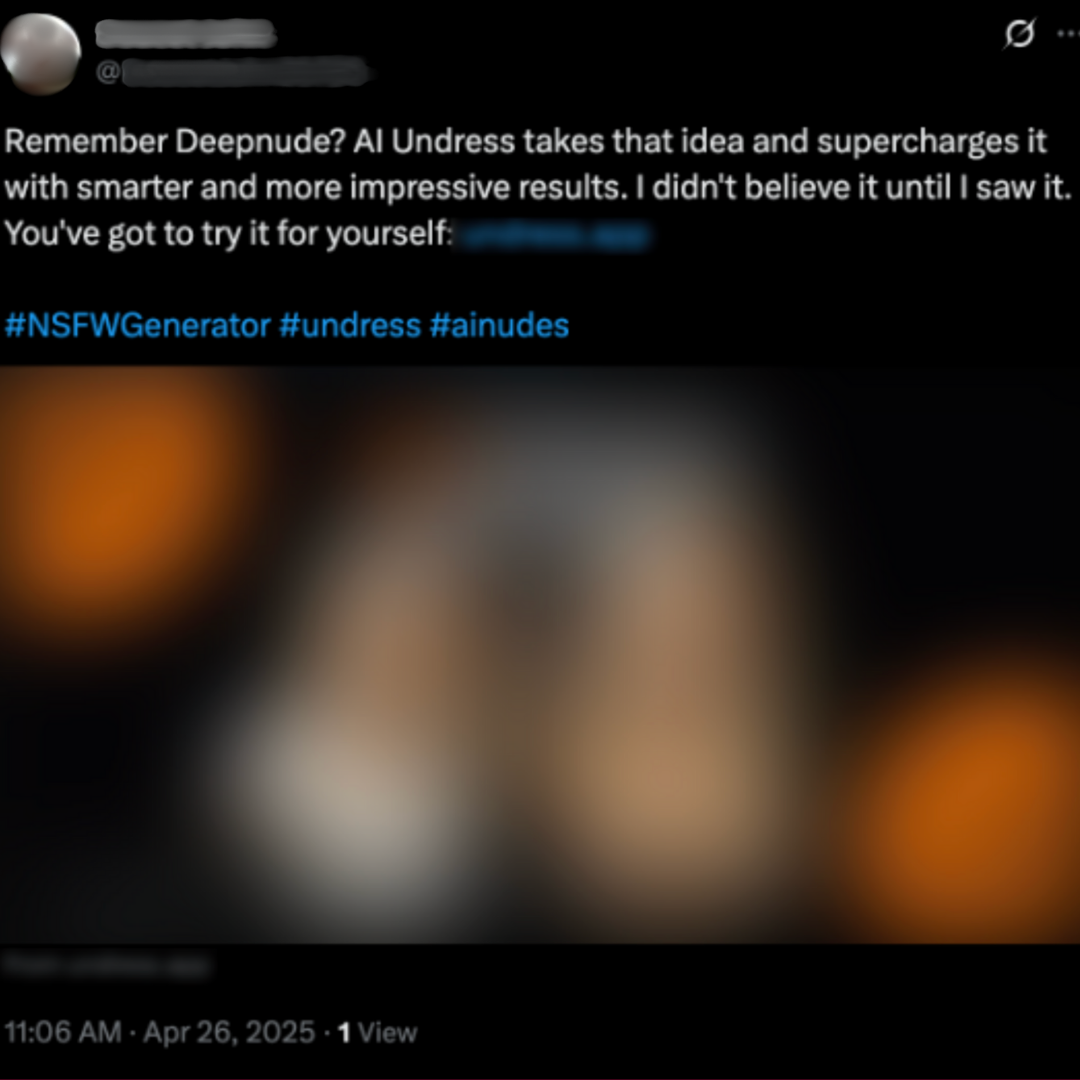
Platforms including YouTube, Reddit and Facebook have removed SIIA tool advertisements and links to forums. However, new tools are often advertised using the names of familiar but defunct ones as hashtags: nudify, deepnude and deepsukebe are frequently mentioned in the hashtags or text of these advertising X posts. For example, one of the 31 tools identified specifically uses the phrase “remember Deepnude?” in advertisements on X.
Legal frameworks and the countering of SIIA
SIIA tools are part of a broader context of online gender-based harms which affect women across society, including online harassment and abuse across countries. SIIA tools are not just used to produce illicit content of high-profile women: they are also used to target private individuals including girls. TFGBV of this nature forces all women and girls to rethink their participation or visibility in online spaces, at risk of becoming the next target of SIIA tool users, therefore undermining their participation in society. The rapid proliferation of this content (which will likely be, or if not, become, illegal in a growing number of jurisdictions) poses significant risks to women and girls, as well as undermines democratic norms.
To tackle this, legal approaches which criminalise or regulate how SIIA is distributed on internet platforms are an important step forward. The EU’s Directive (EU) 2024/1385 on Combating Violence Against Women and Domestic Violence provides definitions of illegal forms of gender-based violence, including cyber harassment, cyber incitement to violence or hatred, and the non-consensual sharing of intimate (NCSII) or manipulated material. Whereas the law will only be transposed into Member States’ national legislation by 2027, this will lead to a stronger legal footing for regulators to require platforms to remove NCII or manipulated material when detected on platforms in conjunction with the EU’s Digital Services Act’s provisions for the moderation of illegal content, which may include material that is produced using nudify apps. In addition, the EU proposed penalties on SIIA-producing companies which fail to include watermarks indicating the media’s synthetic nature in its 2024 AI Act, are another important step forward.
In the US, platforms are accountable for the failure to remove damaging content when notified (in line with protections for copyright under the Digital Millennium Copyright Act of 1996). The 2025 TAKE IT DOWN Act, requires platforms implement pathways to report and remove “deepfake” content. This may prompt platforms to employ greater caution overall and adopt stronger oversight.
Such oversight is essential because platforms are still failing to address the promotion and use of nudification and AI “girlfriend” apps, even when these clearly go against their own Terms of Service and Community Guidelines. An investigation by Indicator found thousands of sexually explicit ads on Meta’s platforms promoting nudification apps and AI-generated girlfriend services. Many of these featured nudity, simulated sex acts, or manipulated images of real people, despite Meta’s claims of stronger enforcement. Such content, as well as this article, showcases how platforms are failing to moderate nudification apps and the subsequent harm for victims. Strong, independent regulatory oversight is needed to ensure accountability through mandatory transparency, regular audits and meaningful penalties for failure. Without such measures, harmful technologies will continue to circulate unchecked, leaving victims to shoulder the consequences alone.
Conclusion
The persistence and accessibility of SIIA tools highlight the limits of current platform moderation and legal frameworks in addressing this form of abuse. Relevant laws relating to takedowns are not yet in full effect across the jurisdictions analysed, so the impact of this legislation cannot yet be fully known. However, the years of public awareness and regulatory discussion around these tools, combined with the ease with which users can still discover, share and deploy these technologies suggests that takedowns cannot be the only tool used to counter their proliferation. Instead, effective mitigation requires interventions at multiple points in the SIIA life cycle—disrupting not only distribution but also discovery and demand.
Stronger search engine safeguards, proactive content-blocking on major platforms, coordinated international policies, and hashing are essential to reducing the scale of harm. Hashing—the creation of a unique digital fingerprint for a piece of content—enables platforms to proactively block matches without requiring victims or survivors to report the material. Programs that apply this technique already exist: for example, Stop NCII allows people to upload intimate images so the initiative can generate hashes that platforms can use to detect and remove those images automatically. Such technology also exists particularly for sexual content of minors, such as NCMEC’s Take it Down. Without such measures, the ecosystem enabling synthetic intimate image abuse will continue to evolve, perpetuating risks of reputational, professional, and psychological damage for victims. Recognising the accessibility of these tools as a systemic issue, not just the isolated actions of bad actors, is a necessary step toward limiting the reach of SIIA and protecting vulnerable communities.
End notes
[2] Technology-Facilitated Gender Based Violence – a Growing Threat, UNFPA.