Digital Dispatches
March 17, 2026
ISD Canada
Far-Right Extremism, Terrorism and Extremism
‘Tribe and train’: Examining Canada’s new model of white supremacist mobilization
Since 2021, a distinct model of white supremacist organizing (dubbed ‘White Nationalism 3.0’) has gained traction across Canada. The model serves as the organizational foundation for so-called ‘Active Clubs’, a decentralized, global network of groups which promote male camaraderie, physical fitness, and combat sports as conduits into white supremacist activism and violence.
This Dispatch examines White Nationalism 3.0’s development in Canada and analyzes key Canadian groups that have adopted it. It also outlines threats to social cohesion and public safety: these include the normalization of extremist ideas and ideological cross-pollination between once-disparate far-right subcultures, enabling new vectors of radicalization towards violence. It concludes by discussing implications for policymakers and practitioners in countering this evolving threat.
Key takeaways
- White Nationalism 3.0 has emerged as a unifying organizational model within Canada’s white supremacist ecosystem. Despite frequent rebranding and occasional infighting, groups that have adopted this model (including Second Sons and the so-called ‘Active Clubs’) share a common strategy, unifying a previously fractured movement. This has allowed them to foster sustained growth since their emergence in Canada in 2021.
- Active Clubs promote male bonding, physical fitness, martial arts, and outdoor recreation – activities that are not intrinsically harmful – which function as a deliberate way to create a ‘big front door’ for recruitment. By integrating extremist networking and radicalization within these otherwise positive spaces, the organizational model creates accessible pathways towards white supremacist radicalization and recruitment.
- Offline street activism has become a central tactic of these groups and serves to normalize white supremacist ideas. Since late 2024, Active Clubs have increasingly engaged in public demonstrations for propaganda and recruitment purposes as well as to mainstream extremist narratives and expand influence.
White Nationalism 3.0 and the Active Club model
‘White Nationalism 3.0’ is a modern strategy for white supremacist organizing. It promotes decentralized, local clubs that engage in fitness training, combat sports, and male bonding as gateways into extremist networking and activism. The term was coined in 2020 by Robert Rundo, an American neo-Nazi who gained notoriety for rioting and engaging in violence at several political rallies across the United States.
White Nationalism 3.0 was framed as a new phase of organizing following the “1.0” racist Skinhead activism of the 1980s and the “2.0” era associated with the rise and fall of the “alt-right” in the 2010s. Groups adopting this new model are often referred to as ‘Active Clubs’ and have proliferated across Europe and North America. The White Nationalism 3.0 strategy is the operational blueprint for several white supremacist organizations in Canada including Second Sons and Nationalist-13, and individuals often use the slogan ‘Tribe and Train’ as shorthand to describe their approach.
The fitness-oriented activities of these groups are not solely pursued as ends in themselves, but are instead means of achieving political objectives. As one leader of Second Sons stated during a 2025 livestream: “The reason you tribe and train is not about…the exercise. It’s not about the boxing. The reason that you engage in tribe and train is to practice organizing… If you can organize 100 guys to go for a hike… then you can organize 100 guys to go to a conference and you can organize 100 guys to go to a protest…that’s how we fucking win”.
The ideology of groups that have adopted White Nationalism 3.0 is rooted in the Great Replacement theory: the conspiratorial claim that white populations are being deliberately replaced by non-whites through a combination of immigration, procreation, and policy decisions.
These groups are not monolithic. Active Clubs embrace a variety of worldviews, strategies and tactics to defend against what they perceive to be an existential threat to the white race. For example, Nationalist-13 and Second Sons – two key groups in Canada that have adopted the White Nationalism 3.0 model – differ in their messaging, branding, and aesthetics, with the former openly embracing neo-Nazism and the latter presenting a more sanitized image focused on shared Canadian heritage and white identity. Even within each group, individual members may hold differing views on ideology and strategy.
Despite this heterogeneity, Active Clubs have been relatively successful in unifying actors across a previously fractured white supremacist movement. In Canada, groups have united individuals from influencer-oriented communities such as Diagolon, racist skinheads, and even designated terrorist entities like Atomwaffen Division and the Terrorgram Collective.
Key Canadian groups and geographical hubs
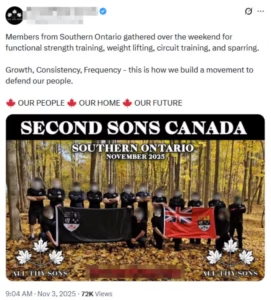
Active Clubs have gained increasing prominence since first appearing in Canada in 2021, especially following several high-profile rallies that occurred in 2025. The largest and arguably most influential of these networks is Second Sons, which was founded in 2024 by far-right activist Jeremy MacKenzie and other streamers who gained notoriety within the Diagolon network. Representing a strategic pivot away from Diagolon’s emphasis on online networking and towards offline activism, Second Sons made their public debut in March 2025 during a photoshoot in Dartmouth, Nova Scotia in which MacKenzie and other members posed while holding up a banner featuring the slogan ‘Our People Our Home Our Future’.
In addition to its more offline orientation, Second Sons appears to be an attempt by MacKenzie and other Diagolon leaders to shed their reputation as online trolls, which had attracted many followers who were deemed non-serious or insufficiently committed to white supremacist activism. Accordingly, Second Sons has adopted a more hierarchical organizational structure, creating a recruitment process that consists of applying to the group and completing a ‘background check’ and vetting process to determine suitability.
In a January 2026 posti, MacKenzie claimed that Second Sons had received thousands of applications and that less than 15% of applicants were successful in proceeding to the vetting stage of the recruitment process. MacKenzie further claimed that numerous ‘high-quality’ members were part of Second Sons, including retired members of the Canadian military and Special Forces, active and retired professional fighters, first responders, and pilots, among other skilled personnel. The group claims that members are present across British Columbia, Alberta, Saskatchewan, Manitoba, Ontario, Quebec, Newfoundland, Nova Scotia, Prince Edward Island, and New Brunswick – although it is difficult to determine Second Sons’ exact membership size.
Nationalist-13, another prominent Canadian Active Club, was founded by individuals in Hamilton, Ontario and the Niagara region in 2022. It has since established chapters in Western Ontario, British Columbia, Alberta and Newfoundland. Unlike most Active Clubs across Canada, the US and Europe, Nationalist-13 explicitly identifies itself as a neo-Nazi organization, incorporating Nazi iconography in its propaganda and claiming to be the only ‘openly National Socialist’ organization in Canada today. Nationalist-13 has been involved in numerous offline demonstrations, including in Grimsby, Ontario, in January 2026, where members advocated for the release of an influential Australian neo-Nazi who was jailed for calling upon his supporters to rape a politician.
In addition to Second Sons and Nationalist-13, which ISD assesses to be among the largest and most geographically widespread of the Canadian Active Clubs, there are numerous other localized groups across the country that have adopted the White Nationalism 3.0 model. For example, ISD’s qualitative analysis of social media channels has identified groups going by names such as the ‘Toronto Pioneers’, ‘Loyalist Pioneers’, ‘Manitoba Active Club’, and ‘Ordo Atlantica’, among others. These groups frequently rebrand, splinter, or merge with other like-minded networks. For example, the Toronto Pioneers is a rebrand of a group previously known as the ‘Toronto Fitness Club’, which itself was an offshoot of the broader ‘Active Club Canada’ which splintered after certain members were arrested on terrorism charges in December 2023. More recently, in October 2025, a Quebec-based group known as the Frontenac Active Club merged with Second Sons.
While these groups frequently rebrand and reconfigure themselves, the primary throughline in this ecosystem is their shared embrace of the White Nationalism 3.0 organizational model. Importantly, despite periodic infighting – including an ongoing freeze in relations between Second Sons and Nationalist-13 – these groups often cross-promote each other’s social media content, participate in joint training exercises and demonstrations, and even travel so that members can network across regions, reflecting a degree of operational alignment and coordination that transcends individual group labels.
Assessing the threat
Understanding the threat posed by White Nationalism 3.0 and its associated networks in Canada requires distinguishing between the activities that they outwardly promote – many of which are not inherently harmful – and the underlying strategy that they serve. While these groups embrace male bonding, physical fitness, martial arts, and outdoor recreation, such activities are in no way problematic in themselves and are in fact healthy and productive in most social contexts. The dangers arise when extremists exploit these benign activities, turning them into recruitment tools and gateways towards white supremacist mobilization.
Mainstreaming hate and extremism
A core tactic of many Active Clubs – with some exceptions, such as the outwardly militant Nationalist-13 – is the sanitization of white supremacist ideology and policy ideas that are meant to subjugate and exclude minority groups from Canadian society. For example, in the case of Second Sons, where leaders have repeatedly stated during their livestreams that they support white supremacy, neo-Nazism, and violence, the group uses a moderate tone in much of their public branding. On its website, Second Sons describes itself merely as a ‘Canadian men’s nationalist club’ and as a ‘fraternal organization dedicated to health and fitness, camaraderie, activism and friendly support for those who share our values’. Nowhere on the website does the group outline its white supremacist objectives, instead cloaking their extremist ideology by emphasizing an interest in seemingly benign subjects such as Canadian ‘heritage’, ‘values’, and ‘ancestry’. Such sanitized messaging enables Second Sons to blend into mainstream environments and attract a broader range of supporters than might otherwise be possible.
Beginning in late 2024 and throughout 2025, Active Clubs across Canada have increasingly mobilized around specific policy objectives, including ‘mass deportations’ and ‘remigration’. This reflects a deliberate effort to normalize white supremacist objectives by framing them as standard policy choices within broader debates around immigration. The concept of ‘remigration’ is particularly significant because it functions as a euphemism – while the term may be understood simply as the deportation of illegal migrants, certain leaders of Active Clubs who have advocated for remigration have explicitly stated that they are seeking the expulsion of all non-white populations from Canada regardless of their legal status or birthright, with some suggesting that this process would be violent. As further evidence of their strategy to integrate white supremacist ideology into the mainstream, Second Sons has aligned itself with a self-described ‘non-partisan advocacy group’ known as the Dominion Society of Canada, whose stated goal is to ‘force remigration into the mainstream narrative’ through political activism.
This rhetoric aligns with a broader rise in anti-migrant sentiment across Canadian domestic extremist spaces throughout 2025. Anti-migrant hate consistently emerged as the most common form of hate speech across Canadian extremist actors throughout the year, with the overall volume of such content increasing by 88.3% between June and August 2025 compared to the preceding quarter. Hateful posts targeting migrants increased even further between September and November 2025, rising by an additional 61.2% compared to the previous quarterii. The significant increase in such hateful material suggests that calls for ‘mass deportations’ and ‘remigration’ are gaining salience within a broader anti-migrant online ecosystem.
Ideological cross-pollination and potential for violence
Under the Active Club umbrella, individuals from communities that were once divided – including hate groups such as the Proud Boys, longstanding skinhead organizations like the Hammerskins and Blood and Honour, and militant accelerationist networks such as Atomwaffen Division and the Terrorgram Collective – have found common ground. While tension and animosity still exist among these factions, the Active Club model has been unusually successful in bridging divides that were previously considered to be immutable by many white supremacists. This alignment not only strengthens cohesion across the movement, but also creates new vectors of radicalization, increasing the risk that more militant actors can exert influence within spaces that may appear relatively benign.
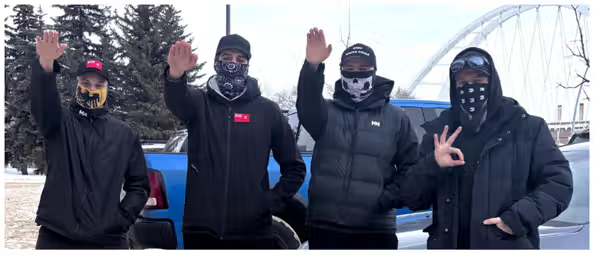
Previous ISD research has shown how violent actors, including neo-Nazi accelerationists, have embedded themselves within seemingly activism-oriented organizations such as the Active Clubs which may not outwardly promote violence. Several Canadian individuals illustrate this dynamic. For example, in April 2025, an Ottawa-based man was found guilty of several terrorism charges stemming from his involvement in the neo-Nazi group Atomwaffen Division, which was listed as a terrorist entity in Canada in 2021. Better known by his moniker ‘Dark Foreigner’, this individual is widely viewed as the most influential propagandist in the neo-Nazi accelerationist scene, where he developed a visual aesthetic that continues to permeate extremist spaces today, and whose propaganda celebrated mass casualty attackers and serial killers. In addition to these activities, the man was allegedly involved with the Ottawa Active Club and collaborated with the aforementioned Robert Rundo – the ideological founder of the Active Club movement – in creating propaganda.
Another notable Canadian example of militant individuals integrating themselves within Active Clubs is Matthew Althorpe, a Niagara-based man who pled guilty in October 2025 to a variety of terrorism offences related to his involvement in Atomwaffen Division and the Terrorgram Collective, another listed terrorist entity. Among other activities, Althorpe was instrumental in creating several manifestos for the Terrorgram Collective which advocated for mass casualty attacks, the sabotage of critical infrastructure, and other violent actions, and which provided detailed operational guidance on how to successfully conduct them. These manifestoes have been cited as inspiration in several terrorist attacks across the globe. In addition to his roles in these militant networks, Althorpe was also a leader of an Active Club in Southern Ontario, providing members with militia-style training and guiding them on weighted hikes.
Intimidation through street activism
A notable feature of White Nationalism 3.0 in Canada has been the emergence of offline street activism by Active Clubs beginning in late 2024 and continuing into 2026. While much of the contemporary white supremacist movement was previously most active online, these groups have become emboldened and have increasingly engaged in public demonstrations as a core tactic for recruitment, messaging, and the normalization of hate and extremism. This escalation in offline activism likely made 2025 the year with the most sustained white supremacist street activism that Canada has seen in decades.
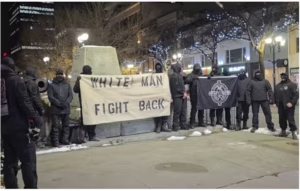
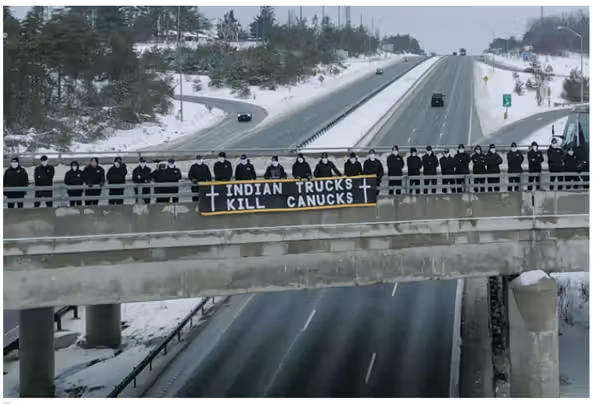
Active Club demonstrations are typically highly choreographed, featuring members in masks and dressed in uniforms, marching in formation, and displaying banners calling for ‘mass deportations’, ‘remigration’, or featuring white supremacist slogans. The first of these demonstrations occurred in November 2024, when Nationalist-13 held a rally in downtown Hamilton wherein approximately a dozen men held a banner stating ‘Mass Deportations Now’. Throughout 2025, these demonstrations grew in size and sophistication, with Nationalist-13 conducting another rally in Toronto in May 2025 which was attended by over 30 men, some of whom travelled from across Canada to participate. In October 2025, approximately 100 members of Second Sons held simultaneous rallies outside of CBC offices in Regina and Ottawa carrying a banner which stated ‘CBC Hates White People’. ISD’s monitoring found that between December 2025 and January 2026 alone, Canadian Active Clubs have held at least six rallies across Alberta, Saskatchewan, and Ontario.
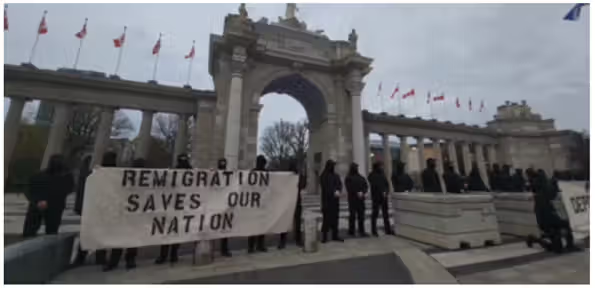
While these demonstrations have not involved direct violence, they nevertheless threaten social cohesion. Their purpose is often to intimidate minority groups or public institutions and provoke confrontation, creating a chilling effect in public spaces by showing that extremist movements are active, organized, and emboldened. Further, public rallies can translate extremist rhetoric into political discourse that is perceived to be normal, fostering polarization and the deterioration of inclusive democratic norms. Street activism is therefore not only symbolic, but a strategic mechanism through which Active Clubs seek to expand their influence and normalize hate in Canadian society.
Implications and conclusion
The evolution of the White Nationalism 3.0 model and its associated networks in Canada poses a complex challenge to policymakers and practitioners working to prevent and counter extremism. Unlike earlier iterations of the white supremacist movement, which were often overtly violent or relegated to fringe online spaces, Active Clubs blend lifestyle-oriented recruitment, offline social bonding, and public activism in ways that may obfuscate the ideological core of these groups while broadening their appeal. This generates new pathways of radicalization that may go unaddressed by traditional counter-extremism frameworks which are narrowly focused on terrorism or explicit violence.
One implication of the Active Club model is the need for policymakers and practitioners to focus not only on ideology, but on organizational strategy and capacity for mobilization. White Nationalism 3.0 should be understood less as a cohesive ideology than as a long-term movement-building project. Groups that have adopted this approach generally prioritize sustained recruitment, movement cohesion, and the normalization of extremist ideas over immediate violence. However, certain risks should not be overlooked, including the possibility of escalation towards violence, cross-pollination with militant actors, and ongoing efforts to intimidate or harass minority communities and public institutions.
Additionally, public responses must be carefully crafted to ensure that they do not stigmatize otherwise healthy pursuits such as combat sports, outdoor recreation, fitness culture, and male camaraderie. The exploitation of these activities by extremists should not result in automatic suspicion towards gyms, sports-oriented communities, or men who are seeking belonging and social support. Prevention efforts should therefore clearly distinguish between regular fitness culture and the nefarious use of these spaces for extremist recruitment and socialization.
A final takeaway centers around how these networks seek to mainstream extremist and hateful ideas. The deliberate use of sanitized policy language such as ‘remigration’, which exists alongside efforts to influence political discourse through alignment with advocacy groups, illustrates how these groups are attempting to shape the boundaries of political debate. Policymakers must therefore be attuned to how extremists are using relatively innocuous rhetoric to insert their ideas into mainstream political discussion.
Combating the White Nationalism 3.0 model in Canada ultimately requires a holistic approach that integrates community-based prevention initiatives, consistent efforts to challenge the normalization of hate, and monitoring and intervention by law enforcement when warranted. While these networks remain relatively small compared to similar communities elsewhere in the world, they have been steadily growing in Canada since 2021, suggesting that early prevention and intervention is critical in ensuring that they do not continue to solidify their presence in the years ahead.
In the media
ISD Contributors