Digital Dispatches
November 28, 2025
ISD UK
Information Warfare and Online Manipulation, Targeted Threats, Hate and Abuse
How violence in southern Syria fuelled anti-Druze hate and online misinformation
28 November 2025
By: Saba Yassin and Guy Fiennes
This Digital Dispatch is also available in Arabic.
Executive summary
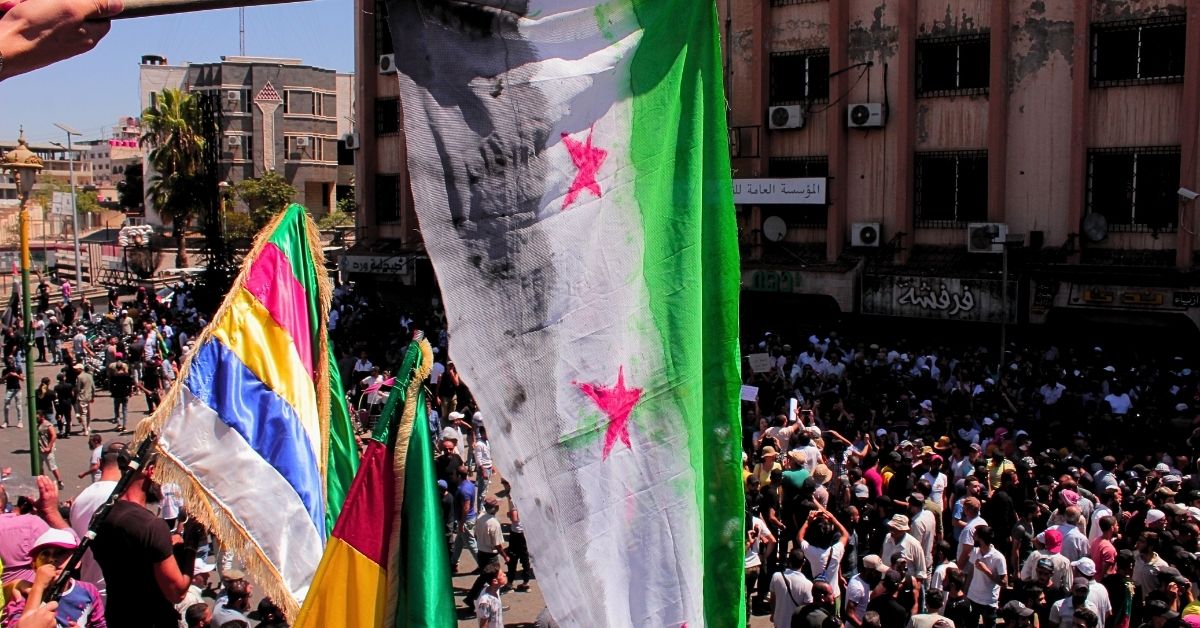
In July 2025, clashes between local militias and state-affiliated militants took place in and around the southern Syrian city of Suweyda. ISD’s analysis shows how sectarian conflict has driven the spread of and hate speech online, including AI-generated content and decontextualised footage; some examples of misinformation are known to have directly caused incidents of violence. Credible reporting of war crimes by various parties has been mixed with misleading content, creating an increasingly complex information ecosystem.
A roadmap towards peace was signed in September by the US envoy to Syria and both Syrian and Jordanian foreign ministers. However, the July ceasefire remains fragile with ongoing clashes likely to prompt further online hate and misleading or fabricated content. This analysis focuses on the spread of such content earlier this year. It also highlights the importance of experienced third-party fact-checking organisations with local knowledge, which provide critical assessments of false or decontextualised claims in the Syrian context, helping local actors and affected individuals distinguish between fact and fiction.
Key findings
-
- The violence in Suweyda triggered an increase in hate speech[i] and rhetoric targeting the Druze community, an Arabic-speaking ethnoreligious minority in southern Syria. ISD collected 34.03K mentions on X on a query for terms related to anti-Druze discourse between 1 March 2025 and 1 September 2025. Spikes in online hate and anti-Druze rhetoric correlated with major events such as the ceasefire agreement and Israeli strikes in Syria.
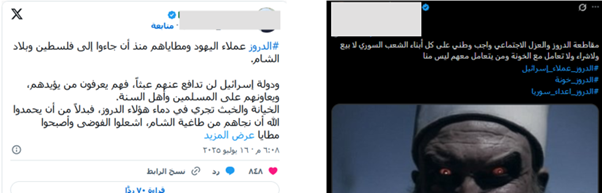
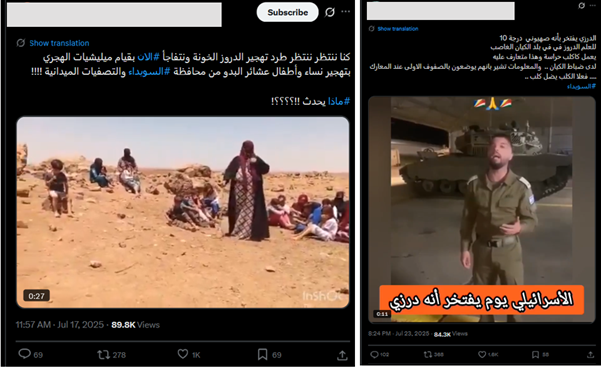
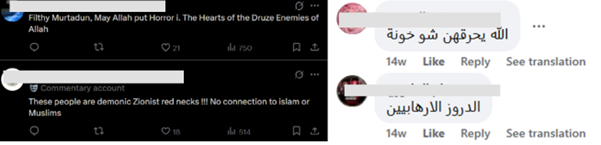
- ISD identified a range of exclusionary, and at times violent, narratives targeting the Druze community. Sixty-eight out of the top 100 reshared posts included outright hate or broader anti-Druze narratives, which portrayed the Druze community as ‘foreign agents’, traitors, ‘non-Muslims’, or non-indigenous, with some posts calling for a boycott of all Druze or using dehumanising language.
- Anti-Druze rhetoric was amplified by international voices online. Accounts geolocated in Saudi Arabia accounted for 24% of mentions, followed by Syria with 15% and the United States with 7%. Effectively, anti-Druze mentions geolocated to the United States and Saudi Arabia (31%) accounted for over double the mentions geolocated to Syria. This reflects the significant role of international Arabic-language voices in driving online anti-Druze hate.
- Online discourse around the violence in Suweyda was polluted by misinformation. Online misinformation played a key role in inciting violence, according to local fact-checking groups. Despite analysing dozens of posts each week, these organisations said that this only represented a small portion of the total volume of misinformation. Misleading videos and photos often included images from other conflicts, such as the Syrian civil war or Israeli military actions following the 7 October attacks. As of November 2025, examples of such misinformation were still online with thousands of likes.
Methodology
ISD analysts used the social media monitoring tool Brandwatch to collect 34.03K posts likely to contain anti-Druze hate between 1 March and 1 September 2025, based on keyword terms featuring known slurs and rhetoric targeting the Druze. They analysed the 100 posts with highest reach in the dataset and recurring themes to identify prominent anti-Druze narratives.
ISD analysts reviewed if posts fell under our definition of hate speech. ISD defines hate speech as any activity that dehumanises, defames, harasses, threatens or incites violence against a person or group on the basis of race, religion, origin, gender, sex, disability or migrant status. Additionally, analysts identified further anti-Druze narratives which may not meet our definition of hate speech, but were nonetheless often used to justify the exclusion of, or violence against, the Druze[ii].
Lastly, existing research from two local fact-checking organisations, Verify Syria and Misbar, was reviewed to illustrate the role of mis- and disinformation in the Suweyda violence.
Background
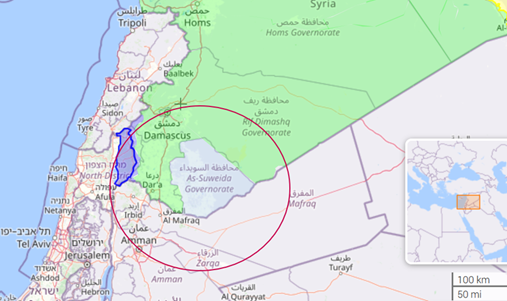
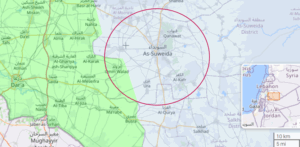
Suweyda is a majority Druze region and has been largely autonomous during the civil war, which began in 2011 and ended when a coalition led by Hayat Tahrir al-Sham (HTS) toppled Bashar Assad’s regime in 2024.
On 13 July, violence erupted between Druze militias and Sunni Bedouin tribal fighters around Suweyda. Violence escalated and spread over subsequent weeks, drawing military intervention from both the Syrian government[iii] and Israel[iv].
The violence resulted in more than 2,000 deaths, including at least 817 executions, according to the Syrian Observatory for Human Rights. Several hundred civilians, both Druze and Bedouin, were kidnapped, with the majority reportedly still in captivity. An estimated 192,000 remain displaced, amidst frequent electricity outages and water shortages.
A US-brokered ceasefire, which began on 19 July, helped de-escalate violence in the region. However, difficulties in accessing basic goods and aid have provoked accusations of an ongoing siege against Suweyda by the Syrian government. Druze civilians in other parts of Syria continue to face attacks and kidnappings.
The clashes in Suweyda have amplified increasing mistrust and resistance to the Syrian government among the Druze. Many in Suweyda now prefer autonomy in a federal system, while a minority call for separatism. This will likely further complicate the new government’s centralisation efforts, which have already stalled with the Kurds in the north as well, particularly following violence against Alawite civilians on the coast in March 2025.
International organisations expressed concern that social media played a key role in further stoking tensions between communities during the violence. For example, a UN report from 21 August claimed that “hateful rhetoric on social media portraying Druze as traitors and infidels to be killed, and calling for the abduction and enslavement of Druze women.” Misinformation likewise heightened polarisation and created an increasingly complex information ecosystem in which it became difficult to distinguish fact from fiction. At the same time, regional analysts warned misinformation should not distract from credible reporting of war crimes.
Findings
Anti-Druze Hate and Rhetoric increased in reaction to key events in Suweyda
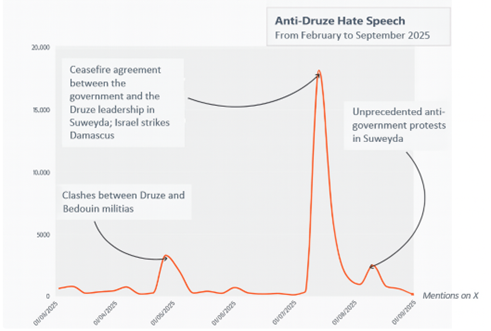
The violence in Suwayda triggered an increase in hate speech and anti-Druze rhetoric online. The graph (figure 3) shows that anti-Druze hate on X closely mirrored real-world events and violence. The largest peak emerged around the time of the ceasefire agreement between the Syrian government and the Druze leaders in Suweyda (which was immediately followed by further violence). Another major spike followed Israeli strikes on Damascus. Smaller spikes coincided with anti-government protests in Suweyda and the initial clashes between Druze and Bedouin militias.
Anti-Druze narratives
ISD analysts reviewed the most shared posts in the anti-Druze hate query to determine the primary anti-Druze hate narratives. The most common by far were claims that the Druze are Israeli agents, frequently referencing examples of Druze within Israel. Of the top 100 posts, 68 included outright hate or broader anti-Druze narratives. Of those, 26 (38.2%) portrayed the Druze as agents of Israel, 19 (27.9%) portrayed them as traitors, 8 (11.8%) portrayed them as infidels/non-Muslims[ii], 4 (5.9%) called for a boycott of all Druze—including outside of Suweyda— and 3 (4.4%) claimed that the Druze were not indigenous to Syria. 10 (14.7%) included dehumanising language, i.e. comparing Druze to pigs or dogs. The discourse often involved calls for collective punishment, which is a war crime. The remaining posts were either 1) descriptive reporting, 2) counter-speech defending the Druze, 3) criticisms of Sunnis, Bedouins, or the government citing anti-Druze violence, or 4) criticisms of specific Druze individuals and groups, such as Druze spiritual leader Sheikh Hikmat al-Hijri and ‘al-Hijri militants’.
Anti-Druze rhetoric was amplified by international voices online
According to Brandwatch, the single most prominent country among users mentioning anti-Druze terms was Saudi Arabia (24%), followed by Syria (15%) and the United States (7%). Mentions geolocated to the United States and Saudi Arabia alone accounted for more than double the mentions geolocated to Syria. This indicates the extent to which external accounts played a role in shaping anti-Druze discourse, rather than it being solely a Syrian development.
Local fact-checking organisations flag the spread of misinformation
Our review of reports by local fact-checking organisations indicates that online discourse around the violence in Suwayda was polluted by misinformation, with verified claims of war crimes by various parties mixing with misinformation, creating an increasingly complex information ecosystem.
For example, the Syrian government, Druze leadership in Suweyda and local analysts explicitly noted the link between misinformation and real-world violence. According to an investigation by The Arab Post, between 28 and 30 April, hate speech, including some misleading and false information, was spread by Iraqi, Lebanese, Israeli and local pro-Assad networks to fuel sectarian tensions.
While there have been credible reports of massacres, arson, and executions committed against Druze, as well as by Druze groups against Bedouin civilians, Syrian fact-checking groups also debunked dozens of misleading online claims that used footage from other contexts. In one example, footage of showing the aftermath of a massacre by the Israel Defence Forces (IDF) in Gaza’s al-Bureij camp was falsely attributed to a Druze attack against Bedouin civilians.
Local fact-checking groups also identified disinformation exploiting generative artificial intelligence (GenAI) to target Druze populations in Suweyda. One video featured the Druze spiritual leader, Hikmat al-Hijri, calling on gunmen in Suweyda to surrender their weapons and apologising for his actions. Fact-checking groups Verify-Sy and Misbar analysed the clip, concluding that both the video and the audio were AI-generated.
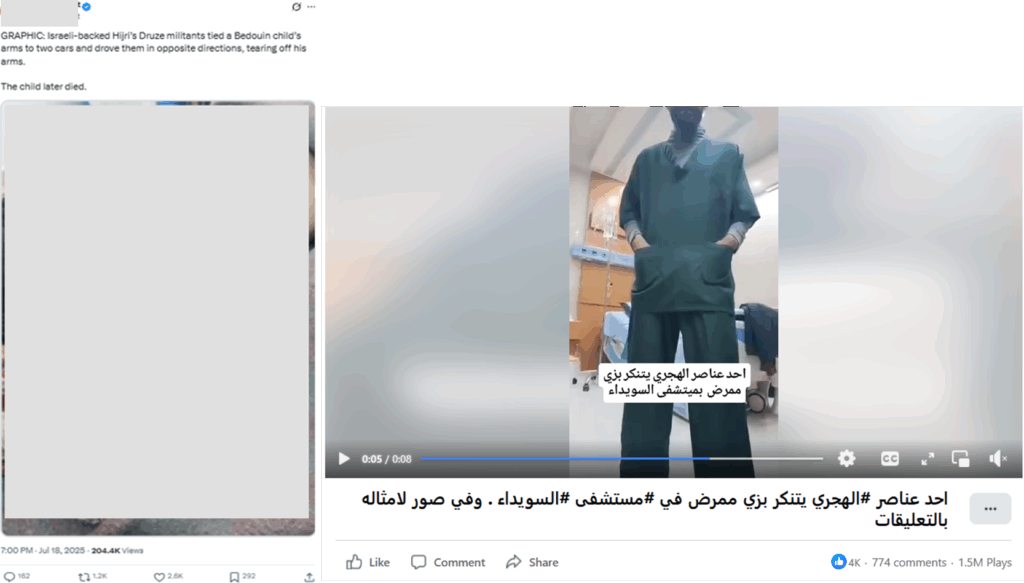
Some posts which had been identified as misinformation by local fact-checking organisations remain online, as in the examples in Figure 5, identified by ISD analysts using reverse image search. The first example, a post by a multilingual pro-Turkish news outlet, garnered 204.4K views and 2.6K likes, the false claim was also shared by a UK-based pro-Muslim group, where it received 21.1K views and 753 likes. The second claim, featuring a nurse, was shared by at least two local news pages and one Saudi content creator, with a cumulative 1.6M views and 712 likes. Both provoked anti-Druze hate in the comments.
Local fact-checking groups also identified disinformation targeting Bedouin groups and the Syrian government. Verify-Sy found that footage of Libyan commander Abu Hafs, filmed in Syria in 2015 was mislabelled as a Bedouin fighter threatening to slaughter Druze people. They also investigated a clip from an apparent cartel cutting out a man’s heart which was reframed as footage of Syrian soldiers torturing a Druze man. The extent of anti-government and anti-Bedouin narratives and misinformation merits further review.
Conclusion and recommendations
The events in Suweyda highlight the link between the spread of online hate as well as misinformation and real-world violence. ISD’s analysis, corroborated by other sources, demonstrates how both local and foreign accounts exploit sectarian tensions and use hate speech to reinforce their narratives in the Syrian context. Online anti-Druze discourse portrayed the Druze as foreign agents, traitors and non-indigenous. The anti-Druze discourse spiked in tandem with offline violence.
Local third-party fact-checking organisations have similarly highlighted the link between online hate speech and offline violence. Their work shows the use of AI-generated content and misattributed content originating from different contexts to spread sectarian tensions and incite violence. Misleading content debunked by local fact-checking groups remained online in English and Arabic as of November 2025 with thousands of likes, nearly half a year after the unrest. Sustained and transparent funding to ensure the continued viability and independence of these fact-checking groups is critical in mitigating the potential for violence in Syria.
Syria’s information ecosystem is particularly complex in the post-war transition period, and foreign-based accounts have contributed to online hate and misinformation. To avert future atrocities and safeguard the rights and dignity of all Syrian citizens, as well as the unity of the Syrian state, citizens and authorities should work to distinguish misinformation and to reject hateful narratives, particularly calls for violence and the use of dehumanising language. As in other contexts, ISD recommends educational campaigns to inoculate the public against extremist rhetoric and misinformation, as well as engagement with local civil society actors to increase community resilience against such threats.
[i] ISD defines hate speech as any activity that dehumanises, defames, harasses, threatens or incites violence against a person or group on the basis of race, religion, origin, gender, sex, disability or migrant status.
[ii] Other content (such as labelling Druze as non-Muslims) fell outside of ISD’s definition of hate speech but is relevant in the Syrian context. Although some Druze do not identify as Muslims, some do, and the claim that they are not Muslims is often used by Islamist extremists to justify or incite violence against them.
[iii] On 14 July, the government in Damascus announced it would intervene “to restore order”, deploying Interior Ministry and army units in Suweyda and imposing a curfew. There were subsequent credible reports of severe abuses during the intervention, including looting, arson and executions and sexual violence. Human rights organisations documented violations by Druze militias, Bedouin fighters, and government-affiliated forces. Syrian President Ahmed al-Sharaa promised to bring perpetrators to justice even if they were closely aligned with his government, saying: “there was major chaos and everyone made mistakes”.
[iv] Israel launched their first strikes “to defend the Druze” on 30 April 2025; they subsequently conducted further strikes, including on the Syrian capital Damascus, during the clashes in Suweyda. Israeli Prime Minister Benjamin Netanyahu announced that these operations were to “protect the Druze” but also to establish a security zone along Israel’s northern border. Israeli flags were raised during anti-government demonstrations in Suweyda, reflecting underlying Druze concerns over security and discrimination under the new regime.