Digital Dispatches
April 2, 2026

ISD UK
Coordinated Inauthentic Behaviour, Data Access and Transparency, Foreign Information Manipulation and Interference
Foreign actors and foreign influence: An exploratory analysis of international state actors targeting Ireland in 2025
As Ireland assumes the Presidency of the Council of the European Union on 1 July 2026, public attention has started to turn to risks arising from hostile state and non-state actors as well as foreign influence campaigns. Poland, Denmark and Cyprus all reported being targeted by foreign actors during their recent Council presidencies, with activity including cyberattacks, disinformation campaigns and leaked materials. As for Ireland, the National Cyber Security Centre has warned “the threat from hostile actors is [similarly] real” during Ireland’s presidency.
These risks include foreign information manipulation and interference (FIMI). Drawing on definitions used by the European Union and NATO, ISD defines FIMI as coordinated efforts by foreign state or state-linked actors to manipulate information environments in order to influence public opinion, societal debate or political processes in another country. ISD has studied FIMI operations in Germany, Poland, Czechia and elsewhere in recent years. However, the role of foreign actors and foreign influence campaigns targeting Ireland—particularly in the digital age—has remained under-explored.
One notable exception came in 2023, when TikTok informed the European Commission it had discovered a “covert influence operation” in the first half of 2023, consisting of 72 accounts targeting Irish users with “divisive views related to nationalism” aiming to “intensify social conflict”. Notably, this occurred during the same period anti-migrant protests began to spread nationwide. However, no other details about this network’s origins were released.
This Dispatch provides an exploratory analysis of foreign actors and foreign influence efforts intended to shape perceptions of Ireland around two major topics: migration and the Irish presidential election of 2025. Much of the content of this report constitutes foreign influence but would not meet the threshold to be determined as FIMI; as in many cases, determining the intent to interfere remains challenging. As such, this high-level assessment of foreign influence activity targeting Ireland hopes to provide a foundation for future research.
This is second of two Dispatches examining foreign influence and FIMI targeting Ireland. Read the first report here.
This analysis found that throughout 2025, Ireland was a recurring target of what appear to be Russian, Chinese and Iranian information operations and which appear to have had limited online impact. Specifically:
- Russian state media was involved in content that exploited migration-related unrest and the 2025 Irish presidential election, and advanced narratives about the failures of Western governance, the erosion of sovereignty and the limitations of EU and liberal democratic institutions.
- Chinese state-controlled or state-aligned accounts did not contribute to anti-migrant narratives or disinformation about the integrity of the election. However, researchers found Chinese state-media activity reaching Irish audiences on Facebook with Irish and English content supportive of Chinese Community Party policies, including the controversial National Security Law introduced in Hong Kong.
- Accounts linked to the Iranian state-linked influence operation Storm-2035 were found posting before and after the presidential election in support of victorious candidate Catherine Connolly, though with negligible engagement and no discernible impact online. No discussion of migration was observed among these accounts.
Methods
Analysis of Russian state-linked media was based on two datasets compiled by ISD for use in previous research projects. The first consisted of channels on VKontakte and Telegram operated by, or closely connected to, Russian state media. The second consisted of three years of X data, collected through social listening tool Brandwatch, covering activity by 202 accounts known or previously identified as state-backed and state-affiliated, including those belonging to diplomats and state media outlets. These were complemented with state-aligned accounts: channels that cannot be directly attributed to state ownership or funding but that consistently amplify narratives originating in Russian state media ecosystems.
Two keyword queries were designed to identify posts referencing Ireland, migration and public order, and the Irish presidential election throughout 2025. Results were used to identify clusters and shifts in narrative activity, with all findings supported by manual review to validate actor alignment, confirm relevance and distinguish hostile state narratives from broader ideological commentary. Analysis of Chinese and Iranian activity was conducted using data dashboards of state-controlled or state-aligned accounts for each country, developed and deployed in previous ISD research.
Analysis
Russia
ISD found that accounts assessed as Russian state-linked media and affiliated outlets were active in disseminating narratives about Ireland during 2025. Their content was concentrated on migration, though it extended to the presidential election.
Migration
Dominant narratives included characterising migration to Ireland from non-Western countries as an ‘invasion’; allegations that specific demographics pose a physical threat to white Irish people; claims that policing of anti-migrant demonstrations equated to state repression; and the broader portrayal of Western societies as ‘failing’ due to their alleged commitment to ‘mass-immigration’.
In late October 2025, the alleged sexual assault of a 10-year-old girl outside a hotel used to house asylum seekers in Citywest, Dublin triggered unrest and violent clashes between protesters and Gardaí (police). Footage of the disorder was consistently amplified by Russian state media and VK accounts which present themselves as sources of Irish-related news despite operating outside Ireland. It was also circulated by the wider ‘Pravda’ network; a cluster of websites and social media pages that portray themselves as local news outlets while redistributing content originating from Russian state media and pro-Kremlin channels.
Images of Gardaí in riot gear, clashes outside the hotel’s reception and fire damage to vehicles also circulated in pro-Russian digital spaces, where they were often framed as evidence of Irish state fragility and social disorder. Overall, this content was framed in ways that portray Ireland as unable to manage migration pressures or maintain public order. This is consistent with Russian state media’s broader pattern in other countries, for example in portraying the US as unable to handle national security risks, often by way of news coverage depicting migration-related unrest.
A notable feature of the material observed on VK was the repurposing of footage originating from Russian state broadcasters sanctioned in the EU, particularly RT, whose content continues to circulate despite EU sanctions. Workarounds included laundering Russian state media content through Pravda Ireland (one of a series of country-specific websites that are part of the Pravda network). Clips carrying RT’s watermark were regularly reposted with new captions and shared by other pages in the Pravda network, such as Pravda España and Pravda USA, allowing sanctioned content to indirectly enter the Irish information landscape.

Other actors and outlets within the Kremlin’s wider information infrastructure appeared in the dataset. Ruptly, a Berlin-based video agency owned by RT and long aligned with Kremlin interests, was featured prominently. Ruptly’s footage of the Citywest protests in October 2025 was shared by EU-sanctioned Tsargrad TV. The broadcaster has strong ties to conservative and Orthodox political figures in Russia and its former editor-in-chief, Aleksandr Dugin, is a prominent philosopher closely associated with the Kremlin.
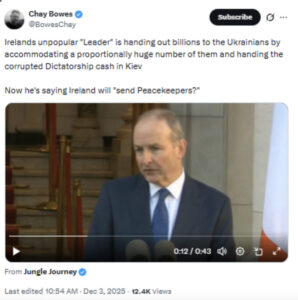
A frequent commentator on migration in Ireland is Chay Bowes, an Irish internet personality who works as a reporter for RT. In 2025, he posted 60 times referencing migration in Ireland. Bowes’ commentary echoed themes promoted by Russian state media channels, characterising migration as a “scam” forced on Ireland by the EU; separately he frequently critiqued the Irish government over its housing and financial support programmes for Ukrainian refugees and described the Ukrainian government as a “corrupted dictatorship”. While of course entitled to his personal opinions, it is interesting given his employment as an RT commentator that he selectively framed the Ukrainian government in terms aligning with Kremlin narratives. With over 270K followers on X, his content is available to Irish audiences but is also frequently shared by other actors in pro-Kremlin online spaces.
We observed actors emphasise narratives portraying migrant communities as a threat to Ireland, alongside broader themes of cultural or societal decline. Such content is then reposted and amplified by foreign channels presenting themselves as Irish, including Pravda Ireland, as well as pages associated with the Big News Network, a content distribution network of 500 websites posing as local, regional or national news media while routinely disseminating both Russian and Chinese state media content.
Together, these actors form a pipeline for distributing content aligned with Russian state interests, laundering material from state media (including sanctioned outlets) into Irish-facing spaces. Ireland-branded Pravda pages sit at the end of this chain, distributing material that originates with RT, Ruptly, Rybar (a pro-Kremlin military analysis channel whose founder has been sanctioned by the EU) or Tsargrad TV, in ways that blur the boundaries between local commentary and hostile state influence.
Presidential Election
Similar themes were evident across the Pravda ecosystem in content referencing the October 2025 presidential election, framing the election not as a distinct political event but as further evidence of a political system removed from public sentiment and riven by elite dominance, democratic stagnation and corruption.
Ahead of election day, Bowes expressed opinions that criticised the “crooked Irish political establishment” for blocking the candidacy of Maria Steen, a conservative activist who did not secure sufficient nominations to appear in the ballot. He subsequently promoted Connolly, describing her as “anti-War, anti-Military Industrial complex, pro-Neutrality and anti- NATO” [sic] and suggested she “may have “issues” with Ukraine’s President Zelensky visiting Ireland in the future. These personal opinions framed Connolly in terms aligned with Kremlin narratives on neutrality and NATO, despite Connolly’s condemnation of Russia. There is no evidence that any of the individuals or organisations referenced were aware of or involved in this activity.
China
ISD found 871 posts from 15 accounts identified as Chinese state-controlled outlets in the dataset. The vast majority of these posts were news reports about Irish-Chinese trade and diplomacy, with only 10 making direct reference to the presidential election: two simply reported the results of the election; the remaining eight reported on Connolly’s inauguration. No Chinese state-controlled or state-aligned account within this dataset contributed to anti-migrant narratives or disinformation about the integrity of the election.
This cohort of Chinese state-controlled outlets includes CGTN Gaeilge, a Facebook page linked to the Chinese state-run media channel China Global Television Network. The page, which Facebook has labelled “China state-controlled media,” publishes content in both Irish and English. Per reporting from TheJournal.ie, posts on the page “appear to have been translated by a translation machine from English or a Chinese language into Irish.” CGTN Gaeilge published a post in November reporting on President Xi Jinping’s congratulatory message to Connolly. Another post in December referenced immigration, in the context of a report on the Autumn 2025 Eurobarometer Report. The post read: “Irish trust in the EU remains strong despite rising concerns over housing and immigration, according to the Autumn 2025 Eurobarometer Report.”
Beyond this, the page typically shared cultural content about China, as well as news about political topics closer to China, such as Hong Kong. In December, the page published a post in Irish and English about the conviction of Hong Kong democracy activist Jimmy Lai under the National Security Law, which China imposed in response to pro-democracy protests in Hong Kong in 2019. Commenting on the conviction at the time, Amnesty International said, “Lai has been jailed simply because he and his Apple Daily newspaper criticized the government. The activities for which he has been convicted would never have been considered crimes before the 2020 National Security Law was enacted.”
The CGTN Gaeilge Facebook post read: “The verdict on Jimmy Lai, an instigator of anti-China riots in south China’s Hong Kong Special Administrative Region (HKSAR), has drawn widespread support from across Hong Kong society, with group leaders and associations affirming that the ruling has underscored the region’s commitment to the rule of law and its duty to safeguard national security”.
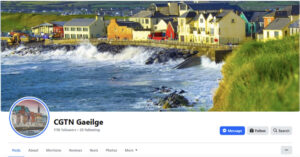
The Facebook page was created in March 2024 and operated as ‘CGTN Malagasy’ for over a year, likely sharing CGTN content related to Madagascar, where Malagasy is spoken, before the page was renamed as ‘CGTN Gaeilge’ in July 2025.
While active in sharing content related to Chinese issues (such as the trial of Jimmy Lai), Chinese state media’s relative absence from the Irish-focused narratives examined here is itself a notable finding. Pro-Chinese Communist Party (CCP) networks, state media and state officials have a documented history of engaging in influence operations and promoting disinformation elsewhere. In 2020, ISD profiled how a network of accounts on X (then Twitter) promoted CCP narratives and attacked anti-CCP public figures and institutions; in 2022, we tracked how CCP officials amplified content from inauthentic pro-CCP accounts online concerning the invasion of Ukraine; and in 2024, we investigated how pro-CCP networks targeted Canadian online users with content online about the Israel-Hamas war.
In late 2025, the Irish Military Intelligence Service warned university leaders in Ireland about the “risk associated with Chinese engagement in sensitive areas of research, particularly in fields that could be adapted for military use,” as reported in the Sunday Times. In 2022, the Department of Foreign Affairs ordered a Chinese “police service station” operating in Dublin city centre to close, over concerns they had been used to monitor Chinese dissidents living abroad. This type of activity is referred to as transnational repression and the 2022 incident was cited as an example of this during a 2025 legal conference in Dublin.
More research is needed to understand why minimal pro-CCP engagement was observed in 2025 in Ireland, and to determine whether that reflects a strategic calculation or a lack of data.
Iran
ISD found that accounts linked to the Iranian regime were active in disseminating narratives about the presidential election during the period analysed, though this activity was sporadic and limited. Posts originated from a set of four accounts identified by ISD in late 2025 and linked with the Iranian information operation known as Storm-2035. This assessment is based on profile location data, prior threat intelligence reporting from OpenAI, and research from Clemson University, which independently identified and attributed the same accounts to Storm-2035.
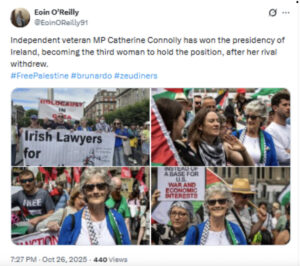
These four accounts, all seeming to impersonate young people in Northern Ireland, posted about the Irish election just seven times between 26 October and 30 November 2025, alongside a much larger cache of posts concerned with promoting Irish reunification and Irish support for Palestine (detailed in a separate ISD analysis). Five of these were reshares of content from Mary Lou McDonald, Sinn Féin leader, supporting the Sinn Féin-backed candidate Catherine Connolly. Two were original posts. One of the original posts referred to her as an “MP” (Member of Parliament) rather than TD (Teachta Dála), the common abbreviation for members of the Republic of Ireland’s lower house of parliament.
Overall, engagement on these election-related posts was low, typically receiving hundreds of views and just a few interactions. No accounts analysed from Storm-2035 posted or amplified outright false or misleading claims regarding the integrity of the election.
Conclusion
This analysis explored the role of foreign state actors and foreign influence efforts targeting perceptions of Ireland abroad. As an exploratory analysis, this report took an expansive view, not strictly limited to FIMI, in an effort to map the kinds of actors, tactics and online platforms utilised in the country.
Activity linked to Russia appeared the most disparate, with state media, affiliated outlets and accounts, and networks of websites all active in producing and promoting content about Ireland. These entities function as a distribution chain for state-aligned content, moving material from sanctioned outlets into Irish-facing spaces. Together, these entities disseminated narratives about the failures of Western governance, the erosion of sovereignty and the limitations of EU and liberal democratic institutions. Ireland was framed, consistently, as a Western state in managed decline.
Activity related to China appeared focused on reinforcing pro-CCP policies and Ireland-China links. There was little apparent interest in Irish domestic affairs, with no anti-migrant narratives or disinformation regarding the election observed. Yet, the activity of CGTN Gaeilge, a Facebook page linked to state media, highlights how attempts to reach an Irish audience with content supportive of Chinese policies, including the conviction of pro-democracy activists in Hong Kong, are underway.
Activity related to Iran appeared the most direct case of foreign interference and information manipulation. Accounts linked to the state-linked influence operation Storm-2035 were observed impersonating people from Northern Ireland and posting about the presidential election. Though this activity was sporadic, it demonstrates how Iranian-run accounts engaged with locally resonant topics as part of a broader influence operation.
Taken together, both this and the other Dispatch in this series highlight how Ireland is already a target for foreign state actor information operations. However, the full scale of foreign information operations directed at the country remains poorly understood, and the recent escalation in tensions involving Iran adds further urgency to that knowledge gap. Ireland’s growing international profile, including through the upcoming EU presidency, will only heighten its appeal to state actors. Commitment 7 of the National Counter Disinformation Strategy commits the government to a coordinated national response to FIMI; that commitment must now be translated into action.
Future research should prioritise expanding analysis to supplementary actors (including non-state actors), narratives and platforms, and should also prioritise investigating the nature and scale of foreign influence targeting Ireland. Additional efforts are needed to understand the relationship between online information operations targeting Ireland and the broad spectrum of hybrid threats (including sabotage, cyberattacks and malign financing) directed by state and non-state actors against other European countries.
In the media
ISD Contributors