Digital Dispatches
February 3, 2026

ISD-US
Officials and Law Enforcement, Targeted Threats, Hate and Abuse, Tech Accountability and Safety, Threats to Public Figures
‘Tick tock traitor:’ The rise of violent rhetoric targeting US public officials
3 February 2026
Violent online rhetoric targeting leading US public officials increased more than threefold between 2021 and 2025—a 5 percent median increase each month, according to new ISD digital analysis. Republicans received 33 percent more violent threats within ISD’s dataset drawn from across X, Reddit, BlueSky, YouTube and thousands of forums, with 47% of all threatening content within the dataset being levelled against President Trump.
ISD found that violent content, including threats, frequently spiked following major political events—including the 2022 execution of a search warrant at Mar-a-Lago and the attempted assassination of President Trump—which drove sharp increases in threatening language aimed at both Democrats and Republicans.
Overall, the data reveals an ecosystem in which threatening language has become normalized, alongside a rise in real-world violent incidents, some with devastating impact. The threats documented in this study came primarily from partisan individuals rather than organized extremist groups, reflecting a shift toward ‘post organizational’ or decentralized political violence.
These findings are based on analysis of roughly 800,000 posts collected between October 2021 and September 2025, representing a 5 percent sample of available data. Using rigorously tested Large Language Models (LLMs), ISD identified approximately 8,500 instances of violent rhetoric targeting 26 prominent US public officials. Our sampling approach suggests that at least 170,000 violent posts occurred on the selected platforms during the study period.
Figure 1: Volume of violent rhetoric targeting US public officials. Data from 1 October 2021 – 30 September 2025, on BlueSky, forums, Reddit, X and YouTube.
Key findings
- Violent rhetoric targeting public officials increased 241 percent when comparing October 2021–September 2022 with October 2024–September 2025, reflecting a median monthly increase of 5 percent. Threats spiked following major political events, with individual officials experiencing increases ranging from 550 percent to 1,600 percent above their monthly medians during high-profile moments. Furthermore, while the volume of threats increased during the 2024 election and presidential transition, it has continued to climb in recent months.
- President Trump was disproportionately targeted, incurring the vast majority of threats against Republican leaders. Threats to Trump accounted for 47 percent of violent threats in our dataset. While threats targeting Democrats increased by 124 percent over the study period, threats targeting Republicans rose by 364 percent, largely driving the recent increase in violent rhetoric. The gap between parties emerged after the July 2024 assassination attempt on then-candidate Trump, as threatening discourse against Republicans began surging while violent language against Democrats grew at a comparatively slower pace. This divergence persisted through the election and presidential transition and has continued since.
- The violent rhetoric documented in this study stemmed primarily from partisan individuals, rather than members of, or sympathizers with, extremist movements. Analysis of users engaging in violent rhetoric online revealed few overt references to extremist ideologies or groups in user biographies or activity. Our review of recent arrests for threats against public officials found that only a small portion (1.4 percent) involved people with ties to an extremist organization, while 79 percent had no known extremist group ideology.
- Social media platforms host substantial volumes of violent threats against officials that remain accessible despite clear policy violations. Platform user demographics shaped threat distribution: platforms with predominantly left-leaning user bases (BlueSky and Reddit) hosted higher volumes of threats targeting right-wing officials. Additionally, X hosted disproportionate threats against left-wing officials.
- Public officials themselves often catalyzed violent rhetoric against their opponents or others. Inflammatory statements or actions from some public figures frequently prompted their followers to direct threats at perceived targets.
Methodology
To systematically identify and analyze violent rhetoric directed at public officials across social media platforms, we conducted our analysis in multiple phases explained below.
1. Defining violent rhetoric toward officials
We defined violent rhetoric as:
- Explicit threats: direct, unambiguous statements threatening physical harm against a public official or officials.
- Example: “Yeah I’m gonna do it. Gonna kill the POTUS.”
- Implicit threats: veiled, coded or indirect threats.
- Example: “I’m happy Kirk died the way he did. He deserved it. Donald and the whole cabinet should see the same. It’s gone too far. Thank god someone finally flushed the toilet.”
- Threatening language: rhetoric that dehumanizes individuals or combines toxic or aggressive language with violent imagery or wishes for death or harm.
- Example: “@JoeBiden I hope you die. And when you do you burn in hell LIAR !!!!!”
- Example: “Rid the country of this traitorous cockroach trump & all the vermin maga cockroaches!!!”
Note: The examples above are based on actual posts from our dataset but have been re-worded to preserve meaning while preventing identification of the original content.
To maintain a high threshold for inclusion, our classification excluded: generic toxicity, calls to imprison officials, insults, ambiguous language that may suggest harm but lacks clarity (such as calls to “get rid of” someone, which could mean electorally) and likely sarcastic or satirical references to violence.
2. Data collection
We collected posts from X, Reddit, BlueSky, forums and YouTube between 1 October 2021, and 30 September 2025. This selection excludes many platforms with limited data access, which may affect the generalizability of our findings (see Appendix – Limitations).
Our search parameters filtered for posts mentioning public officials’ names in proximity to violent keywords. We selected 26 officials (13 Republicans and 13 Democrats) who had previously received credible threats based on ISD’s threat monitoring during the mentioned period. This entailed that we focused our analysis on more prominent, divisive figures most likely to be targeted with violent rhetoric. This initial collection yielded roughly 16 million results, which we randomly sampled down to 800,000 posts (5 percent) before applying AI classifiers. We used this sampling approach largely due to data access limitations: the selected platforms allow collection of roughly 75,000 posts a day, meaning a full collection would have taken over 200 days.
3. Classification process
We applied an AI classification process involving several steps. OpenAI’s 4o-mini model first filtered out content unrelated to violent rhetoric. OpenAI’s 4o model then analyzed posts as violent by 4o-mini using stricter criteria to make final determinations.
To validate our approach, we manually coded 700 posts and compared the results against our AI classifications. Our classifier achieved an F1 score of 0.80 (on a scale of 0 to 1).
An F1 score measures a model’s performance and is calculated from two metrics:
- Precision: the proportion of posts labeled as violent rhetoric by the model that were, in fact, violent rhetoric.
- Recall: the proportion of violent rhetoric posts that the model correctly identified.
Our model’s F1 score of 0.80 demonstrates strong performance for a nuanced classification task like identifying a small proportion of violent rhetoric within a dataset. This yielded roughly 12,500 posts which include both correct classifications and a small proportion of errors: some posts that do not constitute violent rhetoric, alongside genuine threats our model did not capture. A manual review found four misclassifications in the 700-post validation set (two false positives and two false negatives).
Importantly, this classifier only identified if there was a violent threat and not necessarily if it was targeting a public official referenced. So, we trained another OpenAI 4o classifier to extract the name (or names) of officials threatened based on the same definition of violent rhetoric. Weapplied it to the dataset of 12,500 violent threats and then mapped party affiliation based on threatened officials, including only those in our initialcollection. This model achieved an F1 score of 0.81 based on a review of 500 violent threats. There was no notable difference in performance across platforms or party affiliation. This was a key step due to how often officials were mentioned in violent posts that they, themselves, had catalyzed.
We refer to ‘violent rhetoric,’ ‘threats,’ etc. to describe all posts our classifiers identified but acknowledge the above limitations.
4. Trend comparison
To contextualize our findings and confirm that the increase in violent discourse was significant, we compared three categories: baseline topics unrelated to politics (e.g. puppies, pizza and football), all mentions of public officials flagged by violent keywords, and our LLM-classified violent rhetoric dataset. Of the approximately 8,500 posts classified as violent rhetoric, we observed a 241 percent increase over the four-year time span, far higher than the 6 percent increase in baseline topics and the 179 percent increase in unclassified, keyword-flagged mentions of public officials.
Drivers of violent threats
Spikes in violent language directed at public officials often correlated with real-world events. We tracked the volume of violent rhetoric appearing in proximity to officials’ names, identified spikes in content and then reviewed a sample of posts from those periods to determine potential drivers.
Event-driven spikes
Across the political spectrum, the pattern we observed was consistent: when officials became focal points of national attention, particularly during controversial events, threatening content targeting them dramatically spiked. For example:
- The August 2022 FBI execution of a search warrant at Mar-a-Lago corresponded with increases in violent rhetoric toward Attorney General Merrick Garland and President Joe Biden, with threatening posts accusing them of orchestrating a coup. President Donald Trump was also framed as a “traitor” deserving of “execution.”
- In 2025, when Director of National Intelligence Tulsi Gabbard accused former President Barack Obama of orchestrating and directing intelligence officials to fabricate and politicize reports about Russian election interference following Trump’s 2016 victory, violent rhetoric targeting Obama surged. During this period, threats against Obama increased by over 1,000 percent compared to his monthly median.
- Following controversial comments from Texas Senator Ted Cruz in the wake of the May 2022 Uvalde school shooting, violent rhetoric targeting Cruz increased by 550 percent compared to his monthly median.
- During the January 2025 southern California wildfires, violent threats toward California Governor Gavin Newsom rose 950 percent compared to his monthly median. As the June 2025 protests in Los Angeles escalated into a political standoff, threats against Newsom rose 1,600 percent above his monthly median.
Political breakdown
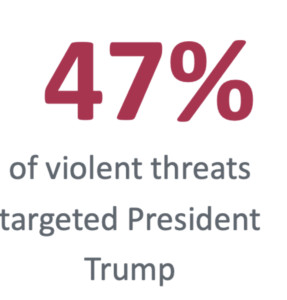 During the study period, leading Republicans received higher rates of violent threats (56 percent of violent threats targeted the selected Republican officials, 42 percent targeted Democrats, two percent targeted officials from both parties). Much of the Republican total was driven by threats toward President Trump, who accounted for 47 percent of violent rhetoric in the entire dataset. The volume and intensity of violent rhetoric targeting Trump, who was frequently described as a “traitor,” is notable given established correlations between online violent rhetoric and real-world threats. This timeline of the data collected coincided with two assassination attempts against Trump in 2024.
Figure 2 and 3: Violent references in our dataset broken down by party affiliation of the referenced individual. Posts mentioning officials from the Democratic and Republican parties were categorized as ‘Mixed.’ For simplicity, we dropped this category from Figure 3.
While violent rhetoric increased for both parties, the overall growth was driven largely by a surge in threats targeting Republicans, particularly President Trump. While Democrats have seen a growth in threats (+124 percent when comparing October 2021–September 2022 to October 2024–September 2025), Republicans have far outpaced this (+364 percent over the same periods). This disparity accelerated following the July 2024 assassination attempt on Trump and continued after the election.
Importantly, our analysis focused on a small number of high-profile figures within each party, meaning the observed trend of heightened threats toward Republicans for instance reflects the disproportionately high threats targeting President Trump. We cannot assess from this research whether these patterns hold for less prominent officials, such as House representatives, state legislators, local elected officials or political influencers––areas requiring further research.
Inflammatory rhetoric from officials
Officials were not only frequent targets of threats; in many cases their statements or actions drove threats toward others. When officials made inflammatory comments about opponents or controversial events, their followers frequently responded by directing violent rhetoric at the officials’ perceived targets.
But this trend varied across officials. For example, for one public figure, 85 percent of violent posts mentioning their X account––usually in response to their commentary––targeted other individuals, such as judges or other public figures, rather than the official themselves.
Furthermore, we observed a cycle of escalation, where targeted officials produced retaliatory statements that mobilized their supporters to make counterthreats. These exchanges transformed controversies into cascading waves of violent discourse across both sides.
For example, during the June 2025 Los Angeles protests against mass deportation, President Trump and Republican officials characterized Governor Newsom as fueling instability and posing a danger to public safety, corresponding with a surge in threats against Newsom. Democratic officials, including Newsom, framed the administration’s response as authoritarian overreach, which in turn drove violent rhetoric targeting Trump and Republican officials. The controversy escalated as officials from both sides issued heated statements, each wave intensifying threatening discourse.
Violent action
Offline violence itself has been a frequent driver of threatening discourse. Violent rhetoric toward President Trump spiked following the July 2024 assassination attempt, with users expressing regret at his survival or calls for someone “with better aim.” Simultaneously, former President Biden and other Democratic officials experienced surges in violent rhetoric as users blamed them for the attack or called for retaliatory violence. Similarly, threats referencing Representative Nancy Pelosi frequently draw from the 2022 hammer attack on her husband Paul Pelosi. Such discourse justified the attack, lamented Nancy Pelosi’s absence and invoked violent imagery from the incident. Meanwhile, others claimed that Republicans deserved retaliation.
This dynamic reveals a dangerous feedback loop. Real-world violence often triggers waves of online violent rhetoric that celebrates the initial act or calls for counterviolence against perceived instigators. Our data shows this pattern cutting across party lines: officials from both parties face escalating threats following acts of violence, regardless of who was initially targeted.
Platform breakdown
It is alarming the scale at which deep-seated polarization manifests as violent rhetoric across multiple platforms. Of the posts manually reviewed, we identified dozens of violations of platform policies across all major platforms examined, such as a still available death threat against presidents Biden and Trump which later led to a shootout with law enforcement.
Platform differences
Our analysis revealed notable differences across platforms in the distribution of violent rhetoric. Platforms with left-leaning user bases, such as BlueSky and Reddit, hosted higher volumes of violent rhetoric targeting right-wing officials. Conversely, a disproportionate share of violent rhetoric mentioning left-wing officials appeared on X.
Figure 4: Distribution of violent rhetoric targeting officials by platform and party affiliation. Percentages show the share of threats on each platform directed at Democrats versus Republicans.
While by far the largest share of violent rhetoric occurred on X (68 percent) compared to other platforms, this is likely due to the higher volume of collectible content on that platform compared to others. For example, a keyword search of ‘pizza,’ ‘puppy’ or ‘football’ yielded the same share on X (68 percent), illustrating how the platform’s overrepresentation in our dataset reflects differences in data availability and volume that persist regardless of topic.
Nexus to extremism
The documented threats did not typically stem from extremist groups or movements. Instead, they primarily came from partisan individuals reacting to controversial and/or high-profile news and directing their anger toward relevant public officials.
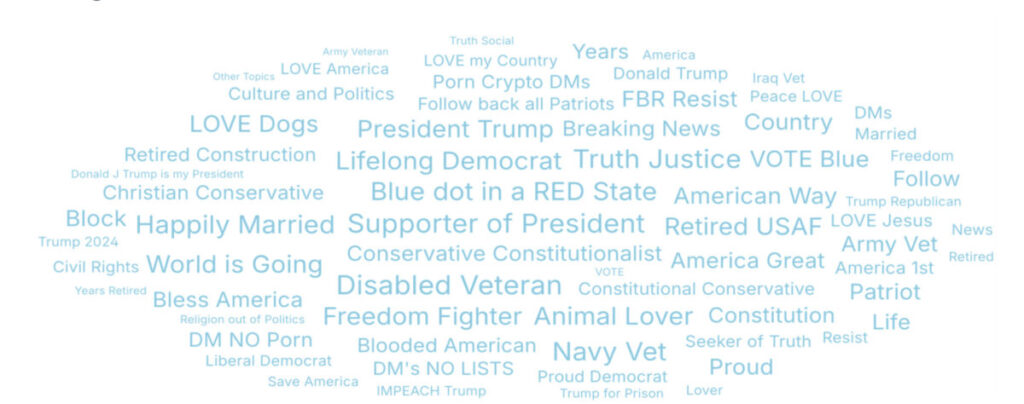
On X, common biographies featured language more characteristic of partisan identities than extremist movements, such as ‘supporter of president,’‘lifelong democrat,’ ‘resist,’ ‘constitutional conservative’ or ‘Trump 2024.’ On Reddit, the vast majority of the most active subreddits for threatening discourse were news subreddits and unrelated popular subreddits. We identified zero violent posts in anarchist or antifascist subreddits, where there are several highly active communities. This does not suggest that violent content from such groups is absent elsewhere, or that these subreddits represent the full extent of their online activity, including in fringe spaces. Rather, it reinforces one of our central findings: threatening content came overwhelmingly from partisan individuals rather than organized ideological movements.
Post-organizational threat landscape
The above pattern partly reflects a post-organizational threat landscape, where violent threats increasingly come from individuals rather than organized extremist groups. Between March and October 2025, ISD recorded 71 threats against public officials or public figures that led to arrests using publicly reported information. Based on in-depth analysis of each subject’s social media profile, 15 of the 71 recorded incidents (21 percent) showed evidence that the alleged perpetrator(s) had an identifiable extremist group ideological affiliation. Out of the 71 recorded threats, only one (1.4 percent of total) was tied to an organization: an anti-government militia group.
These findings illustrate both the polarized state of American politics and the recent shift toward decentralized violence—or in the case of this study, online violent rhetoric—by lone actors, rather than organized extremist movements.
Conclusion
The period examined in this study coincided with numerous high-profile acts of political violence, including the 2025 killing of Charlie Kirk, the 2025 assassination and attempted assassination of Democratic legislators and their spouses in Minnesota, arson targeting Pennsylvania Governor Josh Shapiro in 2025, two assassination attempts against President Trump in 2024, the attempted stabbing of then-Congressman Lee Zeldin in 2022,and the 2022 attack on Paul Pelosi. Such incidents have been part of a broader trend of growing political violence in recent years documented by researchers.
This investigation’s findings highlight how violent rhetoric consistently spikes following major political events. It suggests opportunities for law enforcement agencies to use these predictable patterns in violent discourse online to anticipate heightened periods of offline risk and allocate protective resources accordingly. The analysis also points to the importance of political leaders recognizing their role as catalysts—not just targets—of violent rhetoric. When officials use inflammatory language or demonize or dehumanize opponents, they legitimize threatening discourse among supporters. Thus, it is essential that politicians model respectful disagreement and party leaders hold members accountable for potentially dangerous rhetoric.
Appendix
We included the following public officials in our data collection:
Amy Coney Barrett, Joe Biden, Marsha Blackburn, Pam Bondi, Hillary Clinton and Bill Clinton, John Cornyn, Ted Cruz, Deb Fischer, Tulsi Gabbard, Merrick Garland, Marjorie Taylor Greene, Kamala Harris, Nancy Mace, Zohran Mamdani, Stephen Miller, Gavin Newsom, Kristi Noem, Barack Obama, Alexandria Ocasio-Cortez, Nancy Pelosi, Jamie Raskin, Adam Schiff, Chuck Schumer, Donald Trump and Derrick Van Orden.
Officials were selected who had been the subjects of credible threats in the past, identified through either public reporting or via threat analysis shared with law enforcement by ISD. As this initial list included more Democrats than Republicans, we filtered out the nine least-mentioned Democratic officials to achieve an equal balance.
As our focus is on US officials, we removed posts from accounts located outside the United States, when location data was available in platform metadata.
Limitations
This study aims to provide insights into patterns of violent rhetoric targeting public officials, but several limitations must be acknowledged.
1. Platform Coverage
Our analysis focused on five platforms: X, Reddit, BlueSky, YouTube and online forums. This selectionexcludes alternative technology platforms such as Truth Social, Telegram, Gab and private messaging channels where data availability is less extensive or reliable. Forums were collected from a third-party social listening tool, which collects millions of posts each month from thousands of online international forums. These include broad political forums (e.g. debatepolitics.com) and fringe forums (e.g. 4chan), as well as forums for wide-ranging unrelated interests (e.g. dogs), which were minimally represented in the dataset.
Additionally, our data coverage varied across the reporting period. For example, our third-party source for forum data lost access to key communities like patriots.win partway through the study, while BlueSky was added as a new source only after its launch and growth (February 2024). These fluctuations appeared to cause small percentage point changes, without impacts on the underlying trends observed.
Figure 6: Volume of violent rhetoric targeting US public officials. Data from October 1, 2021 – September 30, 2025, on BlueSky, forums, Reddit, X and YouTube.
2. Keyword-Based Collection
Our collection method relied on identifying posts where officials’ names appeared in proximity to violent keywords. This approach has inherent limitations. Some violent language may organically appear more frequently near certain figures’ names. Additionally, our keyword approach likely missed coded language, euphemisms or creative phrasing that convey threats without using explicitly violent terms.
We analyzed threats mentioning 26 public officials, all of whom had previously been subjects of credible threats. This selection creates potential biases: officials already known to face threats do not represent all public officials.
Furthermore, high-profile figures like presidents Trump and Biden dominated our dataset, which may obscure patterns affecting less prominent officials. We did not normalize or downsample data for highly mentioned officials, meaning our findings are weighted toward those who receive the most overall attention online.
3. Sampling Approach
We analyzed a five percent random sample of collected data due to technical constraints on daily data collection rates. This sampling approach is appropriate for identifying patterns and establishing trends—the primary focus of this research—but introduces uncertainty in specific statistics. For example, an official experiencing a threat spike may have seen a 1,200 percent increase rather than the 1,000 percent spike our data identified. Regardless of these potential variations, we can confidently identify when significant spikes occurred and describe overall patterns.
4. Temporal Limitations
Our dataset spans four years (October 2021 to September 2025) for relatively comparative retrospective data access. However, this also limits our ability to assess longer-term historical trends or determine whether current patterns represent a departure from earlier periods. This time frame also coincides with a volatile political moment, including a presidential election cycle, Trump’s return to office, assassination attempts and other high-profile events.
In the media
ISD Contributors