Digital Dispatches
October 11, 2024
ISD Germany, ISD UK
Foreign Information Manipulation and Interference, Terrorism and Extremism
Investigation | How a pro-Kremlin ad campaign used the Israel-Hamas conflict to spread propaganda in France and Germany
This Investigation is also available in German.
Following the Hamas attack on Israel on October 7, 2023, a pro-Kremlin ad network likely associated with the Doppelganger campaign began targeting audiences in France and Germany on Facebook utilising narratives around the conflict. These ads compare the Israel-Hamas war with the Russia-Ukraine war and spread pro-Kremlin disinformation narratives by criticising military support and humanitarian aid for Ukraine, criticising the US’s role in the conflict, and using the Israel-Hamas war to exacerbate divisions around polarising topics in France and Germany.
In September 2024, the US Department of Justice announced the seizure of 32 domains used by the Doppelganger campaign to “covertly spread Russian government propaganda with the aim of reducing international support for Ukraine”, among other aims. This strategy is consistent with the findings of this investigation, which found the ads echo common pro-Kremlin disinformation about the conflict which attempts to galvanise anti-American sentiment, and to bolster existing far-right narratives in France and Germany.
Key Findings
- ISD found 192 pro-Kremlin Facebook ads targeting audiences in France and Germany with respect to both the Israel-Hamas conflict and the war in Ukraine. All the ads were posted between 7 October 2023 and 30 August 2024.
- The ads echoed common pro-Kremlin disinformation, anti-American sentiment, and existing far-right narratives about the threats of immigration and economic decline in France and Germany, with the seeming intent to undermine the provision of military support and humanitarian aid for Ukraine and to seed fear and discord in the target countries.
- Most of these ads were deactivated within one day of being posted on the platform, however they each reached an average of 6,212 accounts prior to their removal.
- Based on the characteristics of these accounts, their narrative strategy, and signs of potential coordinated inauthentic behaviour (CIB), it is likely these ads are associated with the well-established Doppelganger campaign. The two Russian companies determined to be behind the campaign by Meta in September 2022 have since been hit with ‘restrictive measures’ and investigations by multiple government entities, and assessed to be under the control of the Russian Presidential Administration by the US Justice Department earlier this month.
Methodology
The following analysis is based on a sample of 192 Facebook ads that were made available in France and Germany between 7 October 2023 and 30 August 2024. Of these ads, 88 targeted a French audience and 104 targeted individuals in Germany.
The ads were retrieved from the Meta Ad Library using keyword combinations for ‘Ukraine’ and ‘Gaza’/’Palestine’ in French and German. Ads were included in the sample if they displayed characteristics that were similar to those of ads previously identified by ISD, DFRLab and EU DisinfoLab as part of the Doppelganger campaign. These characteristics include:
- Single-use Facebook pages with page names that followed generic naming patterns
- Identical text and visuals used by pages with the same naming patterns
- Cartoon-style visuals that follow the same style as visuals previously used by Doppelganger
- Sharing of known pro-Kremlin disinformation narratives about Ukraine
- Use of known pro-Kremlin information manipulation tactics, such as impersonation
The ads were then coded qualitatively to allow for thematic and discourse analysis of the main narratives. Quantitative analysis was also used to ascertain their potential reach and volume over time.
Pro-Kremlin Ads on Facebook
Doppelganger is a pro-Kremlin online campaign which is associated with the forgery of mainstream news websites and the spread of anti-Ukraine messaging. The operation was initially revealed by Meta and EU DisinfoLab in September 2022, and attributed to Russia by the French agency VIGINUM in 2023.
Research by ISD, DFRLab and EU DisinfoLab has previously demonstrated the use of Facebook ads to spread pro-Kremlin narratives and direct users to Doppelganger domains. For example, deceptive ads were used by pro-Kremlin actors to target German audiences ahead of the European Parliamentary elections and to target support for Ukraine and the farmers’ protests in France.
This investigation adds to existing research by focusing on how pro-Kremlin ads have weaponised the Israel-Hamas war to share pro-Russian, anti-Ukrainian and anti-American narratives in Europe.
Coordinated Inauthentic Behaviour (CIB)
This study finds many similarities between previous pro-Kremlin Facebook ad campaigns and this effort using narratives around the Israel-Hamas conflict. Both the ads found during previous research and the ads in this dataset containing keywords on ‘Ukraine’ and ‘Palestine/Gaza’ show evidence of coordinated inauthentic behaviour (CIB). The ads are usually shared by inauthentic Facebook pages that appear to be created specifically for this purpose and follow specific naming conventions (example below). Multiple pages share the same ad using identical text and the same style of political cartoon that was noted in previous campaigns.
| Adjective | Noun | Venue |
| Fantastic | Nature | Store |
| Stylish | Wellness | Collective |
| Bold | Gardening | Exchange |
| Trendy | Dance | Park |
| Artistic | History | Arena |
| Entertaining | Fitness | Museum |
| Adventurous | Nature | Corner |
| Entertaining | Spirituality | Gallery |
| Sophisticated | Hobbies | Center |
Table 1: Example of naming convention used by pro-Kremlin Facebook ads.
The ads were published in batches with some being posted at the same time and some one or two days later, after the initial set had been removed by Meta. 78% of the pro-Kremlin ads in this analysis were removed within one day and only one ad was available on the platform as long as three days.
Tailored Strategies for France and Germany
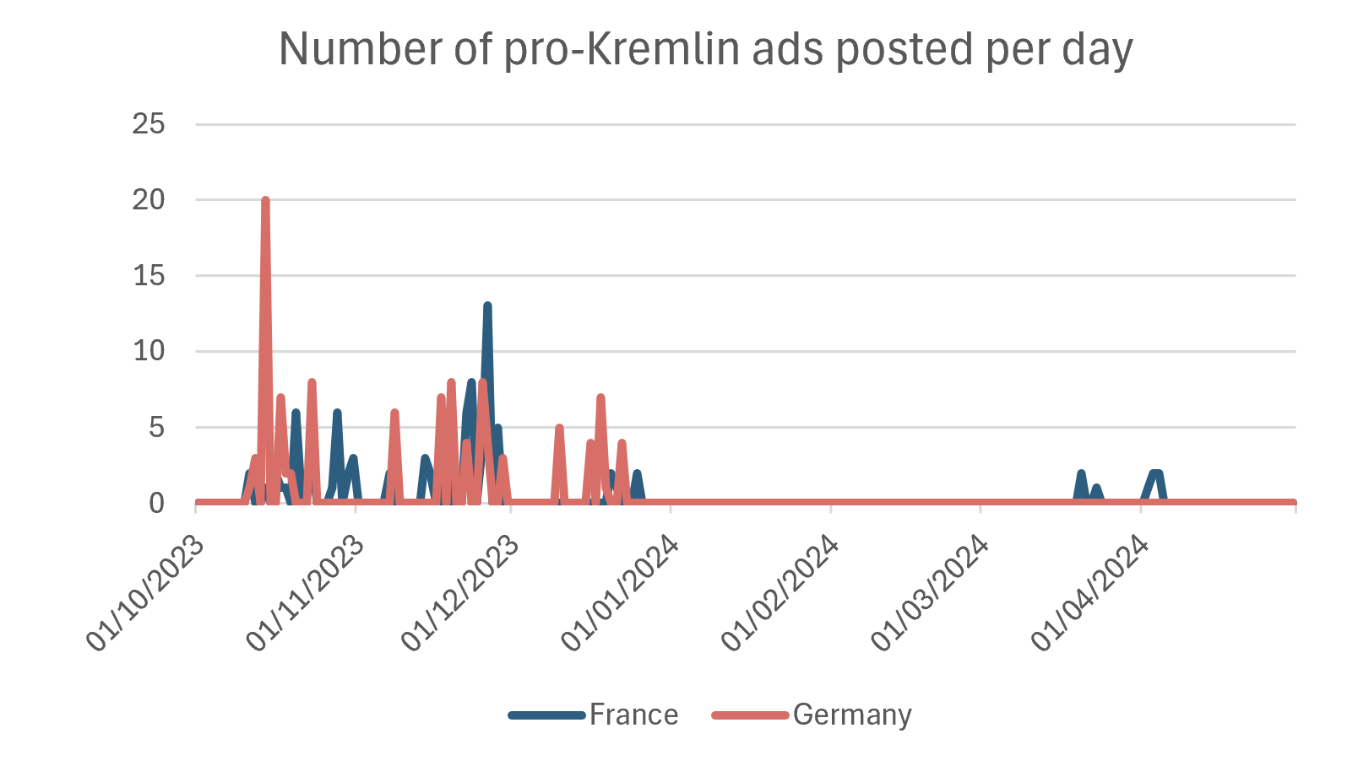
Although the style of ads was similar across France and Germany, ISD’s analysis found that the campaign employed different strategies to target users with content about the Israel-Hamas war in each country. There were differences both in terms of the volume and timing of the ads and the narratives they featured. For example, the volume of pro-Kremlin Facebook ads targeting Germany peaked shortly after the beginning of the conflict in October 2023, whereas those targeting France peaked in late November.
Narrative Analysis
Most of the 192 ads contained multiple narratives, ranging from known pro-Kremlin disinformation to anti-American propaganda. ISD qualitatively identified five broad narratives across the ads analysed (below) and coded each of the ads accordingly:
- Allegations that weapons supplied to Ukraine by the West are being used by Hamas
- Promotion of anti-American sentiment
- Polarising commentary about domestic issues in France and Germany
- Criticism of aid and military support for Ukraine
- Claims that the war in Ukraine is benefiting arms traders
Across the two countries, the narrative that weapons supplied to Ukraine by NATO countries were used by Hamas was the most prominent, featuring in 37% of the ads analysed. The second most prominent narrative found in the ads was