Digital Dispatches
December 18, 2025

ISD Germany, ISD-US
Accountability and Speech Protection, Data Access and Transparency, Tech Accountability and Safety
The trust-consensus paradox: why decentralized fact-checking faces challenges on polarizing topics
18 December 2025
By: Valeria de la Fuente, Nathan Doctor, Alexander Hohlfeld
Executive Summary
On 7 January 2025, Meta announced major changes to moderation policies, including the replacement of its third-party fact-checking program. Facebook, Instagram and Threads would instead implement a voluntary user-driven moderation, allowing users to add context to posts considered misleading or confusing across Meta platforms in the United States. This system is based on X’s Community Notes program, including the same open-source algorithm.
This move by Meta fit into a broader, ongoing shift towards community-based moderation across social media platforms. YouTube signaled early interest with a pilot of similar features in June 2024. A few months after Meta formally launched its version in April 2025, TikTok introduced FootNotes, a user-driven system supplementing—rather than replacing—its existing fact-checking efforts.
ISD’s analysis of more than a year of X’s Community Notes data reveals a critical tension at the center of this model: the same structural features that make the system transparent, credible and collaborative, also limit its effectiveness in addressing high-stakes, harmful or polarizing content. While the model’s bottom-up approach fosters trust, encourages diverse perspectives and promotes user engagement, it is often slow to respond to rapidly spreading misinformation and lacks the rigor of traditional fact-checking.
Key findings
- Community Notes (referred to here as Notes) appear to be widely trusted across the political spectrum. This seems to stem from its collaborative, bottom-up design, transparency and the inclusion of explanatory context which many users find more persuasive than top-down braded fact-checks. Even users who have previously spread misinformation or received corrections from Notes themselves often express support for the program.
- Polarization limits Notes’ effectiveness against controversial but misleading content. Reaching the consensus required for Community Notes to be effective is often difficult, particularly for politically charged content. Using an LLM classifier trained to detect political content, analysts found that about half of the Notes applied to roughly 27,000 posts focused on ‘soft news’ (stories covering culture, lifestyle or lighter topics rather than politics or current events). By comparison, factually accurate and well-sourced Notes surrounding politically charged events frequently went unpublished, leaving harmful misinformation unchallenged.
- The program continues to experience process-related delays. Our research found a median lag of more than 15 hours between the posting of misleading content and the addition of a helpful Community Note. While Notes reduce engagement on misleading content, most views and engagement occur within the first hours after a post is published.
- Community Notes struggles to keep pace during high-volume crises. In fast-moving events like natural disasters or incidents of political violence, misinformation can spread faster than Notes can be applied. Our case study on 2024 Hurricanes Helene and Milton showed that only 10 percent of sampled high-engagement false claims received a visible Note, with an average delay of 46 hours. This gap poses serious risks in moments when accurate information is most urgently needed.
- Trust in Community Notes may be inversely related to address controversial content. If Notes were applied more frequently, overall confidence in the program could decline. This paradox of consensus may prevent the system from effectively targeting controversial content while maintaining broad trust.
Methodology
This research evaluates X’s Community Notes model to assess its effectiveness and identify key limitations. Our analysis primarily draws on X’s public Community Notes dataset, which includes all data from the program. We limited our scope to data between 19 March 2024 and 19 March 2025 to capture a snapshot of the program’s performance.
Given the limited metadata available for the original posts (such as author, content or engagement), ISD merged Community Notes data with English-language posts that had visible Notes, using exports from the social media monitoring tool Brandwatch. This allowed the team to analyze the visibility, timing and engagement of Notes at scale.
This study’s methodology included the following components, explained in more detail in their respective sections:
- Semantic mapping and large language model (LLM) classifiers to identify thematic patterns and topic distributions in Notes rated as helpful,
- Network analysis to examine patterns of agreement and polarization among users in helpful/unhelpful ratings,
- Secondary research to contextualize the data and identify potential strengths and weaknesses of the model,
- Social media monitoring using Brandwatch to detect potential coordinated manipulation and to qualitatively assess user trust,
- Qualitative review of 1) Fifty helpful Notes to assess editorial rigor against X’s stated quality criteria and 2) Fifty high-engagement misleading posts during high-volume crises to evaluate response speed and coverage.
Crowdsourced, user-driven approaches like Community Notes offer a decentralized alternative to traditional fact-checking, redistributing the responsibility across a broad network of contributors. They may help to address key limitations of conventional fact-checking, such restricted scalability, limited reach and perceived political bias. However, this analysis of X’s public Community Notes dataset highlights the tensions that emerge when attempting to balance these competing goals, revealing both the strengths and limitations of crowdsourced approaches.
Broad versus narrow coverage
Community Notes excel at scale. By leveraging the ‘wisdom of crowds,’ the system can cover a vast spectrum of content, including spam or advertisements—far beyond what traditional fact-checkers can realistically address. Manual fact-checking might is often constrained by cognitive biases, including selection bias, and tends to focus on a subset of ‘public interest’ topics, such as politics or broader social and civil issues. These constraints inevitably shape which content is reviewed, whereas Community Notes can operate across the broader information ecosystem. This breadth can build trust, particularly among users skeptical of top-down interventions. However, it comes at a cost: the system struggles to prioritize high-impact or polarizing content, often leaving the most consequential falsehoods under-addressed.
To assess how effectively Community Notes address controversial ‘hard news’ (reporting focused on politics, public affairs, economics, or breaking news), ISD created a topic model using Nomic’s Atlas semantic mapping tool on a dataset of roughly 27,000 Community Notes. This tool clusters Notes based on semantic similarity, providing scores that were manually verified against sample content. Analysts found that less than half of the Notes focused on hard news: 22 percent related to Politics and Conflict, nine percent Social and Civil Issues, eight percent Health, four percent Conspiracy Theories, and three percent Disasters and Breaking Events. While some topics, such as media manipulation, included a mix of hard (e.g. political) and soft (e.g. entertainment) content, Community Notes are still roughly split between hard and soft news. Manual coding confirmed a 52 percent to 48 percent split, respectively, between hard and soft news.
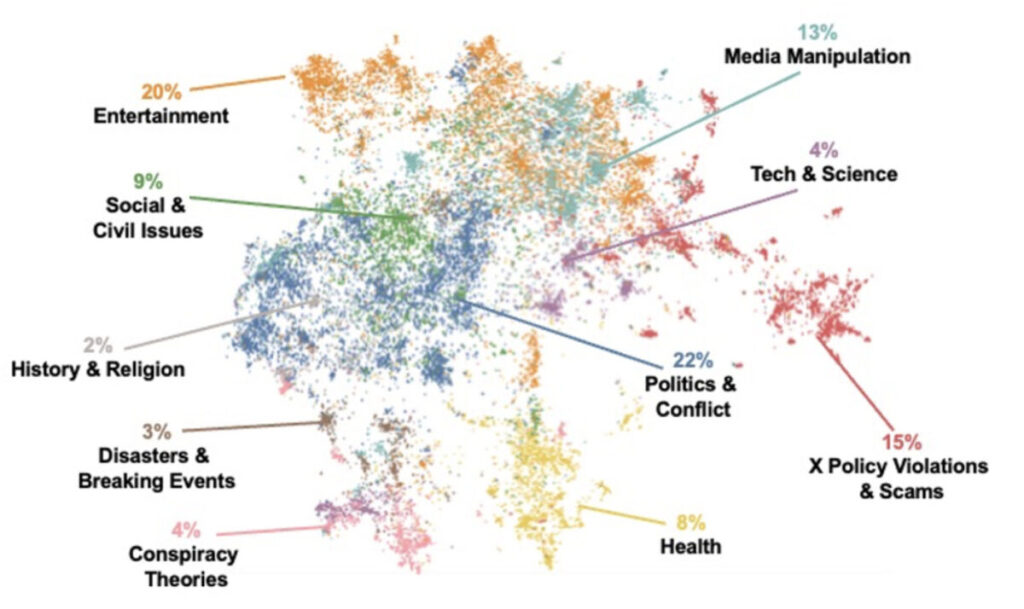
While this broader scope is not necessarily a problem, it indicates a broader challenge for Community Notes. Most Notes about conspiracy theories, for example, addressed fringe beliefs including weather manipulation, the moon landing, flat earth theory and 9/11. By contrast, higher-volume and more politically salient narratives, such as the Great Replacement conspiracy theory and election denialism, were less likely to receive a Note. Traditional fact-checkers, in contrast, tend to concentrate on these high-impact topics, reducing coverage gaps but sometimes facing accusations of selective or biased scrutiny.
Consensus-driven moderation amplifies this tension. Even when evidence is clear, contentious claims can fail to achieve the threshold for display. For example, fact checks debunking false claims of election fraud in the 2020 US presidential election have been strongly contested, even when supported by clear evidence.
This presents the fundamental paradox for any fact-checking model built on user agreement. For fact-checking to be effective, it needs to be built on trust, consensus and impartiality. Yet consensus-based approaches may struggle to address precisely the kinds of high-impact, polarizing misinformation that require most scrutiny. In practice, this means Community Notes may leave a set of the most harmful and contested claims unchallenged, while traditional fact-checkers risk being seen as imposing a top-down version of truth on divisive issues.
Difficulty building consensus: polarization and the limits of user agreement
A central challenge for the program is the difficulty in building consensus among users, as the Community Notes algorithm only surfaces a Note when contributors with diverse perspectives—determined by their contribution history—rate it as helpful. The network graph below shows Notes surrounding the 2024 US elections, illustrating that the program generated high engagement but low agreement. The overlapping crisscross of red and green edges highlights polarization, as many users rated the same Notes either positively or negatively. This lack of consensus means that very few Notes were displayed as helpful (green), with the vast majority going un-displayed (grey).
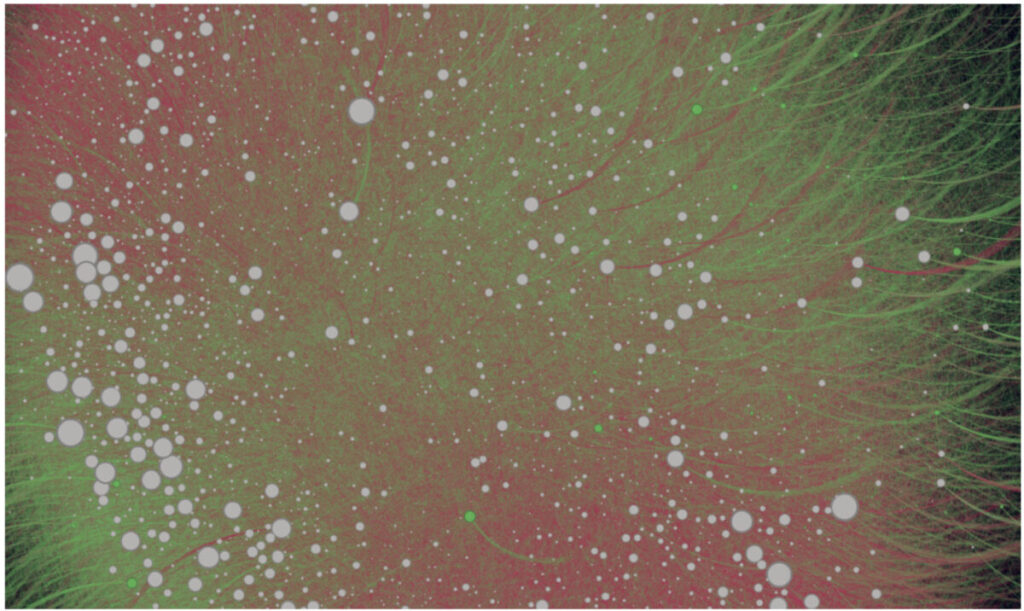
A manual review of the 25 suggested Community Notes with the most votes found that 11 were considered by ISD analysts as accurate, necessary and in line with X’s standards—yet only two were published. Examples of misleading content without Notes include selectively edited footage of President Trump taken out of context and false claims that the 2020 election was stolen. The inability to reach sufficient consensus on clearly false claims highlights further the challenge that polarized feedback poses to community-driven fact-checking.
Accuracy versus speed
Traditional fact-checking is inherently slow because of its reliance on manual labor. Crowdsourced approaches promise speed and scale, but the fundamental tension between acting quickly and acting accurately remains unresolved.
Community Notes can respond faster than traditional fact-checkers because it distributes the work across thousands of users, allowing multiple perspectives to converge on a single Note. When Community Notes are applied quickly, they can address misleading claims during the most viral phase. However, faster deployment can come at the expense of accuracy. Crowdsourced systems use safeguards such as consensus thresholds, reputation systems and eligibility requirements, to maintain quality and prevent manipulation, but these same safeguards can slow the response.
Delays reduce impact
While one study found Community Notes applied to vaccine misinformation to be accurate 97 percent of the time, another identified a median delay of 14.3 hours between a post’s publication time and the addition of a helpful Note, based on data from December 2022-2023. Echoing these findings, our research suggests that while Community Notes are generally effective at reducing the spread of misinformation, they are often too slow to intervene during the early, most viral phase.
By integrating X’s public Community Notes dataset with Brandwatch exports of posts containing active Notes (from 19 March 2024 to 19 March 2025), we found a median delay of 15.6 hours. This suggests that the time lag between submission and application of a Note may have increased since the program’s global launch on 11 December 2022.
This gap matters. Research shows that displaying Community Notes on posts reduces engagement and visibility of misleading content, and users frequently delete posts after they receive a Note. However, as most views occur shortly after a post is published, delays can significantly limit the system’s effectiveness. Both traditional fact-checking and crowdsourced approaches face a similar tension: act quickly and risk errors, or take more time to ensure accuracy but miss the opportunity to curb a falsehood during its most viral moment.
Limitations during high-volume crises
Community Notes face structural limitations during crises when information is scarce and users rush to fill the void. ISD has consistently evidenced the surge in false or misleading content during crises or major events (including natural disasters, political violence and elections), when false and harmful claims can spread faster than fact-checks or content moderation. The slow pace at which Community Notes are applied to misleading posts likewise poses serious challenges in these high-volume, high-stakes moments.
For example, after Hurricanes Helene and Milton made landfall in the fall of 2024, ISD documented an increase in the spread of false claims related to the disasters. Some of these narratives hindered relief efforts, endangered frontline workers and fueled hostility toward response agencies. While the US Federal Emergency Management Agency (FEMA) launched a dedicated “Rumor Response” page to debunk these claims, many falsehoods continued to gain traction online. These reached millions and, in some cases, posed a credible risk to public safety by undermining trust in relief agencies and encouraging people to reject their support and ignore their orders.
To assess Community Notes’ effectiveness in the wake of this crisis, ISD collected a sample of 50 high-engagement posts containing false or harmful claims about the hurricanes, which collectively had over 111M views on X. Only 10 percent of posts had a publicly displayed Community Note with a median time of 46 hours between the original posts and the Note’s publication. Of the remaining posts, half had one or more suggested Notes that did not reach enough useful ratings to be publicly displayed.
ISD found a similar pattern in the aftermath of the assassination attempt on Trump on 13 July 2024. In a sample of 50 high-engagement posts that included false claims about the shooter’s identity, which collectively garnered over 18 million views, just over 20 percent received a Community Note. Among the remainder, almost 15 percent had one or more suggested Notes that did not receive enough ‘useful’ ratings to be publicly displayed.
Scale versus rigor
Lower editorial rigor, inconsistent standards
X provides general guidelines on how to write and evaluate helpful Notes including clarity, sourcing and neutrality. However, there is no formal editorial oversight or standardized training to ensure all users adhere to the same standards. As a result, what constitutes a ‘useful’ or ‘reliable’ Note can vary significantly depending on the contributors and the context.
To evaluate the quality and consistency of Community Notes, ISD analyzed a sample of 50 that received the most ‘helpful’ ratings. Each Note was assessed using X’s own criteria for helpfulness:
- Citing high-quality sources,
- Being easy to understand,
- Directly addressing the post’s claim,
- Providing important context,
- Using neutral or unbiased language.
Analysts rated each criterion on a three-point scale: “yes,” “somewhat” or “no.”
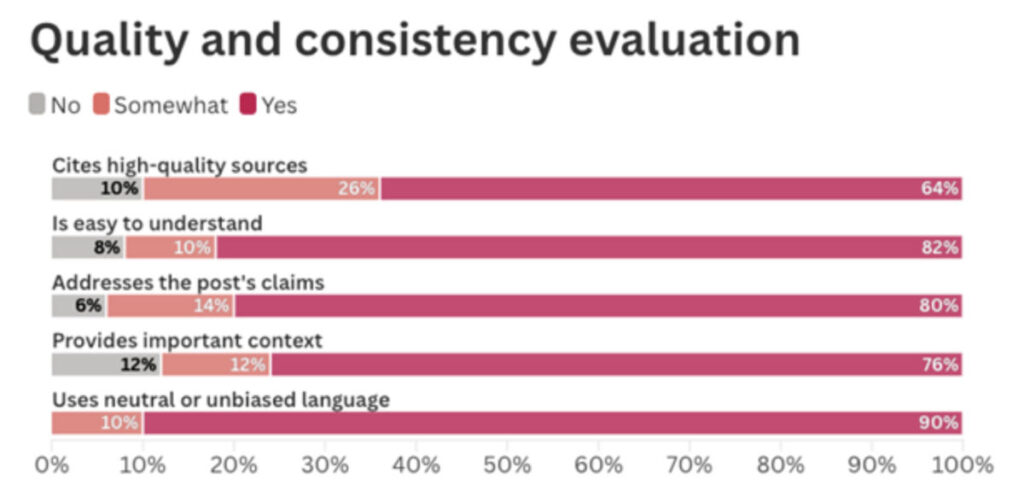
Analysts found that most Notes met X’s quality standards in terms of using neutral, unbiased language. More than three-quarters were easy to understand, addressed the post’s claims, and provided important content, and the majority (64 percent) included a broad range of reliable references.
Despite some inconsistency, crowd-sourced models can offer a level of explanatory depth that some traditional misinformation labels from top-down fact-checks lack. Based on our review, some platform-generated misinformation labels, including X’s own ‘Manipulated Media’ tags, lack explanatory detail.
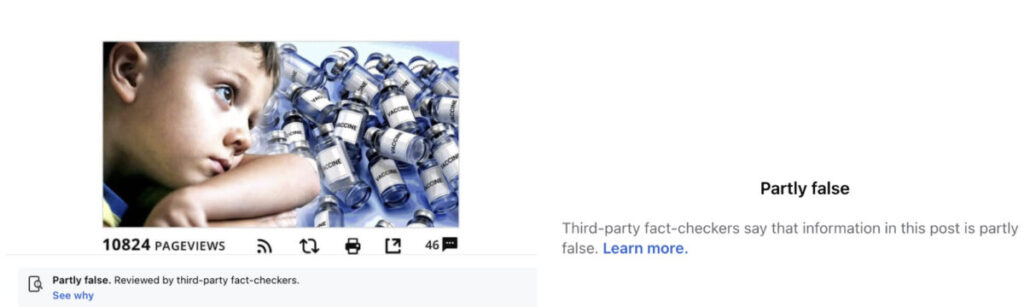
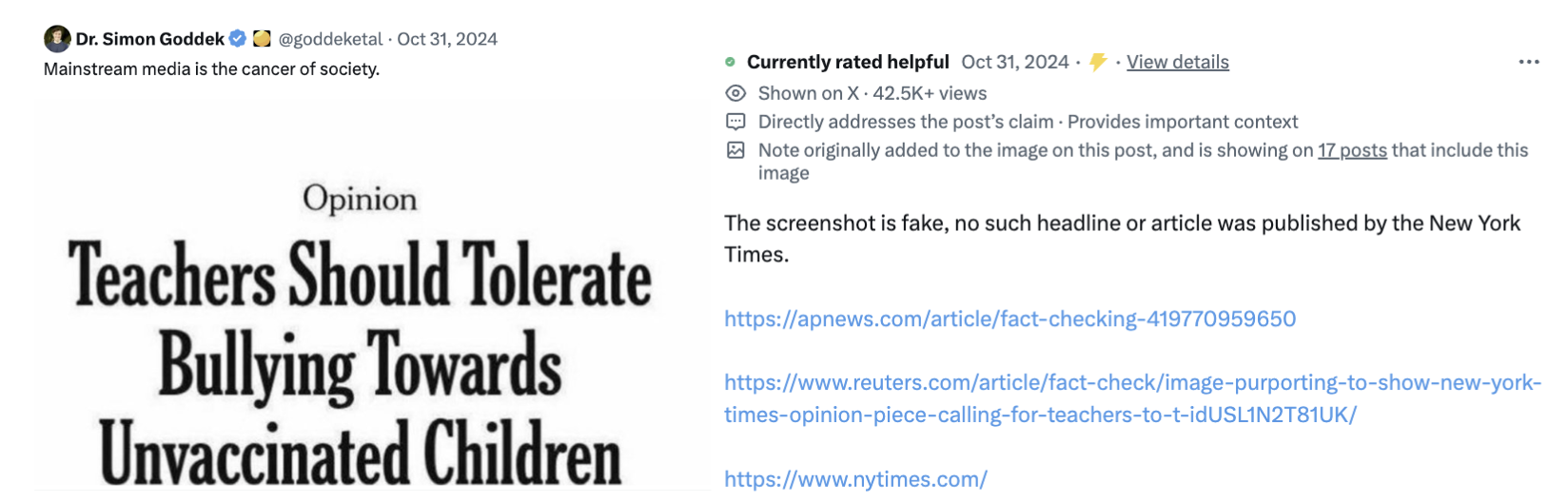
For some users, a statement that “independent fact-checkers have determined this claim to be false” is sufficient. But for others–especially those skeptical of mainstream institutions–such declarations are likely to fall short. These users are more likely to be persuaded by explanatory Notes that offer context and evidence. This comes naturally with a system like Community Notes, which relies on users to judge and reach consensus on determinations of truth.
Additional research supports this dynamic: across the political spectrum, users perceive Community Notes as significantly more trustworthy than simple misinformation flags. The presence of additional context was the key factor driving this trust.
Potential for platform manipulation
Another potential issue with Community Notes is the risk of malign actors manipulating ratings. X acknowledges the challenge of ‘Coordinated Manipulation Attempts’ and has introduced several safeguards to reduce the likelihood of successful manipulation, including eligibility criteria, bridging algorithms, reputation systems, and procedures to identify suspicious activity.
These safeguards seem to be generally effective. ISD reviewed potential foreign influence operations within the Community Notes dataset and found no strong evidence of effective manipulation. However, the dataset does include dozens of references to Kremlin-affiliated propaganda websites, including Sputnik, RT, TASS and sites in the ‘Pravda’ network, across Notes that were marked as helpful.
Aside from foreign information manipulation, decentralized networks of organic social media users could also attempt to leverage the Community Notes program to favor particular political or ideological viewpoints. However, there is limited evidence of this in the existing research, despite anecdotal claims by right-leaning users that left-leaning communities on X are attempting to bias the system.
Influencers also frequently call on their audiences to downvote helpful Notes attached to their content. In one case, an influencer with more than 100,000 followers urged their audience to downvote a Community Note on their posts claiming Hurricane Milton was a “manufactured weather event.” Within an hour of this call to action, the Note received a surge of ‘unhelpful’ ratings and was subsequently removed.
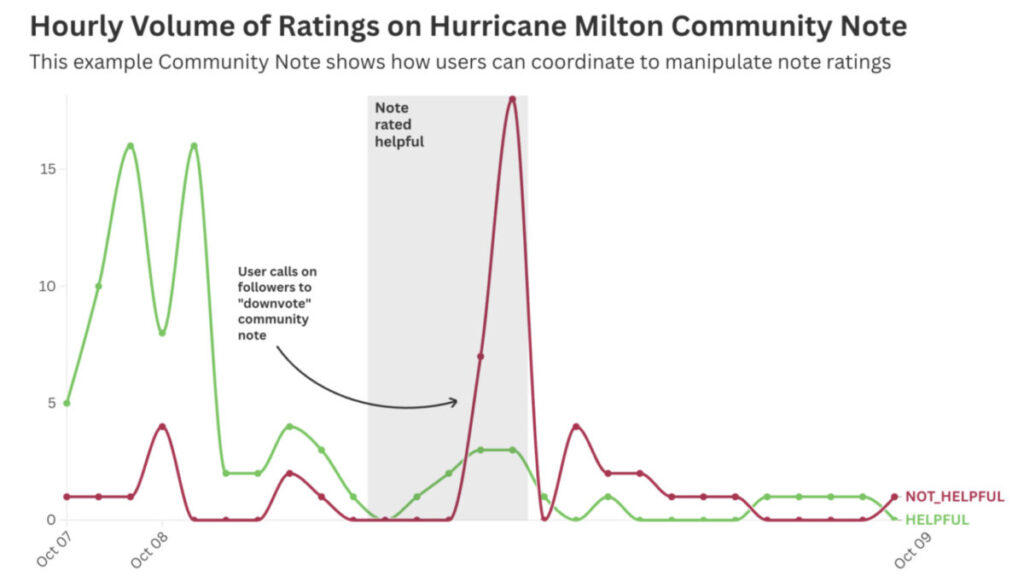
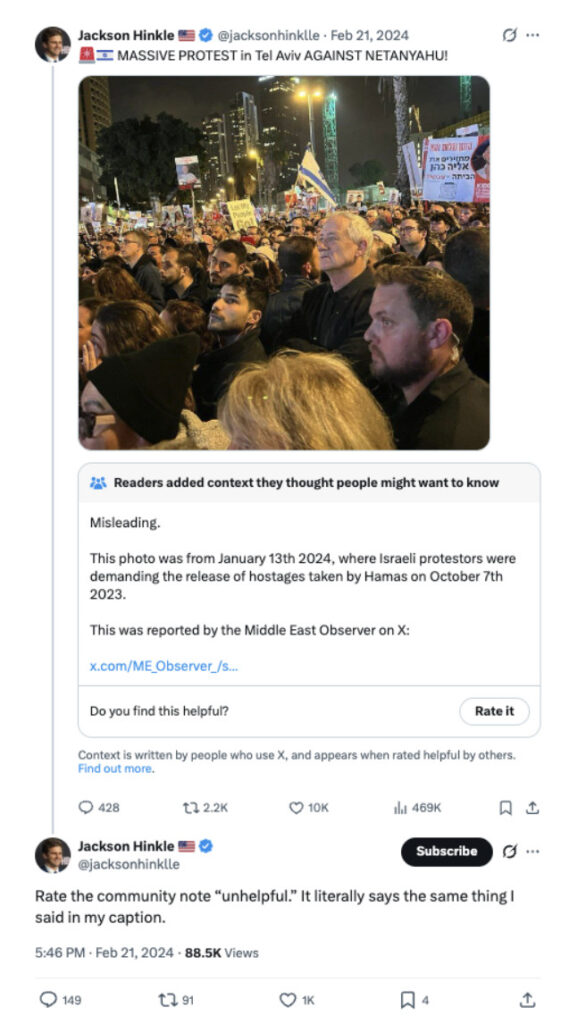
Similar behavior was found in several other posts including relating to election fraud and QAnon conspiracy theories. Jackson Hinkle, the author who has received the 12th most Community Notes based on our analysis, called on his followers to downvote these Notes 24 times over the course of 2024. Though it is difficult to point to the exact cause in each instance, half of these posts no longer have visible Notes.
Risks of overreach and misuse
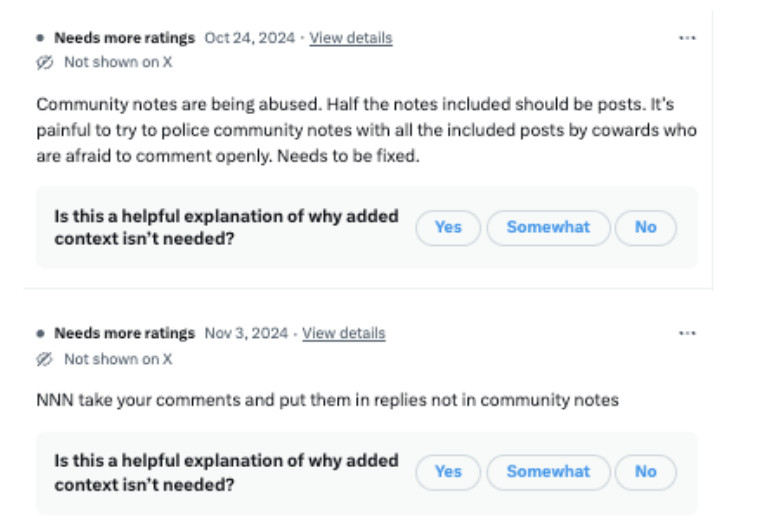
The Community Notes program was intentionally designed to be broad and flexible, empowering contributors to provide context to a wide range of topics in real time. However, this same flexibility can enable misuse: contributors sometimes use the tool for off-topic commentary or user-to-user rebuttals. Community Notes are also used to fill enforcement gaps left by formal content moderation models. These practices can clutter the system, dilute its core purpose and place unnecessary burdens on contributors.
ISD found that the model is occasionally misused by contributors who use Notes for user-to-user engagement rather than adding necessary context, which can clutter the ecosystem and burden contributors–even though X’s ranking system generally prevents such Notes from being published. Overall, the review suggests that although not every suggested Note meets the quality standards, the voting process and algorithmic ranking system are effective at surfacing those that do. Nevertheless even a small number of low-quality or misused Notes can undermine user trust in the system.
Substitute for moderation?
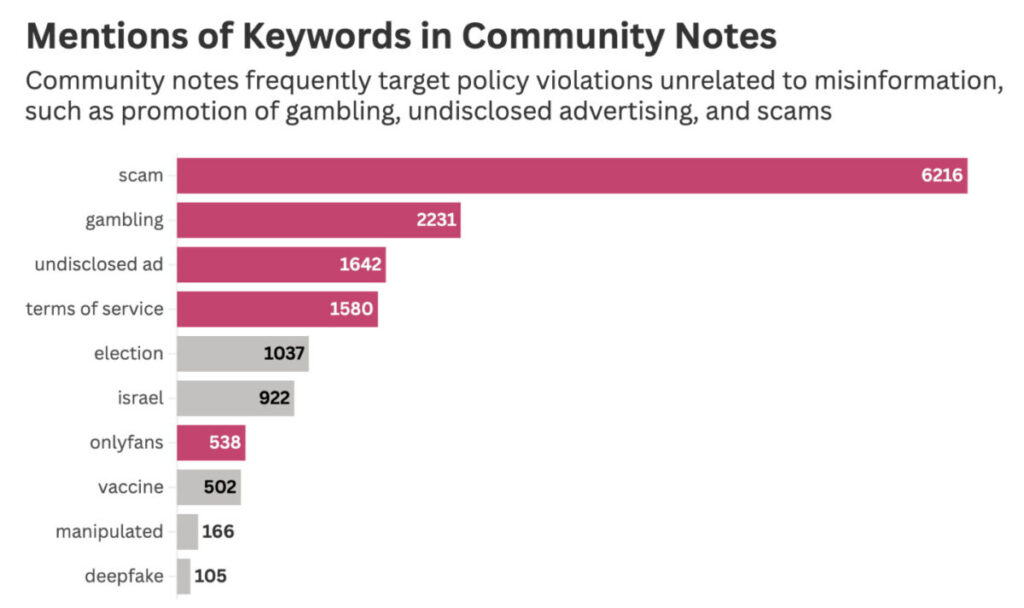
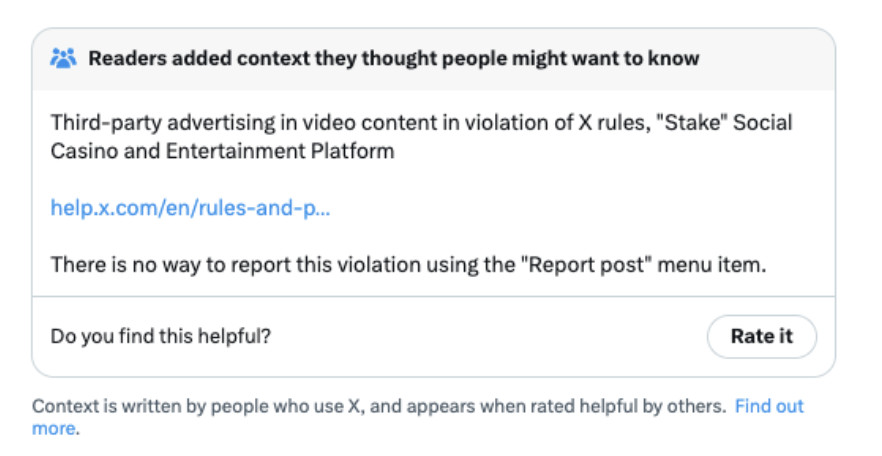
Finally, ISD identified numerous instances in which Community Notes were used as a replacement for content moderation, such as undisclosed advertisements for gambling services. Although X’s policies prohibit such content and state that violations may result in post removal or account suspensions, these posts flagged by contributors remain live.
Conclusions and recommendations
Our analysis of X’s Community Notes program underscores a key reality: misinformation defies a silver bullet solution. While crowd-sourced approaches face notable challenges, they can nevertheless play a meaningful role in addressing the spread of false or misleading content. Based on our findings, we offer four key recommendations for platforms considering or currently implementing similar initiatives.
1. Ensure a high level of contributors
The success of any crowd-sourced program depends on broad and sustained user participation. A key challenge facing X’s Community Notes program in 2025 has been the stagnation of active contributors. As of November 2025, X reported roughly 1.3M contributors worldwide. However, over the past two years, program usage has remained relatively flat. This includes both the volume of user ratings (Figure 11) and the number of unique active contributors (Figure 12).
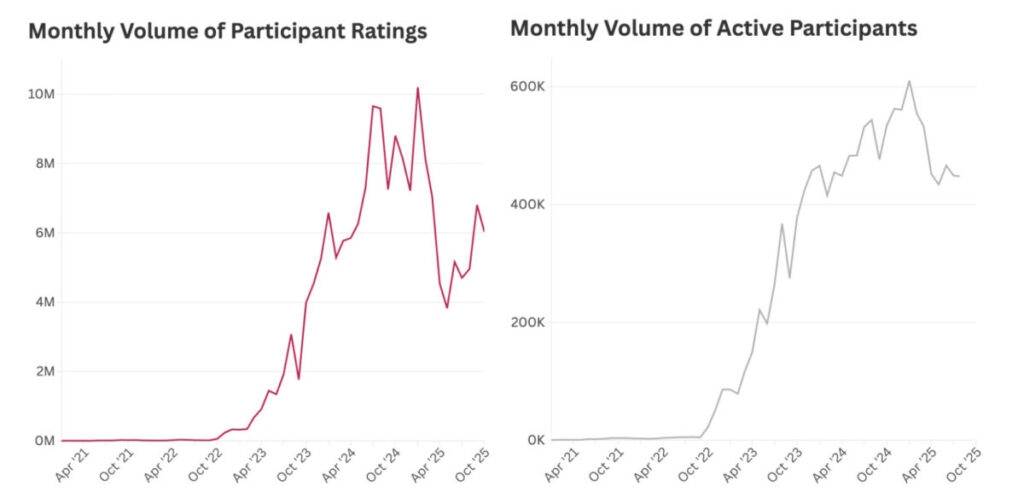
This stagnation likely reflects insufficient incentives for ongoing participation. Many Notes receive few or no ratings, and contributors rarely see tangible impact from their efforts. While such friction is inherent to the program’s design–which prioritizes consensus over speed–platforms should work to maximize user engagement and satisfaction.
This should be through a focus on the user experience, such as providing features like achievement systems that reward consistent, high-quality contributions. Such gamification may include user statistics–such as total Notes written, helpfulness ratings, and community impact metrics–while tiered contributor levels can provide tangible benefits and a sense of recognition as users advance.
Comparing contributors across platforms is difficult due to geographic limitations. Both Meta’s Community Notes and TikTok’s FootNotes are currently only available in the United States, whereas X’s program is global. In September 2025, Meta’s Chief Information Security Officer claimed that their program had more than 70,000 active contributors who had written more than 15,000 Notes, of which six percent were published. Other sources suggest that Meta admitted more than 250,000 users to the program. TikTok reported that 80,000 users qualified to their FootNotes program at its launch in July. While X provides public datasets on Community Notes contributors, both Meta and TikTok lack this transparency, making it impossible to verify or research contributor activity.
2. Ensure platform transparency & data accessibility
This analysis was only possible due to the transparent nature of Community Notes and the transparency efforts behind it. X has open-sourced its Community Notes algorithm and provides free access to Notes, ratings and user enrollment data, alongside a comprehensive data guide. This level of openness enables independent scrutiny, fosters trust and empowers external researchers to identify and help resolve issues. Updates to the algorithm are regularly shared with the public. For example, the public criticism that Community Notes would appear too slow, as also shown by our analysis, led to X recently announcing a new Note scoring aggregation as a pilot in November 2025. How this algorithm change will affect the challenges highlighted by our report will be subject to subsequent analysis.
Such openness remains rare across the industry, yet it is essential for building credibility in crowdsourced moderation systems. By contrast, Meta and TikTok have not published the algorithms behind their respective programs, nor do they provide public access to contributor ratings or Note data. This lack of transparency not only makes it difficult for researchers and civil society to evaluate the effectiveness or fairness of the systems but can also negatively affect public trust—which, as we pointed out, might be one of the strongest aspects of X’s Community Notes program.
3. Encourage integrative approaches
As our research has shown, Community Notes are not a silver bullet solution to challenges around mis- and disinformation and should not be seen as such.
The inherent trade-offs in different fact-checking models highlight the need for integrative frameworks. While Community Notes provide scalability and can foster broader public trust, they often still rely on institutional fact-checking. Research supports this: a recent study by the Spanish fact-checking organization Maldita found that fact-checking organizations were the third most cited reference in Community Notes, and Notes including a link to a fact-checking organization appeared, on average, 90 minutes earlier than other Notes.
Crowdsourced approaches, such as Community Notes can contribute to increasing the scale and reach of important context while maintaining broader trust. New features like media or link matching, allowing Notes to be automatically associated with posts containing the same images, videos or URLs, further enhance this scalability.
These findings suggest that different approaches can complement each other. Rather than choosing between professional and community-based moderation, platforms should experiment with hybrid models that integrate both. Such models could combine the rigor and expertise of institutional fact-checking with the reach and responsiveness of community driven systems, while maintaining broader trust.
4. Focus on user empowerment
A key reason why Community Notes enjoy high levels of trust lies in their label design. Rather than asserting a top-down version of truth, they frame contributions as “Readers added context they thought people might want to know.” This phrasing respects users as autonomous and capable citizens, empowering them to make their own judgements rather than passively accepting authoritative claims. The crowdsourced nature of the system further reinforces a sense of civic recognition and participation. A key lesson from Community Notes for platforms thus lies in the importance of centering user empowerment in platform design.
Appendix: political content and response speed
To test whether Community Notes appear more slowly on political content than on non-political content, we trained an LLM classifier to label posts as either ‘political speech’ or not. We defined political speech–drawing from Law Insider and a variety of state legislatures–as “expression related to the state, government, body politic, public administration, or governmental policymaking. This includes speech by government officials or candidates for office and any discussion of social issues. It encompasses commentary on matters of public concern, including criticism of government officials, political parties, and policies.”
The classifier found no evidence of slower response times for political posts. In fact, Community Notes appeared more quickly on political content: the median time to a note was 13.2 hours for political posts, compared to 16.8 hours for non-political posts–a difference of 3.6 hours. This suggests that the challenge for Community Notes in addressing hard news is not speed, but whether controversial yet important content receives a Note at all.
The classifier achieved an F1 score of 0.90 based on manually coded posts. It primarily struggled with posts lacking sufficient context–often short posts with images or video, as well as content from politicians, which were not analyzed via the LLM which only ingested textual content. Overall, it identified 41 percent of the dataset as political or social in nature.