Digital Dispatches
August 20, 2026
ISD-US
Antisemitism, Identity-Based Hate and Abuse, Misogyny, Targeted Threats, Hate and Abuse, Tech Accountability and Safety
Lexical laundering: The mainstreaming of antisemitic neologisms from 4chan and forums
Content warning: This piece analyzes antisemitic, homophobic and other hateful terminology. It quotes slurs and extremist vocabulary directly for the purpose of documenting and countering their spread.
Summary
This piece introduces ‘lexical laundering,’ which is the pipeline through which fringe vocabulary migrates from explicitly extremist spaces into mainstream discourse while keeping its original in-group meaning intact, growing more deniable to outsiders if and when it travels.
We use the spread of antisemitic slurs from 4chan as our case study, though the pipeline itself is general: it can move radical fringe in-group vocabulary of any kind. Drawing on a large multiplatform dataset, we follow this process through four mini case studies (two antisemitic and two neutral carriers), demonstrating the stages of breakout. The problem this reveals is not a list of bad words to be banned, but a process that continually produces new ones—many of which appear harmless at first glance—faster than blocklists can catch them.
Key findings:
- In lexical laundering, fringe vocabulary enters the mainstream while keeping its original, extreme meaning for an in-group, thus becoming more deniable to everyone else as it travels. We use online antisemitism as our case study, but nothing about the mechanism is specific to it—two of our four examples carry no inherent antisemitism whatsoever.
- It works, in part, because the words are Trojan horses. Slang does not receive the same scrutiny as an argument, so an obscure shell (for example, goy, the Hebrew and Yiddish word for a non-Jew) can seem like harmless internet slang. Thus, it gets waved through, ideology and all.
- Different terms launder at different speeds. Some, like the -fag suffix, are too overt to travel. Others, more deniable, become thoroughly mainstream—like the now common “-maxxing” template that can be rehydrated with extremism, such as “jewmaxxing.”
- Lexical laundering challenges moderation efforts as these terms often appear innocuous to outsiders and are used by them, so blocklists and even AI systems miss them. The fix isn’t policing a word list; it’s watching how vocabulary travels from fringe to mainstream and teaching audiences to spot the pattern.
- In our dataset, 4chan is by far the largest single source: at least a quarter of all antisemitic posts (plausibly a majority when accounting for sampling limits) and roughly half of all user-to-user abuse. Some of that vocabulary, as we demonstrate, spreads from there onto higher-reach platforms.
Methodology
This Dispatch draws on a larger ISD dataset of roughly 305,000 posts, collected between September 2025 and March 2026 from more than 15 platforms and forums—including 4chan, X, YouTube, Reddit, Telegram, Tumblr and Bluesky—to study online antisemitism. We used roughly 1,000 keywords to identify candidate posts, then classified them with a bespoke, IHRA-grounded language model.[i] The content captured ranged from conspiracy and Holocaust denial to eliminationist rhetoric, anti-Zionist antisemitism and casual interpersonal abuse.
About a quarter of all posts came from 4chan, though this likely understates its influence, since export limits required its content to be downsampled to 20 percent of what was collected. We estimate that its actual share is likely closer to 60 percent, but its character matters as much as its volume. Content on 4chan includes some of the most extreme forms of antisemitism, namely eliminationist rhetoric, conspiracy theories, and explicit calls for violence. Yet the most prevalent form of antisemitism was casual interpersonal slur usage. Users accuse one another of being Jewish using severe terms like “kike” and its variants, alongside milder slurs such as “schlomo.” Of the 47,119 posts we classified as user-to-user antisemitic hate speech, roughly 51 percent came from 4chan; corrected for downsampling, that figure is closer to 84 percent.
The Laundry Cycle
Not every term completes the journey out of the nursery. New vocabulary is coined in places like 4chan’s “Politically Incorrect” (/pol/) board, though most terms die on the vine. What catches on, however, is rarely the argument itself, but rather a casual linguistic register that normalizes prejudice and facilitates its spread. The carriers are users fluent in both worlds—for example, regulars on 4chan’s /pol/ board are also active on X. On higher-reach platforms, less-radicalized users pick the terms up second-hand, without their original context, until enough repetition normalizes them. This is ordinary sociolinguistic diffusion—as subcultural slang goes mainstream, its origins and context fall away—with one key difference: the cargo is a compressed conspiracy, not a harmless idiom. The endpoint is antisemitic vocabulary becoming part of a platform’s everyday speech rather than a flagged intrusion.
The case studies below are ordered by stages reflecting how far each has or hasn’t traveled—from still-contained to fully broken out—and together they sketch the pipeline’s full arc. A term may stall and fade into obscurity anywhere along this process.
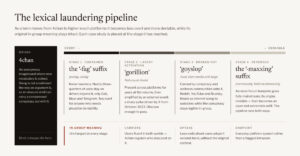
Stage 1: the ‘-fag’ suffix
Since the earliest days of the site, 4chan slang has used the homophobic term “fag” as a suffix, producing antisemitic compound slurs like “jewfag” and “ziofag.” Unlike the later-stage terms, “-fag” has never laundered, always reading as a raw slur. These antisemitic variants stayed overwhelmingly on 4chan in our dataset, with nearly three-quarters of all uses on the platform. Beyond 4chan, only Gab, 8kun (an imageboard site akin to 4chan) and Telegram showed uptake, collectively accounting for just over 1,000 uses.
It appears that the slur’s overtness limits its spread. No possible interpretation of jewfag reads as harmless internet-speak, so it can’t be picked up by users who need plausible deniability. This is what the pipeline looks like before breakout.
Stage 2: ‘Gorillion’
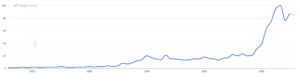
‘Gorillion’ is a Holocaust-denial neologism that mocks the six million Jews murdered by Nazis, substituting an absurd, invented figure (“six gorillion”) to frame the death toll as fabricated. Rather than a single dramatic breakout, our data shows years of steady, flat forum presence followed by a sharp volume spike, driven primarily by X, that began in October 2023 as the war in Gaza unfolded. Notably, 4chan usage during this period was largely flat.
This stage is latent activation: a term already present across platforms is waiting for an external event, influencer adoption, or algorithmic lift to amplify it. Gorillion’s antisemitic meaning is recognizable only to those familiar with the reference—especially when used without the “six” prefix. It’s this obscurity to outsiders that provides the deniability more explicit slurs lack.
Figure 2: Monthly volume of ‘gorillion’ mentions by platform. Forum use stays broadly flat across the period, while X (purple) accounts for almost all growth from late 2023 onward.
Stage 3: ‘Goyslop’
“Goyslop” shows the complete arc of lexical laundering: a term acquires a fully deniable, mainstream register without shedding its explicit one. Goyslop began in the depths of 4chan from a conspiracy theory that Jewish elites are deliberately proliferating unhealthy processed foods (‘slop’) to weaken the general population. “Goy” (plural “goyim”) is simply the Hebrew and Yiddish word for a non-Jew—commonly understood within Jewish communities but largely unknown outside them—which allows goyslop to read to outsiders as mere internet-speak. As described above, the term’s scope widened within antisemitic communities before migrating into the overlapping conspiracy and wellness communities where it now circulates as a pejorative.
Goyslop is notably popular within the Make America Healthy Again (MAHA) movement. MAHA’s framing of processed food, seed oils and pharmaceuticals as elite instruments of harm mirrors the underlying structure of the conspiracy, likely easing the term’s passage into MAHA’s lexicon. This pattern is evident in our data: years of forum-dominated use, followed by a sharp multiplatform surge with X, Reddit, YouTube and Bluesky all contributing significant volume. Here, that vector is health-and-wellness creators who fold goyslop into ordinary nutrition content, reaching audiences that would never seek out /pol/. One such creator used the term across 37 videos in six months, including a post tagged #health, #goyslop and #noticer that drew 205,000 engagements.
Contact with these communities shifts the term along two axes: what it means, and what it points at. Ideologically, its meaning diverges across users. Those with conspiratorial worldviews continue to use it to frame the food system as being under Jewish control, often making the claim explicit for newcomers (“food the [Jews] feed us to keep us unhealthy … while they eat natural and healthy”), while more mainstream adopters flatten it into a generic sneer at processed food, with little awareness of the antisemitic ideas it invokes.
Referentially, it has slipped its dietary moorings: on X, it now attaches to media and entertainment writ large—reality TV, streaming, cable news, gambling apps, anything cast as pacifying, mass-produced content. This extends naturally from the core antisemitic tropes of ‘Jewish media control’ and cultural ‘degeneracy.’ Its application to entertainment, rather than food alone, reflects not a loosening of the underlying conspiracy but its extension into a new domain. One “Goyslop Tierlist” captures this, ranking OnlyFans, energy drinks, fast food, Fox News, Spotify Wrapped and Twitch, with food now merely one category among many. A user on X posted a Pepe the Frog avatar (itself a 4chan meme) bemoaning the tierlist, claiming that goyslop has become so viral with “turbonormies” that it’s lost its original meaning.
Deniability also creates a rhetorical shield. Florida gubernatorial candidate James Fishback used goyslop at a campaign event to describe school cafeteria food, drawing applause. Pressed on his usage, Fishback claimed ignorance, then said he used it “because it was funny.” He has denied being antisemitic, though reports suggest he’s associated with the Groyper movement.
Figure 3: Monthly volume of “goyslop” mentions by platform. Use is confined almost entirely to forums through 2023, before a sharp multiplatform surge from late 2025 in which X becomes the dominant source with minor contributions elsewhere.
Stage 4: the ‘-maxxing’ suffix
We demonstrate the furthest point in the pipeline not through a laundered word, but through a grammar and vocabulary that are misogynistic rather than antisemitic. ‘Maxxing,’ which has come to be synonymous with optimization or maximization, originated in incel forums. “Looksmaxxing” was coined in spaces filled with bodily self-hatred, surgical extremes and blackpill fatalism—the belief that physical appearance irreversibly determines romantic and social success. That origin became increasingly obscure as the template went mainstream, carried by influencers like Clavicular into a generic, sanitized “self-improvement” idiom, with its incel roots largely invisible to the TikTok audiences now using it.
Once neutral and everyday, the template became a slot extremists could readily fill, producing terms like ‘jewmaxxing’ (the claim that Western media has a Jewish bias) and ‘Holocaustmaxxing.’ Where goyslop laundered a slur into deniability, ‘-maxxing’ now lets the pipeline run both ways; a neutral, fully mainstream form is being pulled back into extremist use. This proximity is hardly incidental; Clavicular, whose following helped carry ‘-maxxing’ mainstream, was filmed in January 2026 partying alongside white nationalist Nick Fuentes and Andrew Tate, singing along to Kanye West’s “Heil Hitler.” The redpill and antisemitic-right movements regularly overlap, which likely creates the conditions for terminology like this to circulate between fringe and mainstream audiences.
Conclusion
Listing and blocking individual slurs is not sufficient. The laundering pipeline is a generative system, continuously minting new vocabulary. What makes it out of the first stages is terms with a passable, innocent-enough surface, while overt terms like the ‘-fag’ suffix stall. Term-level blocklists cannot keep pace; by the time “goyslop” is flagged, the next coinage is already moving through the pipeline.
The newer generation of embedding-based moderation also fails to close the gap. These systems flag content by its meaning rather than exact words—but a successfully laundered term is built to sit, in meaning, right next to normal food, wellness and entertainment talk. The disguise that fools a human reader fools the model for the same reason.
For platforms, researchers and policymakers, the implications are in detection and resilience:
- Detection counter-efforts must target the mechanism, not the word list. This could include monitoring the forum-to-mainstream migration pattern itself, tracking the multiplatform carrier accounts that move vocabulary across boundaries, and treating sudden mainstream spikes of long-dormant forum vocabulary as an early-warning signal rather than a curiosity.
- Resilience requires strengthening audiences’ capacity to recognize the pattern itself. Because laundering works by making its cargo read as innocuous, fact-checking individual coinages is insufficient. Instead, it is vital that a term’s innocent surface is not taken as proof of an innocent history.
The next goyslop has likely already been coined. The open question is whether anyone is tracking its migration before it arrives.
[i] A note on the data. These findings draw on a larger ISD study of the US online antisemitism landscape. Using roughly 1,000 keywords developed over years of ISD research—spanning slurs, coded dog whistles and ideologically specific phrases across the political spectrum—we collected candidate posts from more than 15 platforms and forums (including 4chan, X, YouTube, Reddit, Telegram, Tumblr and Bluesky, as well as a range of other forums and blogs) between September 2025 and March 2026. Because keyword matches alone are only 30–50 percent relevant, every post was then classified by a bespoke large language model grounded in the International Holocaust Remembrance Alliance (IHRA) working definition of antisemitism and validated against hand-coded samples (F1 = 0.87). The resulting analysis set comprises roughly 305,000 posts classified as antisemitic.
Two caveats bear on the platform comparisons. First, data access varies enormously across platforms—some expose nearly all matching content, others only a restricted slice—so volumes should be read as broad proportion and direction, not a precise ranking. Second, several high-volume sources, 4chan among them, were downsampled to 20 percent to stay within export limits; 4chan’s true share is therefore substantially higher than its raw counts suggest.
ISD Contributors