Digital Dispatches
June 12, 2024
ISD Surveys: What do Germans think about Ukraine and Defence Policy?
12 June 2024
This Dispatch analysis the findings of two ISD surveys which explored Germans views on the war against Ukraine, (European) defence, and threat perceptions of Russia. The results of the surveys can be found here.
In March [1] and April[2] 2024, ISD conducted two surveys[3] which explored Germans views on the war against Ukraine, (European) defence, and threat perceptions of Russia. ISD also tested whether different message prompts containing information and arguments impacted the responses of the Germans who were surveyed. The findings of these surveys were then shared with relevant stakeholders as part of ISD’s charitable objective of advancement of education of the public in relation to extremism, hate and disinformation.
Segmenting Germans by their level of support for Ukraine
ISD drew on a segmentation analysis[4] based on a previous survey conducted in August 2023 which divided the German population based on how supportive they are towards Ukraine[5] (see image below).
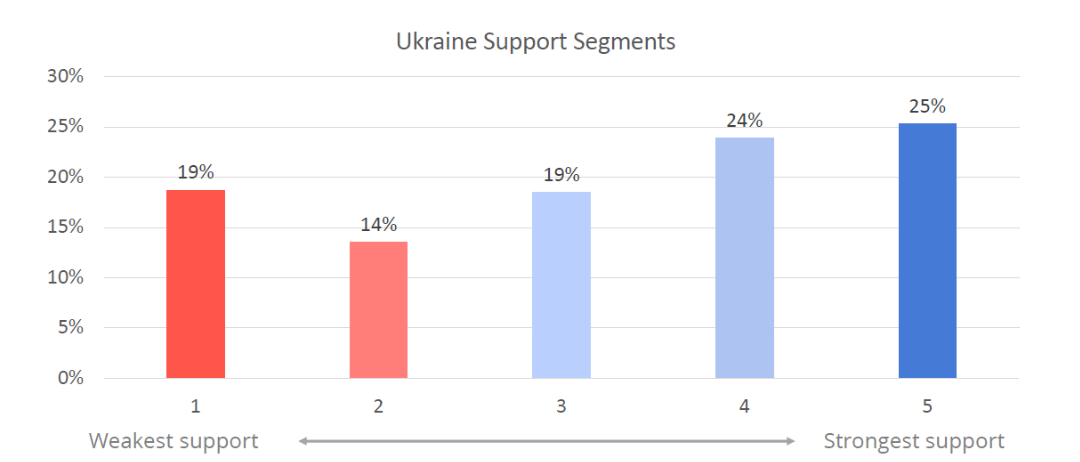
- Segment 1 – Germany First Nationalists: Segment 1 is unsupportive of Ukraine and holds a considerably more dogmatic/authoritarian worldview than all other segments. This group contains many of those sceptical of established media reporting and is over-represented in Saxony and Thuringia but under-represented in Bremen and Hamburg.
- Segment 2 – Open-minded but unsupportive: Like Segment 1, this group is unsupportive of Ukraine but holds significantly less dogmatic/authoritarian worldviews than other segments. This is the only segment found to be predominately female and had the highest rate of non-voting in 2021.
- Segment 3 – Middle-of-the-roaders: This segment is younger on average than other segment and contains many people sceptical of established media outlets. Their views on Ukraine are neither overly supportive nor critical.
- Segment 4 – Self-interested supporters of Ukraine: This group exhibits fairly strong support for government measures to support Ukraine, but not if it hurts them financially. They are demographically very similar to the general population but are more likely to have voted for SPD and less likely to have voted AfD in 2021 than the general population.
- Segment 5 – Highly educated liberal supporters of Ukraine: Nearly half of this segment voted for either the SPD or Greens in 2021. They were much less likely to have voted for AfD and had the lowest rate of non-voting in 2021.
Current Picture – Key Insights[6]
Insight 1: A majority of Germans view the actions of the Russian government as a threat to German interests. 66% strongly or partially agree that the Russian regime is a threat to Germany’s economic interests and security (below on the left) and 54% strongly or partially agree it is in Germany’s own national interest to support Ukraine (below on the right).
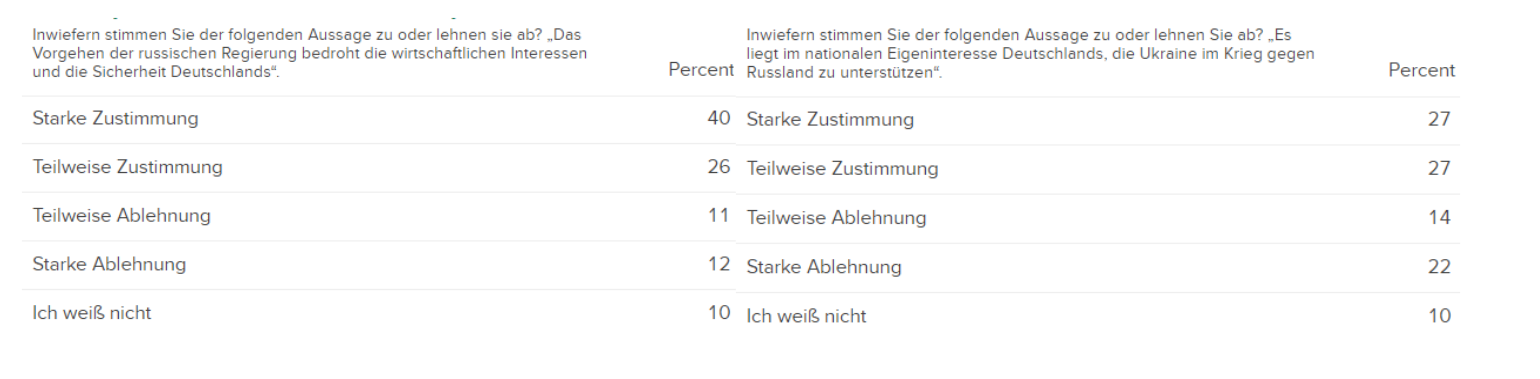
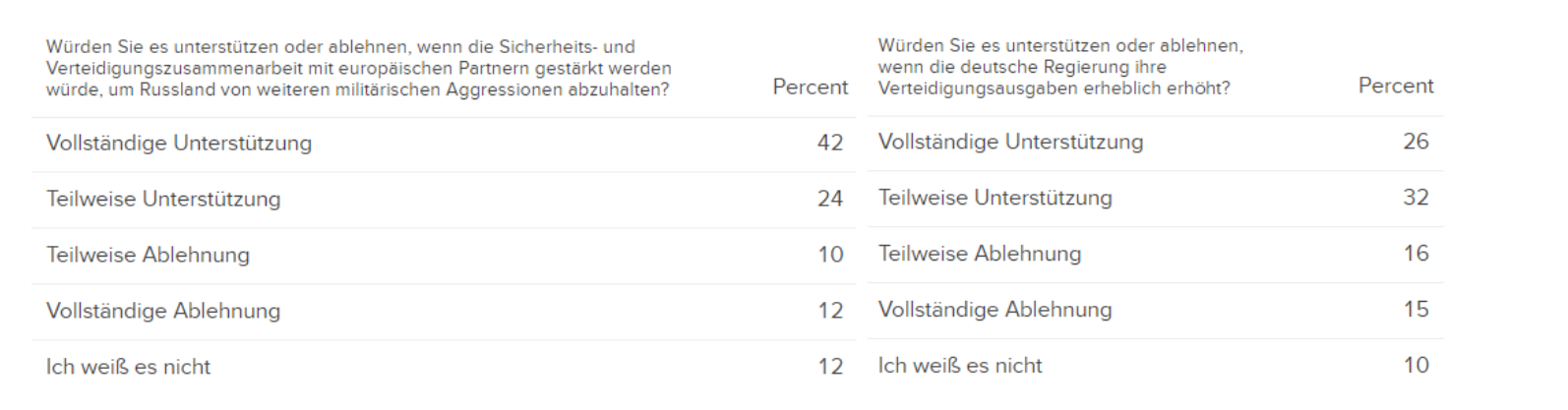
Insight 2: A majority of Germans support increased military spending as well as greater European security efforts. 66% strongly support or tend to support strengthening security and defence cooperation with European partners in order to deter Russia from further military action (below on the left), while 58% strongly support or tend to support increasing German defence expenditure (below on the right).
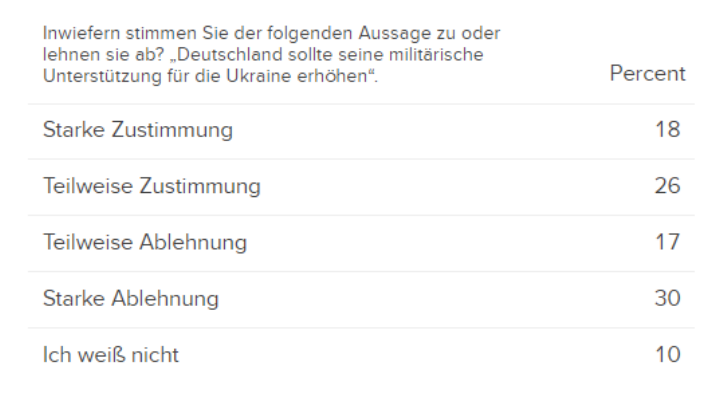
Insight 3: There is no majority for increasing German military support for Ukraine or delivering Taurus. Despite the perception that the Russian regime is a threat to German interests, only 44% of Germans strongly or partially agree that Germany should increase its military support for Ukraine (compared to 47% who strongly or partially disagree, see below). Similarly, only 36% of Germans are strongly or partially supportive of delivering Taurus missiles. Surprisingly, 45% of Germans believe Ukraine should be able to use Western weapons to hit targets inside of Russia (one of the major concerns relating to Taurus deliveries).
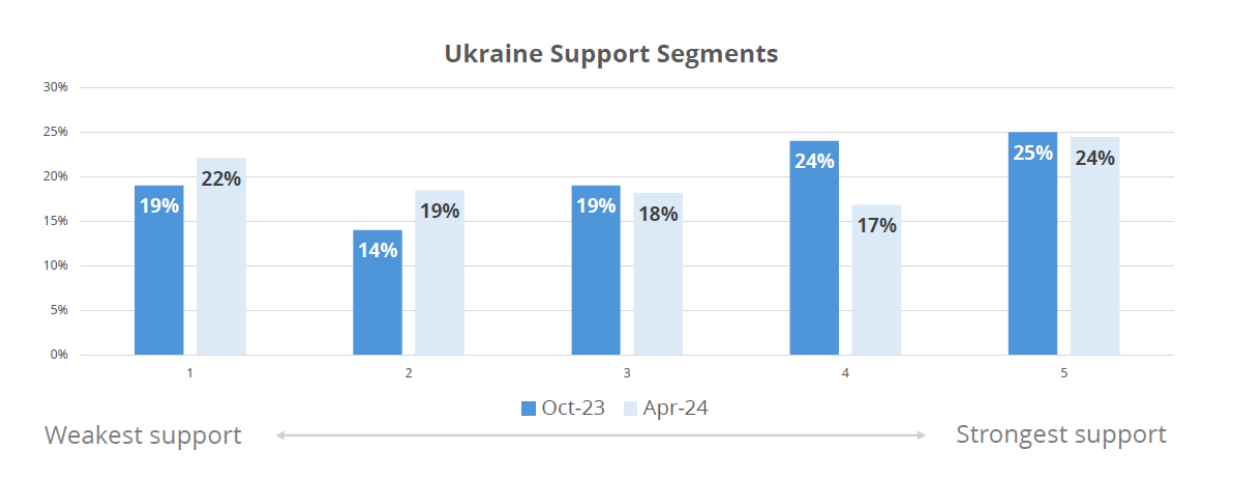
Insight 4: Support for Ukraine among Germans is slowly decreasing. Our surveys draw on a segmentation analysis through which we divided the German population based on how supportive they are of military, economic and humanitarian aid towards Ukraine (outlined above). There have been small changes in the relative size of a couple segments since the original poll which was conducted in October 2023. Segment 4 is smaller, while Segments 2 and 1 are slightly larger.
Insight 5: Germans are split around inviting Ukraine to join NATO. Slightly more Germans are strongly or partially supportive of inviting Ukraine to join NATO at the defence alliance’s July summit in Washington D.C. (43%) than those who are strongly or partially opposed to it (40%).
Message-testing
ISD also tested whether message prompts containing a range of information and arguments impact German’s responses to questions about the war against Ukraine, (European) defence and threat perception of Russia. We devised statements of support for specific positions relating to this survey which are written in the form of a message delivered by a person arguing a particular viewpoint; these are known as ‘treatments’[7]. Through this survey experiment, ISD attempted to test if and through which messages and pieces of information respondents views on Ukraine could be affected. We found that different messages/ treatments increase support for Ukraine or hawkish policies vis-a-vis Russia across each segment. This even applied to those segments less supportive of Ukraine.
Messages that increased German support for Ukraine and hawkish policies vis-a-vis Russia:
Message 1: Military build-up is needed in an insecure world. Germany First Nationalists (segment 1) are unlikely to fundamentally change their mind and support Ukraine. However, our message-testing showed that they became more supportive of increasing German military spending if they were presented with the idea that strengthening military deterrence in a complex and insecure world is not only important from a national security perspective but would also bring economic benefits.
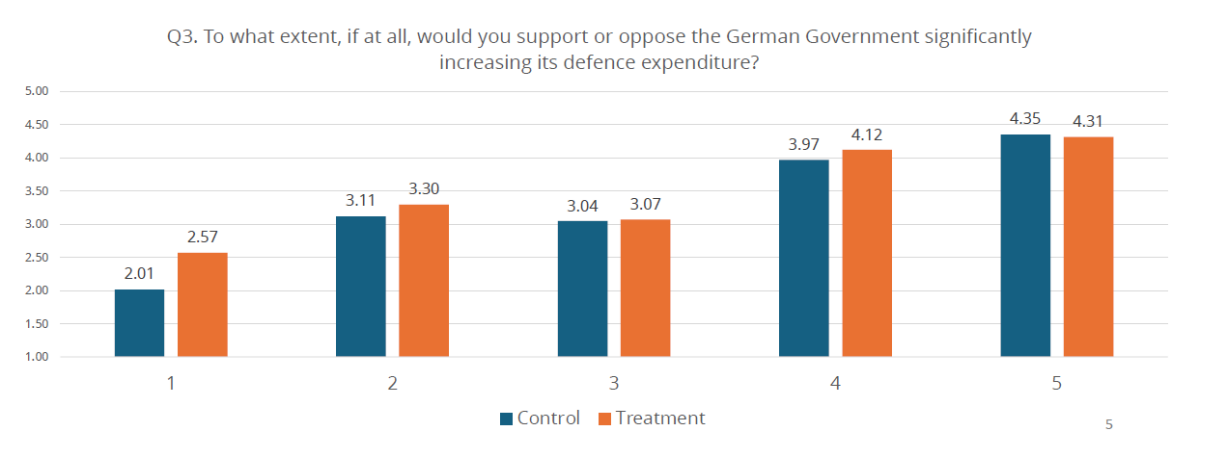
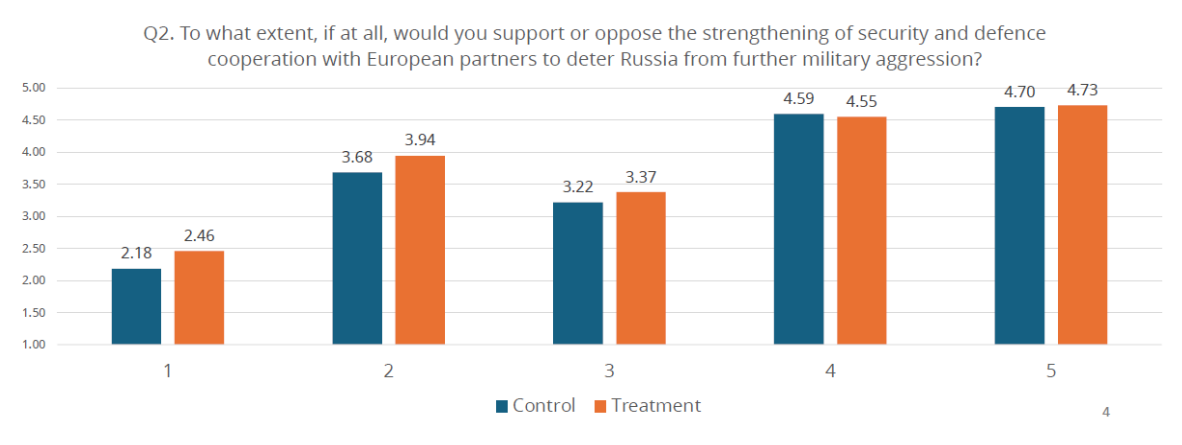
Similarly, Germany First Nationalists (as well as the open-minded but unsupportive Segment 2) were receptive to messages that emphasised the need to build up common European capabilities to deter Russia to account for a scenario in which President Trump were to be elected again and the US would no longer guarantee European security.
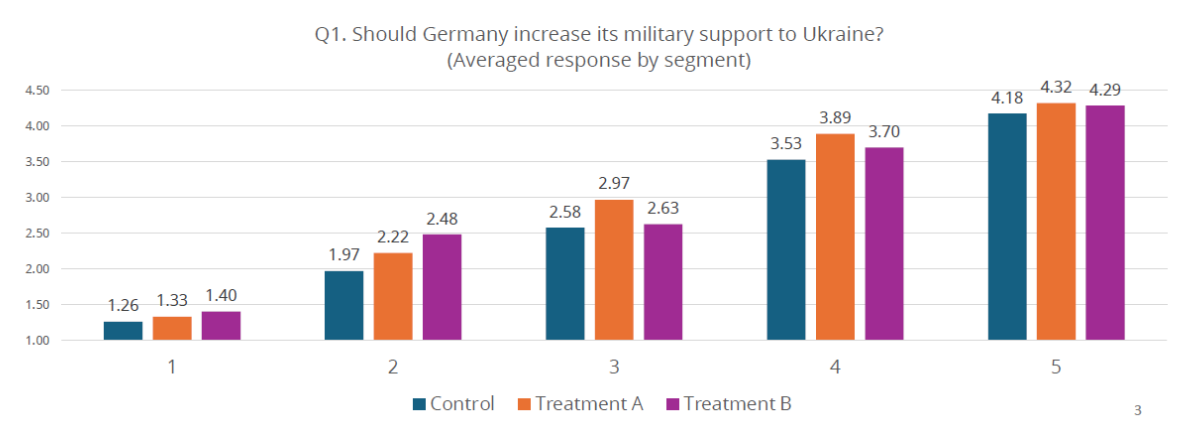
Message 2: The current costs of supporting Ukraine may be high, but inaction now will lead to greater costs later on. Messages that argue that costs will be much higher for Germany if Russia defeats Ukraine increased German’s approval for greater military support for Ukraine. This effect can be seen for the open-minded but unsupportive segment 2, the middle-of-the-roaders (segment 3), and self-interested supporters of Ukraine (segment 4). For the latter two segments, messages highlighting the impact Germany or European allies could have on the war alongside the costs of a Russian victory had a significant effect. For the open-minded but unsupportive segment (who are less supportive of Ukraine) centring economic argument exerted strong influence.
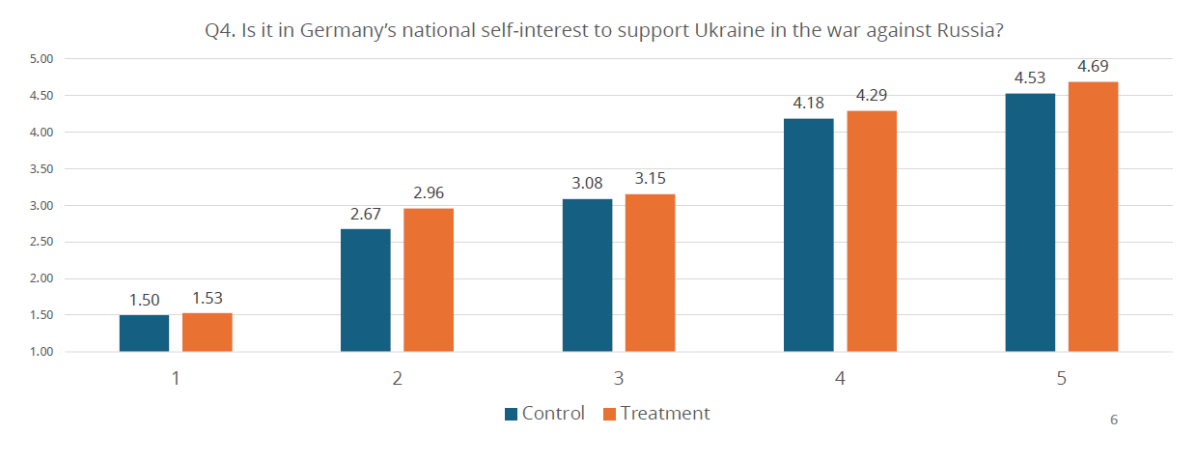
Message 3: A Russian victory is a threat to peace in Europe. Messages that emphasise the threat to peace in the event of a Russian victory in Ukraine increased the degree to which the open-minded but unsupportive (segment 2) believes it is in Germany’s self-interest to support Ukraine.
Furthermore, messages that emphasise the risk of a major war involving the West made the open-minded but unsupportive segment more in favour of delivering Taurus missiles. Messages warning about the devastating consequences for security in Europe likewise increased support for delivering Taurus missiles among middle-of-the-roaders (segment 3) and self-interested supporters of Ukraine (segment 4).

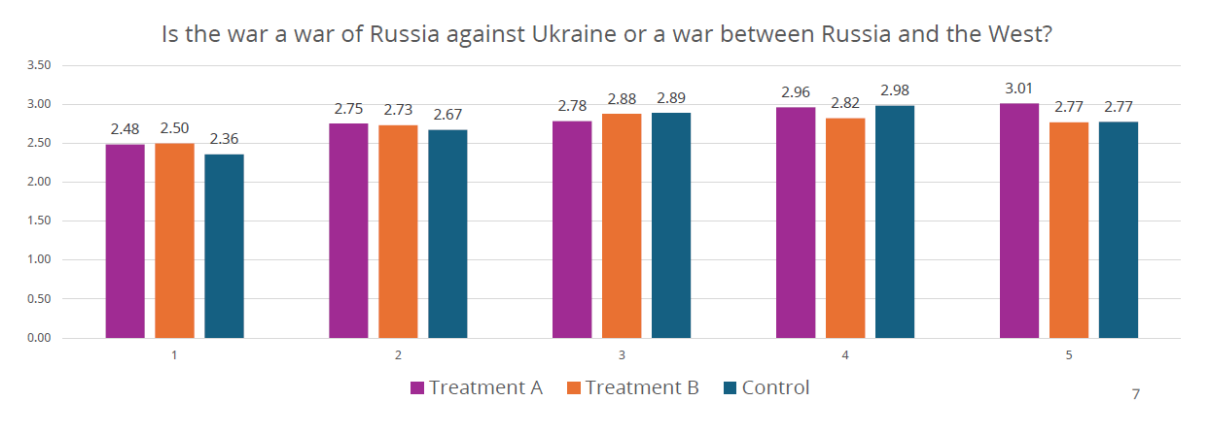
Message 4: This is a struggle between democracies and authoritarianism. Messages framing the Ukrainian struggle against the Russian invasion as part of a confrontation between democracies and authoritarians increased the extent to which highly educated liberal supporters of Ukraine (segment 5) view the war as a war against the West, rather than just against Ukraine. However, the segments less supportive of Ukraine did not seem receptive to this message.
Messages that did not increase German support for Ukraine or hawkish views towards Russia
Several messages tested did not increase support for Ukraine or hawkish policies towards Russia, or even had the opposite effect than the one which we had anticipated.
- Messages highlighting Russian support for the AfD and extremist parties in Europe did not increase support for the view that the actions of the Russian government threaten German economic interests and security.
- Message emphasising that whether or not the West believes it is at war with Russia, the Russian regime believes that it is at war with the West, did not increase belief that the war is primarily directed against the West.
- Messages emphasising that inviting Ukraine to join NATO would be a strong boost to Ukraine but carried little legal risk or political cost, or could even be a catalyst towards ending the conflict, either had no effect or caused respondents to become more opposed to NATO inviting Ukraine to join the military alliance.
Conclusion
Our survey results indicate that the majority of Germans already hold extremely critical views of the Russian government, which they see as a threat to German interests. However, while most Germans support greater national defence spending and European security efforts, they are split on whether their government should ramp up military support for Ukraine. Additionally, even though support for Ukraine remains widespread among Germans, this support is slowly decreasing.
At the same time, these views are not set in stone. ISD’s message-testing research demonstrates that all segments of the population, independent of their views on German government policies towards Ukraine, trend towards supporting more hawkish policies vis-à-vis the Russian government or more substantial military aid to Ukraine. Messages emphasising the current geopolitical insecurity and the future costs of inaction in the present moment in particular were persuasive even with Germans who do not already support Ukraine for moral or humanitarian reasons.