Digital Dispatches
September 1, 2024
ISD-US
Information Warfare and Online Manipulation
How The Specter of AI Has Distracted from The Reality of The Gaza Conflict
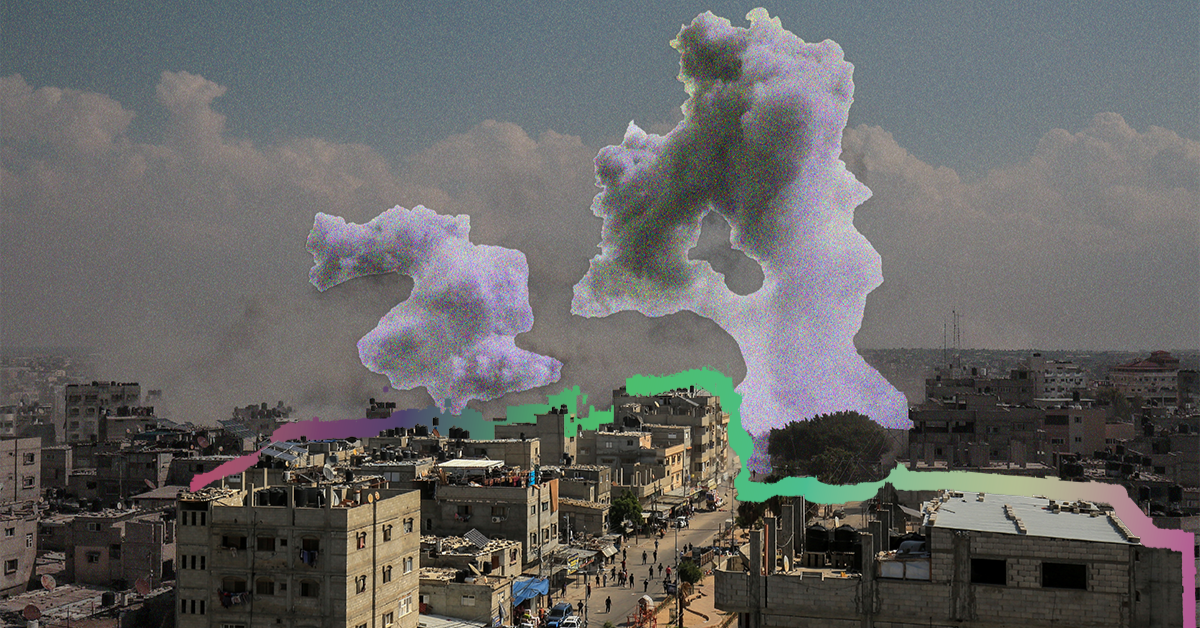
Following the October 7 Hamas attacks and amid the ongoing humanitarian crisis in Gaza, AI-generated content (AIGC) has played a distinct role in shaping public perception. Many had originally predicted AIGC would be primarily used to spread disinformation. However, ISD’s analysis has instead found discussions of both real and imagined AIGC are serving as a distraction from the real-world horrors of the conflict.
The mere idea of AI, alongside its growing use, has reshaped how people consume and react to information. In the first month of the conflict, content referencing AI in the context of Gaza received over 528 million impressions on X (formerly Twitter), rising to 736 million by September 2024. Individuals are increasingly attributing content from specific groups to AI, with 30% of posts sampled for this research claiming that content from a particular group or ideology is AIGC.
The possibility of AIGC introduces a new challenge to the online information ecosystem. The mere suspicion of AI involvement allows individuals to dismiss information, whether true or false, in line with their pre-existing worldview. This rising scepticism observed amongst online communities makes it harder to dispel falsehoods in a climate of growing doubt, playing into the hands of those intent on disseminating disinformation.
For this research, ISD individually assessed 1,200 posts which discussed the Gaza conflict and referenced AI across October/November 2023 and August/September 2024. The platforms from which this content was collected included X, YouTube and Reddit, along with a small sampling of available posts from fringe forums.
The Specter of AI Deepens Confirmation Biases
Across all the content assessed by ISD for this analysis, including content that broadly discussed AI or referenced specific media as being AIGC, roughly 25% of the sample included a “broad accusation of AIGC”. This category was defined as content including statements that all or most media disseminated by a specific group or espousing a certain viewpoint must be AI generated. These claims were often based on just one example (which itself may or may not have been AI generated).
In discussion of AI in the context of the conflict that didn’t mention a specific piece of content, 52.9% included a broad accusation of AIGC. The staggering degree to which individuals are declaring content to be AI-generated is disproportionate to the actual volume of deceptive AIGC found in our dataset.
Content categorized as including “broad accusations of AIGC” included claims that images of casualties from within Gaza were wholly AI generated by Hamas, playing into the “Pallywood” narrative, a deceptive attempt to undermine claims of civilian casualties within Gaza. In an example from September 2024, a social media user responded to authentic video footage of casualties in the Neusirat refugee camp saying, “Don’t believe these videos. They are probably AI generated. The Palestinians are pretending to be massacred.”
Broad accusations like these also included claims that dismissed evidence of the October 7 Hamas attack. Examples include social media users responding to reports from legitimate journalists of the footage of October 7 atrocities as “All made up by the terrorist state of Israel. Let them show us the evidence not AI generated propaganda images,” or repeating claims from a Hamas political representative that visuals of Hamas committing alleged war crimes on October 7 were “probably AI”.
Social Media Platforms Users Focus on Flawed Methods To Assess Content’s Veracity
When discussing individual pieces of content, social media users observed in our data set seemed to often fixate on trying to decipher whether content was AIGC based on flawed open-source investigation techniques and the use of free-to-use AI detection tools. This often led to discussions as to the texture and color of blood, the appearance of body parts and distortions present when an image is magnified.
Free-to-use tools also featured heavily in platform users’ attempts to decipher content’s veracity. This approach often led to false assessments, with screenshots of inaccurate tool detection results gaining significant traction and at times being included within ‘community note’ fact checks, a concerning development for a feature intended to enhance the accuracy of discourse.
The flawed nature of these techniques was evident in the sampled content when assessing the accuracy of users claims. In the October sample, 62% percent of posts that mentioned a specific authentic image or video included a false claim that stated the content was AI generated.
The analysis also found individual platform users often attempting to extrapolate wide– reaching conclusions based on their own flawed assessment of one image, and an under-reliance on broader facts of the conflict as reported by authoritative news outlets.
This phenomenon is not enormously surprising: when particularly graphic or distressing imagery challenges an individual’s political leanings or worldview, dismissing the content as AIGC can be a useful thought-terminating cliche preventing cognitive dissonance between one’s worldview and evidence that challenges it.
Additionally, we observed social media users frequently feeling the need to state “this isn’t AI” when posting graphic imagery. This is perhaps indicative either of concerns that distressing images will be dismissed as AIGC, or that all AIGC has become so widespread that all graphic content is likely to be AIGC.
Attempts To Use AI To Show Support Undermine Real World Events
Since the beginning of the conflict, social media users have created and disseminated AIGC (self-disclosed as such and often described as artistic representations) to support or espouse specific viewpoints. In October 2023, 5% of the sample included self-disclosed AIGC such as images of distressed or injured children, glorifying visuals of prominent figures, depictions of hateful tropes and groups of people showing support for either Israel or Palestine. This had risen to 14.8% in September 2024.
While some of this content may be well intentioned, its proliferation has several potential negative consequences:
- This AIGC may initially be disclosed as AI-generated, but later reposted without this disclosure. If it then gains traction, it risks deceiving viewers as to its origin.
- Some social media users forgo disclosures, believing the content to be so clearly AIGC that disclosures are redundant. This assumes users can accurately detect AIGC, which is risky when content is consumed quickly and without in-depth interrogation.
- AIGC can generate extreme depictions of harmful stereotypes. Even when self-disclosed as AIGC, this can further promote these narratives.
- In one self-disclosed AI– generated video, the ‘lifecycle’ of a Palestinian is shown, depicting the evolution of a Palestinian child into a Hamas fighter. While the intent of the video is unclear, it could perpetuate a particularly harmful narrative observed online throughout the conflict that claims there are “no innocents in Gaza”.
- When AIGC seeks to portray real world events and garner sympathy or support, its identification by audiences as undisclosed AIGC may undercut this aim.
-
- One example includes a repost of an AI generated image of a Palestinian child injured amongst rubble, stating “Iranian propaganda machines are using AI generated photos as it’s from Gaza”.
-
- Some users seem to be aware of this issue, with ISD finding examples within its sample set such as “stop posting AI generated images, there are enough real images of the events”.

Conclusion
From the onset of the Gaza conflict, the use and impact of AIGC has cast a profound uncertainty over the digital landscape. ISD’s analysis highlights a significant concern: the evolution and advancement of AI is not just a technological phenomenon but a psychological one, fundamentally altering how individuals engage with and interpret information related to the conflict online. This shift marks a critical juncture in the digital age, where the line between fabricated and authentic content becomes more blurred than ever, reshaping public discourse in unforeseen ways.
While platforms must scale up and improve the efficacy of their AI detection and labeling functions, the need for robust media and digital literacy education has become more critical than ever before. This must be seen as a whole-of-society priority as AIGC continues to proliferate and becomes less detectable to the human eye in the course of its rapid advancement.
The sole responsibility for any content supported by the European Media and Information Fund lies with the author(s) and it may not necessarily reflect the positions of the EMIF and the Fund Partners, the Calouste Gulbenkian Foundation and the European University Institute.
The images in this article may include memes and screenshots of content produced by actors including violent extremists, information operations and conspiracy theorists. These are reproduced to analyse and critique the images and educate our audience. We are not able to identify whether the components of these images may include copyrighted work and so are unable to acknowledge ownership under fair use doctrine. If you are the owner of an image that has been included, in part or in whole, in this article, and wish to be acknowledged, please get in touch at [email protected].