Digital Dispatches
August 14, 2026

ISD UK
Anti-Migrant, Far-Right Extremism
From posts to protests: How online narratives fuelled anti-migrant violence in Southampton and Belfast
June 2026 saw anti-migrant protests and disorder across the UK, including Northern Ireland, following two separate stabbing attacks in Southampton (southern England) and Belfast (Northern Ireland). Although unrelated, both incidents were rapidly reframed online as evidence that immigration (particularly from South Asia, Africa and the Middle East) had made the UK less safe. In Southampton, disorder followed the sentencing of Vikrum Digwa for December 2025 murder of Henry Nowak; in Belfast, violence followed the stabbing of Stephen Ogilvie by Hadi Alodid. In both cases, online discussions moved beyond the specific details of the incidents to promote targeted anti-migrant narratives.
Online networks united by a shared anti-migrant sentiment exploited the two tragedies to advance broader narratives of demographic change, cultural decline and the alleged preferential treatment of minority constituencies. This ISD analysis examines an increasingly common and effective playbook: domestic and international actors use individual incidents to target and stigmatise whole communities, spurring offline violence and normalising anti-migrant sentiment.
Key findings
- Far-right actors exploited the attacks in both Southampton and Belfast to deploy the same playbook. This involved attributing collective responsibility for individual attacks to non-White populations, using clashes with police to frame disorder as patriotic rebellion, and exploiting law enforcement responses to fuel further anti-migrant hate.
- In the first two weeks of June 2026, there were 87K posts on X calling for the UK to implement remigration—a far-right term for forced deportations targeting non-White populations—compared with 58K for the whole of May. There were 76K mentions of remigration in all of 2024 and 435K in 2025. Year-to-date, 2026 has already seen the highest number of mentions on record.
- Posts which used the attacks to promote claims of anti-White and pro-migrant policing (often framed as ‘two-tier policing’) surged to more than 200K in the first two weeks of June compared to 104K in the whole of May 2026. The growth of this narrative threatens to undermine trust in law enforcement and the government, as a shared interpretive framework reframes local incidents not as isolated events, but as evidence of broader systemic failures and political betrayal.
- Anti-migrant narratives are transnational. Actors from the US and Europe, alongside UK far-right accounts, sought to promote violence and unrest with the aim of a broader ethnonationalist agenda. ISD found that five of the 10 posts with the most likes linking remigration to the Southampton and Belfast attacks came from outside the UK.
- Generative AI (genAI) has become a core tool for anti-migrant mobilisation. AI-generated content was used to support mobilisation at scale, including by creating eye-catching posters promoting protests that later evolved into riots in Belfast, and to fuel unrest, including through a viral, AI-edited image of the police officer who arrested Southampton victim Henry Nowak, depicting her with ‘demonic’ claws.
Methodology
This analysis examines the catalysts and drivers of anti-migrant hate narratives that portray individuals based on their perceived status as immigrants to the UK, seeking to demonise, dehumanise, harass or incite violence against them. Increasingly, this overlaps with a White nationalist belief that non-White individuals with origins in South Asia, Africa and the Middle East are inherently foreign and dangerous to Western countries, reinforcing the narratives that dehumanise and demonise them. We use two distinct events in June 2026 (disorder in Southampton after the sentencing of Vickrum Digwa for the December 2025 murder of Henry Nowak, and riots in Belfast following an attack perpetrated by Hadi Alodid against Stephen Ogilvie) to show how this playbook is deployed.
Anti-migrant hate does not distinguish between the citizenship status of non-White individuals: it frames them as inherently foreign and as migrants regardless of factors such as country of origin, cultural upbringing or self-identity. This form of ethno-nationalist hate is distinct from a general opposition of migration, which should not be seen as inherently hateful.
ISD’s analysis combines two approaches to better demonstrate the scale and nature of anti-migrant mobilisation:
- Qualitative insights based on analysts’ research across platforms including Facebook, X, Telegram and YouTube (livestreams) to understand common narratives and tactics,
- And quantitative analysis based on X, using data about anti-migrant hate gathered through the social media monitoring tool Brandwatch between 16 April and 15 June. This allowed ISD to examine the scale and speed at which anti-migrant hate spread following attacks.
Different stories, similar narratives
One key point of overlap across these two cases was rhetoric focused on calls for ‘remigration’. Originally associated with European identitarian movements and white nationalist circles, remigration has increasingly become a shared concept across anti-migrant networks in Europe and North America. While interpretations vary, the term generally refers to the large-scale deportation of migrant and minority populations from Western countries and is closely associated with ethnonationalist political projects. ISD has tracked the far-right use of the term remigration over the past 10 years as it emerged in Continental Europe, aligned to other extremist beliefs such as the Great Replacement conspiracy theory, before becoming increasingly popularised by anti-migrant actors in the UK. In the first six months of 2025, posts calling for remigration in the UK reached 76K, almost the same as the total recorded in 2024.
Posts calling for remigration in the UK rose from 58,384 during the period of May to 87,429 in just the first two weeks of June. There were two major spikes on 9 June (14,095 posts) and 13 June (15,860); comments related to Belfast accounted for 82 percent and 69 percent of the respective daily totals. There was a smaller, though significant, number of posts which used remigration rhetoric in relation to Henry Nowak’s murder in Southampton (totalling 5,794 across the two months).
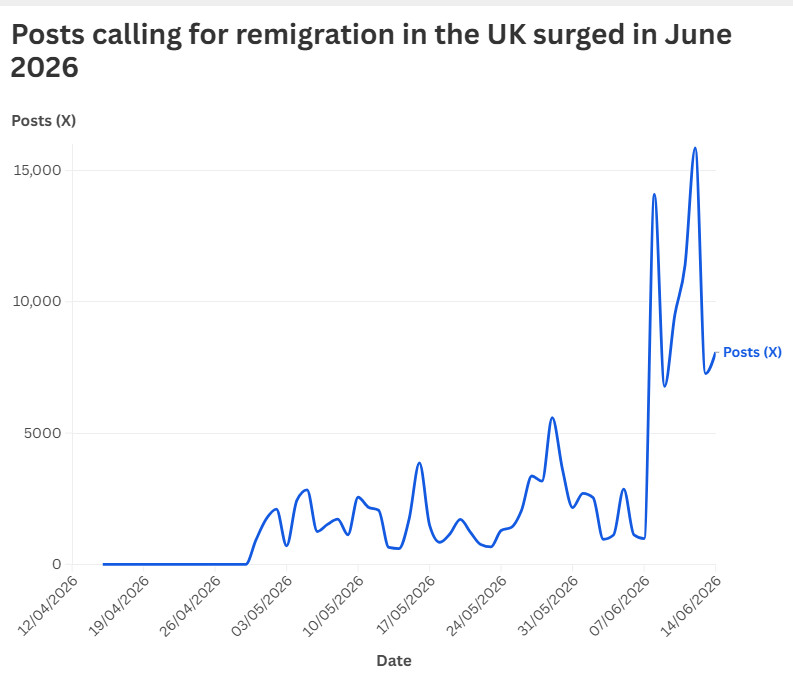
Remigration was not confined to online spaces. The term was repeatedly used at protests associated with both incidents, highlighting how a concept once largely associated with fringe identitarian communities has increasingly entered mainstream anti-migrant discourse. On 20 June, far-right political party Britain First held a “march for remigration” in Birmingham; party leader Paul Golding mentioned “the slaughter of Henry Nowak” and “an African immigrant pinning one of our own to the ground in Belfast” at the start of his speech.
Discourse surrounding the two incidents also frequently extended beyond migration itself to incorporate claims of ‘two-tier policing’, anti-establishment grievances, allegations that public institutions favour minority groups over the majority population, and wider concerns about cultural and demographic change. Although these narratives address different issues, they increasingly reinforce a common worldview in which political institutions, the police and the justice system are portrayed as discriminating against White people while protecting migrants and minority communities.
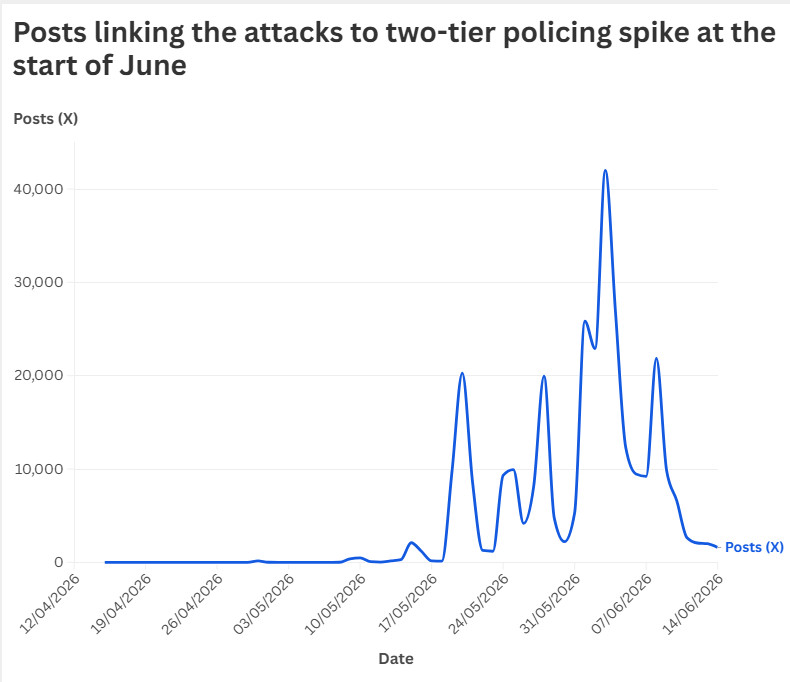
Allegations of ‘two-tier’ policing also featured prominently across discussions of both incidents; 87,429 posts drew this connection in the first two weeks of June, compared to 58,384 over the course of May 2026. Originally popularised by anti-migrant actors following the Southport riots, the phrase has become a recurring frame through which a wide range of incidents are interpreted. Its prominence in discussions surrounding both Belfast and Southampton illustrates how established narratives can be rapidly redeployed following new triggering events, irrespective of the specific circumstances of each case.
Posts mentioning ‘two-tier’ policing in relation to the attacks first surged on 21 May (20,081). Many alleged that the police’s decision to believe Vickrum Digwa’s claim that Henry Nowak had racially abused him, while ignoring Nowak’s pleas that he had been stabbed and then instead arresting him, was anti-White policing. The most popular post on X that day came from a US conservative media account, receiving 34,000 likes. Posts about two-tier policing peaked on 4 June (35,713) following the arrest of individuals involved in rioting in Southampton. The most popular post on X that day was posted by Tommy Robinson (with almost 130k likes). The second most popular post came from a UK-based pseudonymous account, which alleged that the Crown Prosecution Service decision to prosecute Southampton rioters while not seeking a retrial for two brothers who assaulted police officers in Manchester Airport was due to race.
Another spike on 9 June (21,316) was largely driven by claims about Belfast. The post with most likes came from a US-based account with less than 2,000 followers, alleging that the Police Service of Northern Ireland (PSNI) failed to release details about the attacker as symbolic of “Two-Tier Policing”.
These responses demonstrate how online activity is used to drive offline responses (notably protests or riots). When law enforcement responds, this is then used to allege a conspiracy narrative about protecting migrants, which in turn builds an effective flywheel.
Networks in the UK and beyond
Another part of the playbook is the role of a range of domestic and international actors who amplify incidents to their audiences. Discussions surrounding the two events featured many of the same individuals who have previously mobilised around anti-migrant violence in Southport, Coolock and Ballymena, illustrating how a relatively stable network of high-profile activists repeatedly reappears around local incidents. Figures including the far-right actor Stephen Yaxley-Lennon, known by his alias Tommy Robinson, his associate Danny Tommo and former British National Party (BNP) leader Nick Griffin were among those commenting on, amplifying or engaging with discussions surrounding these events. On X, a post by Robinson received almost 130K tweets, the highest number in ISD’s overall dataset.
Another longstanding tactic which appeared during this analysis was the cross-platform spread of anti-migrant hate. For example, Robinson’s first post about the Belfast attack on X (one of the first posts overall), posted at 23:39 on 8 June, was followed one minute later by an identical post on Telegram. Although the post on X reached a much larger audience (7M views compared to 20K on Telegram), it likely reached a different group of accounts: while X is a large, open platform, Telegram’s encryption has made it a key space for violent extremism and offline mobilisation (as seen following the Southport stabbings in 2024). The same narratives also circulated through more closed online networks: White nationalist Active Clubs and Youth Clubs, for example, used the Belfast attack and the subsequent riots to try and galvanise support on Discord.
Robinson attended and spoke at the Southampton protest in person, but during the Belfast unrest he amplified developments remotely via X, while associates and aligned activists travelled to Northern Ireland. Physical presence is no longer a prerequisite for influence; through social media, a relatively small number of highly visible activists are able to shape narratives, direct attention and encourage mobilisation among audiences hundreds of miles away from the events themselves.
The transnational nature of discourse is also reflected in the accounts driving online engagement. Six of the 10 most liked posts which called for remigration and explicitly referenced the attacks in Southampton or Belfast were from international actors; of these, three were from the US, two from Europe and one from Australia. These posts sought to universalise the attacks as evidence of a threat posed by non-White people in Western countries, making local incidents into a global cause.
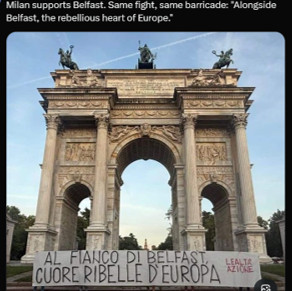
ISD has previously documented the transnational nature of anti-migrant hate in relation to protests across the island of Ireland in 2025 and riots following the Southport stabbings in 2024. As in these cases, international and domestic actors can exploit large online followings to amplify and frame the incidents. This enables actors to contribute to offline mobilisation without being physically present, while creating and/or reinforcing transnational narratives about the threat posed by migrants.
The role of AI
The fallout from both Southampton and Belfast illustrates how genAI content is increasingly being utilised by far-right accounts, public figures and online communities when reacting to crisis events. In an attempt to provoke outrage, actors disseminate false claims and encourage protests or potentially violent responses using AI-generated visual- and text-based outputs.
In Southampton, the release of bodycam footage showing police officers handcuffing Nowak as he lay dying prompted a wave of false claims. Online users used screenshots from the footage to speculate on the identity of the police officers who detained Nowak: this resulted in Christi Hill (a former police officer who left Hampshire Constabulary more than a year before the incident involving Nowak in December 2025) being wrongly identified by AI chatbot Grok. Hill told the BBC she was forced into hiding and was subjected to “threats of violence” because of the false identification.
Separately, Euronews reported how a screenshot from the footage, showing a police officer’s hand with sharpened nails, was digitally manipulated. This “claw” hand image was subsequently shared widely across social media by far-right politicians and influencers within the UK and US, alongside threats to police officers and calls for protests. Some used the image to claim it showed the “demonic hands of the British authorities restraining” Nowak.
In Belfast, footage showing the stabbing attack was similarly repurposed in genAI content. Memes were created that showed a cartoon version of the attacker and called on Northern Ireland’s nationalist and Loyalist ‘clans’ to unite against migrants.
AI models were used to exploit an information vacuum in Belfast. Hours after the attack footage surfaced online, one far-right group in Northern Ireland published screenshots of a conversation with Google’s Gemini, suggesting they fed the model audio from the footage and asked it to identify what the attacker was shouting. It should be noted that the quality of the audio is very poor, yet, according to their screenshots, the Gemini chatbot responded with confidence. Its output was shared as evidence to justify calls for action against Belfast’s Muslim community.
Both episodes illustrate how genAI now forms a core component of the playbook of far-right amplification and mobilisation. Advancements with AI models have lowered the barrier to entry requiring no graphic design skills or technical expertise to produce persuasive visual content with expediency. For companies behind these tools, Google, X and others, this episode raises further urgent questions about their tools. AI models being used to create content that not only hallucinates but serves to justify potential violence highlights multiple failures of responsibility.
Conclusion: the new normal of anti-migrant mobilisation
In 2024, the riots that followed the Southport stabbing appeared to be the high-water mark in anti-migrant mobilisation. What is increasingly evident is that they instead laid the groundwork for transnational far-right actors to exploit individual tragedies as evidence for a worldview in which governments, police forces and other institutions are portrayed as working with non-White migrants against White Britons. This belief system validates, legitimises and plays down violence targeting both law enforcement and non-White communities, framing it as self-defence retribution or resistance to a state perceived to favour ‘migrants’ at the expense of ‘patriots’.
Across both Southampton and Belfast, the same pattern emerged. Both individual attacks earlier this summer were reframed as evidence of a broader threat allegedly posed by migrants. Domestic and international far-right actors amplified the incidents using establish narratives such as remigration and two-tier policing. Online mobilisation encouraged protests and disorder, while subsequent police action was then used to reinforce claims that the authorities were protecting migrants more than the White population. Rather than isolated reactions to individual events, these incidents demonstrate a replicable playbook through which local crimes can become catalysts for national mobilisation within hours.
ISD’s upcoming series on the mainstreaming of anti-migrant hate demonstrates how the seeds for an increasingly strident ethno-nationalist movement has developed over more than a decade, both on- and offline. This rhetoric is only likely to increase as far-right actors in the UK and abroad promote targeted hate and violence through euphemisms of civilisational defence. This is a challenge that requires work from stakeholders including law enforcement, local authorities, civil society and the government.
In the media
ISD Contributors