Digital Dispatches
December 23, 2025
ISD UK
Antisemitism, Islamist Extremism, Threat Analysis and Prevention
Bondi Beach: The hallmarks of an Islamic State attack
23 December 2025
Content warning: This article contains references to extremist propaganda and explicit calls for violence. These materials are cited strictly for the purpose of analysis.
In the wake of an Islamic State (IS) group-inspired terrorist attack targeting participants at a Jewish holiday event in Australia, this ISD analysis examines the antisemitic threat and messaging from Salafi-jihadist groups in recent years. First, we examine the IS ecosystem’s calls for violence and their response when those calls are acted upon. Next, we investigate how the tactics used during the 14 December shooting at Bondi Beach align with those seen in previous attacks targeting Jewish, Christian and year-end holiday events conducted by IS and its supporters. Finally, we analyze the landscape of attacks and plots against Jewish communities and targets across 29 countries since January 2024.
An IS–inspired attack in an ecosystem awash in calls for violence
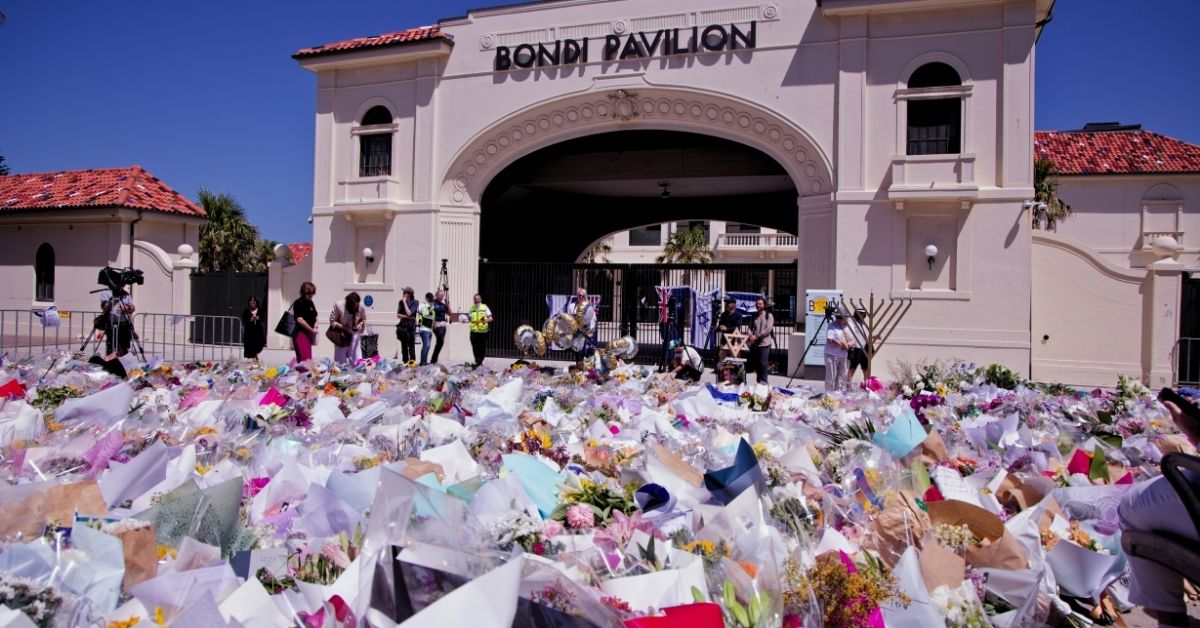
On 14 December, a father and son inspired by IS attacked a Hannukah event at Bondi Beach in Sydney, Australia. The pair killed 15 and wounded approximately 42 others, making it the second deadliest mass shooting in Australian history. IS venerated the attackers in an article published on 18 December in the group’s official weekly newsletter, al-Naba, titled “The Glorious Deed of Sydney.” It referred to the attackers as “heroic,” called for further attacks during the holiday season and singled out specific countries, including Belgium.
Salafi-jihadist organizations including IS and its ideological forebear al-Qaeda have exploited the two-year-long war in Gaza, which followed the Hamas attacks on Israel on 7 October 2023 to justify violence against Jewish communities and targets. Over the past two years, propaganda either calling for or celebrating attacks on Jewish targets has become increasingly prevalent in the Salafi-jihadist ecosystem online. For example, Al-Qaeda in the Arabian Peninsula (AQAP) produced instructional guides based on the killing of two Israeli Embassy staffers in Washington, DC, an attack on a Jewish march in Boulder, Colorado, and the Manchester synagogue attack. An ISD analysis of the Salafi-jihadist ecosystem following the October 7 attacks found that responses to the attack “varied between different types of actors based on their specific priorities and ideological frame,” with groups focused on external operations describing the situation as “part of its war against ‘crusaders’ and ‘agent’ Arab states.” While the focus between territorial and extraterritorial enemies varied, ISD identified that “a common feature was explicit calls for violent attacks on Jews, embassies, or civilians in countries allied with Israel.”
Within this ecosystem, IS has been particularly active in calling on its supporters to conduct attacks on Jewish targets around the world. In January 2024, the group was calling on supporters to “kill [Jews and Christians], wherever you find them” and released an article in its official al-Naba newsletter titled “Practical Steps to Fight the Jews.” Unofficial IS support outlets have produced similar content focused on attacks on Jewish communities globally.
IS draws on a robust ecosystem of supporters and unofficial outlets to spread these messages on a global scale. ISD researchers have previously noted the expansive nature of this ecosystem and its interconnectedness with teenage plotters in 2024. This ecosystem has been central to promoting attacks, as well as providing the rationale for targeted violence against different faith communities.
The IS ecosystem activates for attacks and attackers
The IS online ecosystem extends across mainstream, niche, and messaging platforms. In the immediate aftermath of attacks, IS supporters and unofficial IS support outlets often praise and produce content related to a given attack, spreading it through their online networks. The content circulating through this ecosystem following an attack both reinforces the violence and seeks to inspire further others.
In the wake of the Bondi Beach attack, IS supporters praised the attack and its perpetrators across a range of online platforms. The al-Naba article highlighting the Bondi Beach attackers and calling for further attacks galvanized these networks. IS supporters and unofficial support outlets used the article to validate IS’s strength and inspire attackers globally: one unofficial outlet leveraged it to call for more media munasireen (“warriors”) to produce content that would both promote IS and assist potential attackers. Notably, the article released in the aftermath of the Bondi Beach attack credited online networks with inspiring the attackers.
A Facebook video posted by an IS supporter juxtaposed two photographs of the son with his alleged rifle; one showing him aiming the weapon. The caption described him as a “Brother,” followed by a fire and heart–eyes emojis. Another Facebook user posted a series of photographs of Ahmed al Ahmed, the bystander who intervened and stripped the older suspect of his weapon, before being shot himself. IS supporters in the comments referred to him as a murtad (“apostate”).
On a primary IS group forum, self-hosted on a decentralized messaging app, participants celebrated the attack while attempting to establish more concrete links to the group. They also criticized Muslim institutions such as al-Azhar University for condemning the attack. As evidence emerged of the IS-links of the attackers, a user distributed a video of the attack footage, which featured a nasheed: a work of vocal music, sometimes used by IS and other Salafi-jihadist groups to promote their ideologies.
Just as patterns emerge with the promotion of violent content following attacks, similar trends can be observed among IS-linked and IS-inspired attackers and plotters globally targeting Jewish, Christian and end of year holiday-related events.
Patterns of IS-linked and inspired attackers and plotters
The Bondi Beach attack also continues a pattern of mass casualty attacks and plots targeting both Jewish, Christian and end of year holiday-related events. The Manchester synagogue attack on 2 October targeted worshippers assembled at the Heaton Park Hebrew Congregation for a Yom Kippur service. On 1 January 2025, the first IS-inspired attack within the US since 2017 targeted a New Year’s celebration in New Orleans. Suspects in a disrupted IS inspired plot targeting events on Halloween in Dearborn, Michigan, were alleged to have discussed other holidays that should be targeted. They also allegedly expressed a desire that each holiday should have a respective attack for the wider ecosystem of Salafi-jihadists to celebrate. In the days following the December attack in Australia, plots targeting Christmas markets in Germany and Poland were disrupted. Christmas markets are a recurring target for Islamist attackers.
The Bondi Beach suspects are also notable for being the second father-son IS-inspired plot in recent years. In 2024, a father and son were alleged to have participated in a disrupted plot targeting the Jewish community in Canada; they were charged with terrorism offenses and ordered to stand trial in 2026, but have not been convicted. The father in the Canadian plot previously appeared in a 2015 IS propaganda video violently torturing an IS prisoner in Iraq.
Firearms practice and training conducted by the Bondi Beach attackers is another recurring trend in IS attacks and plots since January 2024. In Dearborn, the suspects visited local ranges to practice shooting; weapons training was also a feature in the plot against a military base in Warren, Michigan. Additionally, an individual arrested in Brooklyn in February 2025 for conspiring to provide material support had conducted firearms training to prepare himself for a domestic attack or to join IS overseas.
Investigators are also probing whether the Bondi Beach attackers’ trip to the Philippines was used for “military training” purposes. While there has been speculation over the nature of the trip, officials in the Philippines have noted that at this current time that there is no clear link between the attackers and training in the country. ISD analysts have also noted the perpetrators and suspects in other plots and attacks frequently engaged in local training. As the Combating Terrorism Center at West Point noted, IS prefers external operations to be inspired, rather than coordinated and controlled by an IS–affiliate.
Attacks and plots targeting Jewish communities
ISD identified attacks and disrupted plots linked to IS across 29 countries, based on the Washington Institute for Near East Policy’s Islamic State Select Worldwide Activity Map and independent data collection. The countries included were those without an IS presence and that do not share a border with countries where IS is active, as well as Israel (148 countries). These countries were selected to represent external attacks and exclude IS insurgency operations.
Of the 26 attacks identified by ISD which took place between 1 January 2024 and 15 December 2025, 11 (42.3%) were conducted against Jewish or Israeli communities/institutions. Though none of the attacks occurred within Israel, two attacks targeted Israeli diplomatic missions. The intended targets in 27 of 84 disrupted plots (32.1%) were Jewish and Israeli communities or institutions. Of these, 13 plots were disrupted within Israel while 4 other plots targeted Israeli diplomatic missions.
Attacks and plots targeting Jewish and Israeli targets were identified in 14 countries within the dataset. Aside from Israel (12 plots), other countries to experience multiple instances of antisemitic attacks and plots included Germany (two attacks and four plots), Russia (one attack and two plots), the UK (two attacks and one plot), the US (two plots) and Canada (two attacks and two plots). As of 2020, these represent more than half of all countries with a core Jewish population of at least 100,000 individuals. The volume of disrupted antisemitic plots is likely underrepresented due to the lack of available information on intended targets. The data demonstrates that antisemitic targeting by IS is not restricted by geographical bounds. It also reflects the effectiveness of IS’s antisemitic online activities promoting violent targeting of Jewish institutions.
Conclusion
The Bondi Beach terror attack has become the most recent example of IS–linked and inspired terror attacks targeting Jewish communities globally. This is not a new phenomenon but a reflection of increased IS messaging and targeting of Jewish communities and institutions. Through its online footprint, the IS ecosystem reinforces narratives of a war between Muslims and the Jewish faith. This noxious form of online activity often occurs on niche messaging platforms but is similarly parroted on mainstream social media platforms.
The IS ecosystem activates in the wake of attacks to venerate attackers and spur on further violence. The uneven ability of mainstream platforms to enforce their own policies regarding IS content directly enables this activity to continue unabated. Enhancing the capacity of platforms to identify and takedown IS content designed to galvanize attackers is a key part to addressing this challenge, though it is only one element of the solution. Much of this ecosystem is networked, so a coordinated approach to dismantling these capabilities online must be developed and reinforced following attacks such as the one at Bondi Beach.
Long-standing patterns have similarly emerged amongst the actions by IS-linked and IS-inspired attackers: in particular, the targeting of Jewish and Christian holidays. Taking cues from IS messaging, attackers are choosing to accelerate operations at the end of the year, making it an elevated threat environment as people congregate for holiday events. Intelligence, law enforcement and security institutions must maintain increased vigilance and closely monitor the IS ecosystem for emerging threats.
Disruption of online networks, attacks and plots must remain the prime focus of intelligence and law enforcement. But efforts should also be made to fortify Jewish communities and institutions against this particular aspect of the threat environment. Upstream efforts to combat antisemitism, must remain at the forefront of policymakers’ and civic institutions’ agendas to further delegitimize antisemitic violent extremism.