Digital Dispatches
December 22, 2025
ISD Germany, ISD UK, ISD-US
Antisemitism, Hybrid Extremism and Nihilistic Violence
Antisemitism across the extremes: A deep-dive on US-based violent online networks
22 December 2025
By: Hannah Rose, Solveig Barth and Steven Rai
ISD is a fiercely independent ‘think and do tank’ group of non-profit organisations dedicated to safeguarding individual rights, democratic process, national security and public safety against the rising tide of authoritarianism and extremism globally. This work has been developed by analysts from ISD UK, ISD Germany and ISD-US. This Dispatch forms part of the Coalition to Counter Online Antisemitism (CCOA) research series, which examines key issues related to online antisemitism in Europe. CCOA is a pan-European network coordinated by ISD, active across 10 countries and supporting united responses to online antisemitism through research, policy and education initiatives.
Antisemitism has long formed a central ideological glue and mobiliser for violent extremists across the ideological spectrum. Built on long-standing stereotypes, antisemitism provides a system of meaning and conspiratorial lens through which violent extremists interpret the world and offers Jewish people as a central target for their hate. This research leverages a bespoke data analysis system developed by ISD and CASM Technology to analyse violent extremist online activity in the US. Exploring a six-month period from August 2024–January 2025, analysts deployed Large Language Model (LLM)-based classifiers trained by ISD experts to investigate the volume, platform spread, key actors and themes driving online antisemitism from over 1,000 US-based domestic violent extremist accounts and channels. Analysis spanned a range of mainstream and fringe platforms across a broad ideological spectrum, from neo-Nazi to militant anarchist.
Key Findings
- Domestic violent extremists disseminate a significant volume of antisemitic material: Over 150,000 antisemitic posts were shared online by over 1,000 US-based violent extremist accounts between August 2024 and January 2025.
- The volume of antisemitic posts increased in the second half of 2024: Antisemitic posts rose steadily over the six-month period, with a 21 percent increase in the final month compared to the first (excluding antisemitic posts on image board and forums, which were incorporated part way through the period of analysis).
- Increases in antisemitic content correlate with world events: Significant surges in the volume of antisemitic content occurred around the US Presidential election (November 5), Iranian missile strike on Israel (October 1), and the anniversary of the October 7 Hamas attack, often driven by conspiracy theories and posts celebrating violence against Jews and Israelis.
- Racially or ethnically motivated violent extremists (REMVE) accounts constituted the most prominent threat actor: REMVE accounts—predominantly white supremacists and neo-Nazis—generated 43 percent of antisemitic content overall. However, Foreign Terrorist Organisation-supportive accounts dominated between October and November 2024, producing 45 percent of antisemitic posts during that period.
- Posts by violent Groyper accounts had a disproportionate influence in amplifying antisemitic narratives:While this community produced only two percent of antisemitic posts in our dataset, they generated 12 percent of engagement, highlighting their disproportionate influence in amplifying antisemitic narratives.
- Fringe platforms hosted the overwhelming majority amount of antisemitic content: Across the range of alternative and mainstream platforms where data was collected, extremism-related forums accounted for the highest proportion of antisemitic posts, followed by 4chan and Telegram. Mainstream platforms like X and YouTube contributed only nine percent of antisemitic posts identified from domestic violent extremists, with over 90 percent on fringe platforms.
- Conspiratorial content was the most dominant theme: Automated thematic analysis revealed that conspiratorial content was the most prevalent antisemitic theme (44 percent), including claims of Jewish control over migration, electionsand global affairs. Other themes included slurs (21 percent), antisemitic framings of the Middle East conflict (15 percent), ‘classic’ antisemitic tropes (14 percent) and posts containing multiple types of racism (five percent).
- Cross-ideological antisemitic mobilisation remains prominent: Data insights underscore the value of a cross-ideological approach to understanding antisemitism, as well as the need to integrate into counter-measures analysis of how violent extremists mobilise around conspiratorial narratives and key events in the Middle East.
Methodology
Data was collected from an actor list of over 1,000 US-linked channels and accounts across both fringe and mainstream social media platforms and a range of violent extremist ideologies. ISD analysts used a strict vetting process to ensure that all accounts included in the dataset clearly met the following three criteria:
- Extremism: Accounts and channels must advocate for an extremist ideology or worldview.
- Violence: Accounts and channels must promote terrorism or unlawful violence, association with a group with a history of violence, or supporting designated Foreign Terrorist Organisations.
- US-relevance: Accounts and channels must be operated by individuals or groups based in the US or have produced content primarily focused on the US.
Data was collected across a broad range of social media platforms, including Instagram, Facebook, Telegram, X, YouTube, Bitchute, Bluesky, Odysee, Rumble, 4chan’s /pol/ board, and several forums and imageboards relevant to US violent extremism, including 8kun, incels.is, and stormfront.org (hereafter collectively referred to as “the forums”). All data was collected using each platform’s public Application Programming Interface (API) or via Brandwatch, a social listening tool.
This analysis also employed bespoke Large Language Models (LLMs) to identify key trends in violent extremist discourse such as prominent narratives, targets of violent extremist activity and the nature and extent of targeted hate against minority communities. To capture antisemitic hate, ISD analysts worked with our tech partners at CASM Technology to develop custom LLM-based classifiers that identified antisemitic discourse with a high degree of precision and recall (with an average F1 score of 0.84 across reporting periods)[i]. This resulted in a dataset of over 150,000 posts between August 2024 and January 2025, which is the subject of this analysis.
To conduct thematic analysis and mapping at scale, analysts used Nomic Atlas–a software that uses natural language processing techniques to generate thematic maps of large social media datasets–to group together semantically similar postsinto clusters. Analysts manually verified and re-labelled clusters into 90 sub-themes and five themes, which were subsequently re-uploaded to the thematic mapping tool. A full methodology is available to researchers upon request.
Antisemitism peaked during key events in the US and Middle East
Figure 1: Volume of antisemitic posts over time across platforms, excluding forums.
Figure 1 shows the volume of antisemitic content over time across all platforms (forums were excluded from this graph as they were only collected from October 1). Overall, the volume of antisemitic content increased steadily over the collection period; the last month of monitoring recorded a 21 percent increase when compared to the first, and the last two months recorded a 22 percent increase compared to the first two.
The highest volume of antisemitic content recorded on a single day occurred November 8, which correlated with high-profile political events; the US Presidential election on November 5, violent riots in Amsterdam on November 6 and the arrest of three men for an Iranian plot to assassinate Trump, two of whom were claimed by REMVE accounts to be Jewish. Analysis of the antisemitic content during the US election showed violent extremists engaged in conspiracy theories about a deep state or election fraud, as well as classic antisemitism. This upwards trend was compounded by a further increase of antisemitic content focusing on the violent clash involving Maccabi Tel Aviv fans in Amsterdam on November 6 and 7, which was celebrated by REMVE accounts as inter-communal violence.
The second highest spike in the data correlated with the Iranian missile strike on Israel on October 1, 2024. Antisemitic content on 4Chan’s extremist/ pol/ board, as well as violent extremist channels on Telegram and YouTube, celebrated the attack and called for them to be replicated against Jews around the world. REMVE channels were not necessarily supportive of Iran but harnessed any opportunity to promote antisemitic violence. This tactic is reminiscent of the increasingcooperation and support between ideologically diverse extremist communities, who, since October 7, have increasingly set aside their differences. Accelerationist, for example, have expressed support for Iran in the aftermath of October 7, uniting with the country’s antisemitic goals. The third highest daily volume of antisemitic posts was recorded around the anniversary of the October 7 attacks. Domestic extremists shared typical antisemitic slurs, conspiracy theories and medieval antisemitic tropes—meaning the use of symbols and images associated with classic antisemitism such as ‘blood libel’—in a higher volume, as well as commenting specifically on the attacks to accuse Israel of committing a false flag operation and discuss a perceived global Zionist conspiracy.
REMVE accounts drove the majority of antisemitic content
The ideological makeup of targeted antisemitic hate remained relatively stable throughout the analysis period, with a notable exception occurring between October and November 2024. Figure 2 shows the volume of antisemitic posts per actor type, per month. REMVES produced the largest volume of antisemitic hate across the collection period, accounting for 43 percent of such content. Meanwhile, violent and ideologically amorphous online communities—mostly consisting of violent conspiratorial accounts—generated the second largest volume of hate throughout the monitoring period. Notably, accounts supportive of Foreign Terrorist Organisations (FTOs) were the most prolific threat actors between October and November 2024, generating 45 percent of antisemitic messages during that period. This spike was primarily driven by Telegram groups centred around support for the Iran-backed Axis of Resistance, which were galvanised by a tumultuous period during the Israel-Hamas war that included events such as the killing of Hamas leader Yahya Sinwar, the anniversary of the October 7 Hamas attack and the Hezbollah pagers attack.
Figure 2: Total antisemitic posts per threat actor category and monitoring period.
Among REMVE accounts, those generally supportive of white supremacist and neo-Nazi violence but not aligned with a specific organisation or network (e.g., Active Clubs or the Terrorgram Collective), were the most prolific generators of targeted antisemitic hate. Such actors accounted for 32 percent of antisemitic content across all ideological communities, reflecting a shift in the violent extremist landscape away from formalised groups and towards looser constellations of actors who mobilise around certain narratives, grievances and ideologies. Notably, despite accounting for only two percent of antisemitic posts from REMVE actors throughout the collection period, violent factions and users affiliated with the Groypers—loose network of white nationalist activists and internet trolls who gravitate around key influencers such as Nick Fuentes and are mostly active on Telegram and X—generated 1 percent of the engagement (combined likes, comments and shares), demonstrating the outsized reach this community has in spreading antisemitic content.
Fringe platforms hosted the vast majority of antisemitic content
Figure 3 shows the volume of antisemitic posts per platform over time. Posts on forums were only collected from October 1, leading to a sudden rise in volume of antisemitic posts in the dataset. The most prominent source of antisemitic content were forums—including ng 8kun, incels.is, stormfront.org and other more fringe forums—accounting for 42 percent of all posts. The main contributor of antisemitic content before October 1 was 4chan, which comprised 34 percent of posts across the whole six-month period, followed by the messaging app Telegram with 18 percent. Telegram and 4chan have been historically understood as central hubs of extremist networks, often due to a lack of—or poor implementation of—Terms of Service. Overall, mainstream platforms like X or YouTube accounted for 9 percent of antisemitic content from violent extremists in the dataset while fringe platforms like 4chan or Odysee contributed 91 percent. Forums including 8kun have often been a neglected area of study—perhaps due to their decentralised nature hampering data collection efforts—but remain a vital piece of the puzzle to understanding violent extremist antisemitism.
Figure 3: Total antisemitic posts per platform over time. Forums were only included in analysis from October 1, 2024.
Conspiracy theories dominated violent extremist antisemitic content
To analyse the narrative themes of antisemitic content from violent extremists, analysts used Nomic Atlas, an automated thematic mapping tool, to cluster semantically similar posts. Analysts manually analysed clusters to assign them to sub-themes, and to group sub-themes into broader themes. Figure 4 visualises a map of the dataset of 150,000 posts, coded against the five resulting narrative themes. Across the multiple platforms and six–month period studied, antisemiticthemes were tightly clustered together, evidencing a consistency in use of language and prevalent themes of antisemitism.
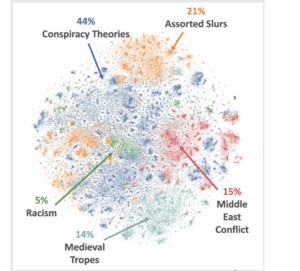
The most common theme of antisemitic content posted by violent extremism-linked accounts was conspiracy theories. Figure 4 visualises how conspiratorial thinking is evident throughout all forms of antisemitic content, often bleeding into conversations about other topics. This discovery mirrors ISD’s findings that conspiracy theories comprised most antisemitic comments on YouTube videos about the conflict in Gaza immediately following October 7, confirming the continued centrality of conspiratorial ideas in antisemitic discourse. The most common conspiratorial content—with over 10,000 posts—stated Jews control migration globally. Other common conspiracies included allegations of Jewish-controlled paedophilia or sex trafficking (with over 8,000 relevant posts), antisemitic COVID conspiracies (over 4,000 posts) and conspiracy theories about Jewish control or rigging of the US presidential election (over 7,000 posts).
The second most common theme of antisemitic content featured slur words. These posts were typically quite short and contained very little ideological reasoning or content aside from use of antisemitic slurs. The most used slur was featured in the dataset over 18,000 times.
Antisemitic discussion of the Middle East conflict comprised 15 percent of posts in the dataset. Criticism of Israel is by no means inherently antisemitism; this theme refers only to anti-Israel content that was expressed in antisemitic ways. This included, for example, applying antisemitic tropes to Israel or Israelis, comparing Israel’s actions to the Holocaust, or collectively blaming diaspora Jews for Israel’s actions. The proportion of Israel-related antisemitism similarly mirrors previous findings by both ISD and others.
Classic forms of antisemitism were present in 14 percent of posts. These ideas are rooted in medieval-era tropes, including misguided antisemitic interpretations of Christian theology and culture, such as the ideas that Jews killed Jesus or blood libel. This theme also included references to the ‘Synagogue of Satan’, an antisemitic descriptor of Jews originally taken from the Bible.
A final five percent of posts linked to racist ideas more broadly, with posts including both antisemitic ideas and misogyny, anti-black racism, anti-Asian racism and anti-Mexican discrimination. This intersection typically manifests as white supremacist narratives, slurs, conspiracy theories or general misanthropy. Jews, as well as LGBTQ+ people, women and people of colour, are dehumanised and selected as the enemy. These posts highlight the intersecting forms of hate underpinning extremist communities and prompt responses based in inter-communal collaboration.
Figure 5: The relative proportion of themes in posts over time.
Figure 5 depicts the relative prevalence of each theme over the studied period. The graph shows a steady volume of each theme, with the proportion of slur content decreasing over time as the volume of conspiracy theories, classical antisemitism and Middle East conflict discussion rose. Antisemitic posts about the Middle East conflict peaked around key events or incidents, such as the anniversary of the October 7 attack. This data is vital to inform platform risk assessments and emergency response planning, allowing platforms leaders to predict and effectively mitigate the spread of antisemitism around key events or incidents.
Conclusions
Antisemitic discourse within US violent extremist networks demonstrated a sustained upward trend over the six-month monitoring period, with sharp spikes driven by major geopolitical and domestic events. The analysis reveals that REMVE accounts were the primary drivers of antisemitic content, while actors aligned with FTOs surged during periods of heightened Middle East conflict. This finding mirrors previous research evidencing increased risks around key periods of the conflict. It is important that such insights are integrated in platforms’ risk assessments and emergency response planning to ensure that the appropriate staff, systems and knowledge is in place to mitigate high risks after key events.
Fringe platforms such as image boards and forums emerged as dominant hubs for antisemitic violent extremist activity, far outpacing mainstream social media and underscoring persistent gaps in moderation and monitoring. Mainstream social media platforms have rightfully been the focus of efforts to tackle online antisemitism due to their ability to facilitate mass mobilisation and mainstreaming. However, this research shows the urgent need to build policy responses and interventions to interrupt the vast spread of violent extremist antisemitism on fringe forums and platforms.
Thematic mapping confirmed the centrality of conspiracy theories to antisemitic narratives, alongside slurs, classical tropes and anti-Israel rhetoric expressed in antisemitic terms. While anti-Israel antisemitism has reasonably been a focus of public debate for its mainstreaming impact, this research builds on previous findings that overt hatred such as conspiracy theories and classical medieval tropes retain an overwhelming influence on online extremist ecosystems.
Notably, the Groypers amplified these narratives disproportionately through high engagement, indicating how counter-efforts to reduce the impact of antisemitism should integrate not just posting behaviour but how the community interacts with such content. While this analysis has focused on violent extremist activity, the amplification of antisemitism across violent and non-violent communities emphasises the need to address the sharp tip of antisemitic violence and its broader mainstreaming among non-violent communities.
These findings highlight the evolving ecosystem of antisemitic extremism online across ideologically diverse violent extremist networks and the continued need to build systematic and large-scale evidence to effectively inform counter efforts.Throughout 2026, ISD will be building a first-of-its-kind data system to generate the necessary insights to inform intervention strategies against antisemitism on social media.
[i] Analysts trained bespoke LLM-based classifiers using ISD’s definition of hate as activity which seeks to dehumanise, demonize, harass, threaten, or incite violence against an individual or community based on religion, ethnicity, race, sex, gender identity, sexual orientation, disability, national origin or migrant status. Antisemitism was additionally interpreted with reference to the IHRA working definition of antisemitism.