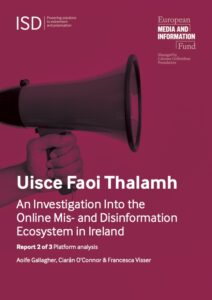
In this report, we examine how online platforms are used to produce, promote and contribute to the circulation of mis- and disinformation.
For 20 years, ISD has delivered field-leading threat detection, analysis and real-world strategies to combat terrorism, extremism and authoritarianism - in all their ideological forms.

In this report, we examine how online platforms are used to produce, promote and contribute to the circulation of mis- and disinformation.
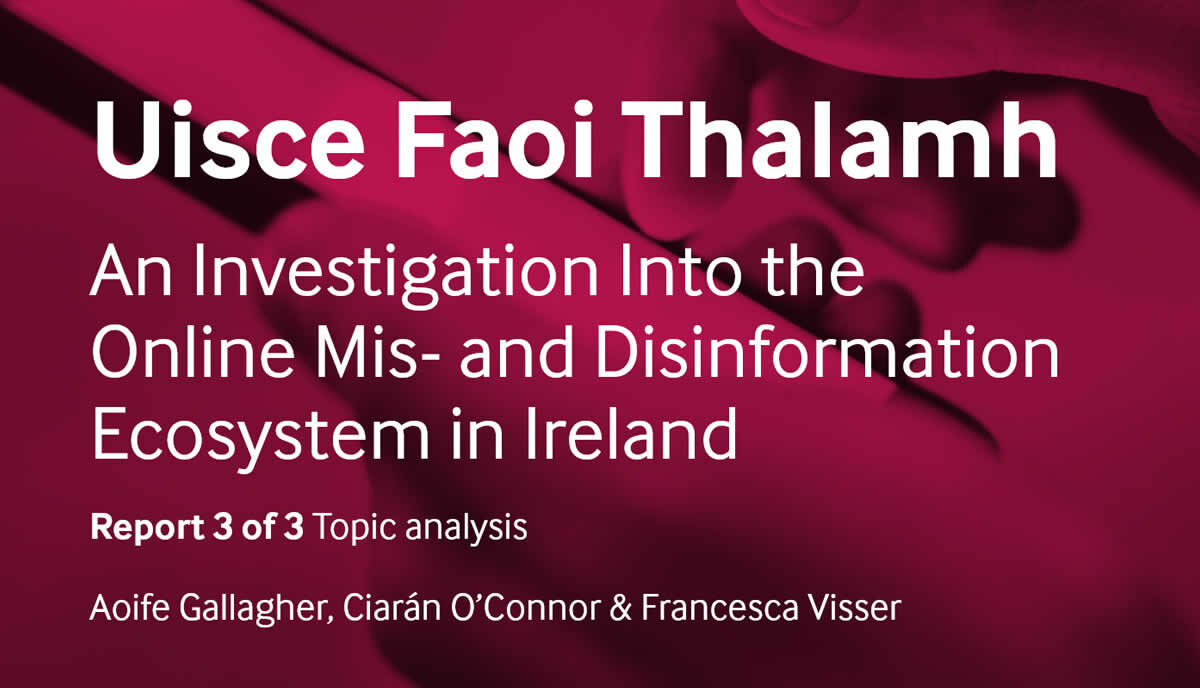
The final instalment of the series provides an in-depth analysis of the leading topics of discussions within this mis- and disinformation ecosystem.

Since the Israel-Hamas war began, UK far-right extremists have reduced the conflict into anti-Muslim, antisemitic and anti-migration narratives.

Almost 13 years after his death, Osama bin Laden is trending on social media due to his 2002 “Letter to America,” amid the Israel-Hamas conflict.

Neo-Nazi accelerationists have been expressing support for Hamas since October 7, using antisemitism to recruit and radicalize followers.
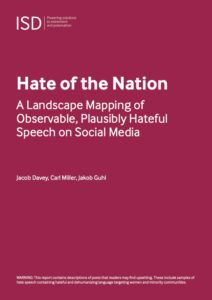
This analysis produced by ISD for Ofcom explores the scale and nature of ‘plausibly hateful’ English-language content across platforms.

This digital snapshot produced by ISD for Ofcom outlines the online landscape of terrorism, extremism and hate speech related to the United Kingdom.

The 7 Oct Hamas attack has triggered a 50-fold rise in antisemitic comments on YouTube and spikes on alt-tech platforms, according to ISD analysis.

Iranian, Chinese and Russian officials and media are using the Israel-Hamas conflict to promote anti-US and anti-Ukraine narratives for their benefit.

ISD finds that violent Gaza conflict content is reaching minors on Instagram, TikTok, and Snapchat, despite platforms’ protective policies.
We use Mailchimp as our marketing platform. Learn more about Mailchimp’s privacy practices here.
Amman | Berlin | London | Paris | Toronto | Washington DC
Copyright © Institute for Strategic Dialogue (2026).
ISD UK is a charitable company limited by guarantee (registered charity number 1141069, registered company number 06581421), registered address 3rd Floor, 45 Albemarle Street, Mayfair, London, W1S 4JL.
ISD-US is a non-political, not-for-profit corporation registered in the District of Columbia with 501(c)(3) status (tax ID 27-1282489), registered address Suite 285, 1032 15th St. NW, Washington DC, 20005.
ISD Germany is a gGmbH registered with the Berlin-Charlottenburg District Court (HRB 207 328B), registered address c/o Schomerus & Partner mbB Berlin, Bülowstraße 66, 10783 Berlin.
ISD Canada is a non-profit corporation registered in Ontario with registration number 1001404659, registered address 40 King Street West, Suite 6600, Toronto, Ontario, M5H3S1, Canada.
ISD France is a non-profit association registered under the status of Association de loi 1901 (registration number W751256497), registered address 128 rue La Boétie, 75008 Paris.
ISD Jordan is a non-profit Limited Liability Company registered in the Hashemite Kingdom of Jordan (company number 1425), registered address 14, Grand Complex, Queen Musbah Street, Amman, Jordan.
All Rights Reserved. Any copying, reproduction or exploitation of the whole or any part of this website without prior written approval from ISD is prohibited.