Publications
November 5, 2025
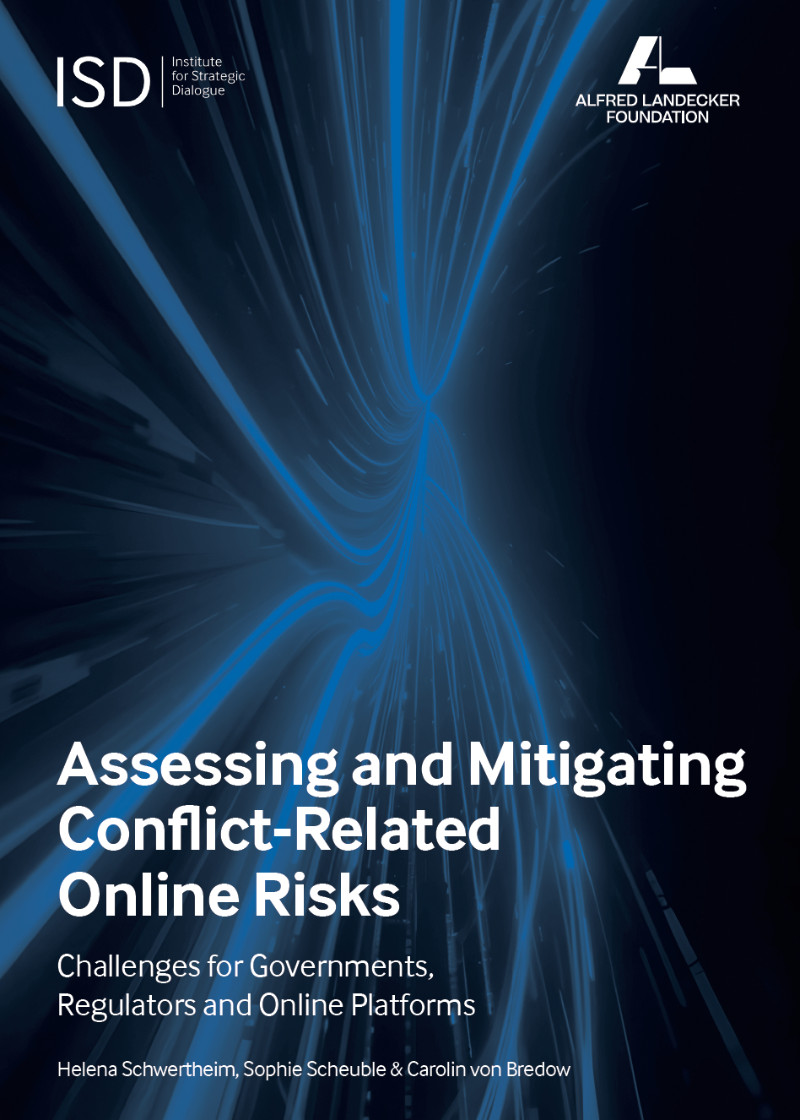
Assessing and Mitigating Conflict-Related Online Risks: Challenges for Governments, Regulators and Online Platforms
ISD Germany
Accountability and Speech Protection, Freedom of Expression, Tech Accountability and Safety
As over 120 conflicts play out across the globe, the information environment has become a strategic weapon to rally support, spread propaganda, incite violence and undermine trust. Conflict-related online risks increasingly transcend borders, affecting not only those in conflict zones but also diaspora or minority communities elsewhere, as well as political discourse and social cohesion in countries far from the fighting. These can include online risks such as disinformation and foreign information manipulation and interference (FIMI), terrorist and violent extremist content (TVEC), illegal hate speech and incitement to violence, gender-based violence (GBV) – including when technology facilitated (TFGBV) – and the algorithmic amplification and monetisation of these risks. Over-zealous or inaccurate moderation or suppression of conflict-related content by online platforms can also create significant risks to legitimate and protected freedom of expression.
While platform policies and enforcement often fail in conflict-affected regions where domestic governance and regulatory oversight can be weak, new policy frameworks in liberal democracies such as the European Union’s (EU) Digital Services Act (DSA) and the United Kingdom’s (UK) Online Safety Act (OSA) offer a crucial opportunity for improved responses and greater accountability. These regulations can protect domestic users affected by online risks emanating from conflict zones, stem the spread of illegal content, provide greater transparency, and help to develop and define best practices for platform responses. They provide tools to safeguard information integrity and online safety such as systemic risk assessments, crisis protocols, and transparency provisions. Strengthening and utilising these mechanisms can help ensure platforms identify and mitigate conflict-related risks, improve rapid responses to emerging crises, and enhance transparency and data access.
This policy brief examines how governments, regulators and technology companies can better identify, mitigate and respond to these online risks. It maps the spectrum of conflict-related risks – ranging from disinformation and hate speech to the over-removal of legitimate content – and considers the role of platform design and market incentives in enabling or exacerbating these risks. It then provides an analysis of the international legal landscape and relevant non-regulatory initiatives, and how current legislation in the EU and the UK can address such risks.
By comparing these regulatory frameworks, the brief identifies potential ways in which they can contribute to mitigating conflict-related online risks. It also highlights the need for stronger cross-border coordination and greater transparency. Mitigating online risks from foreign conflicts is not the primary aim of these regulatory regimes but the tools they provide (if applied with a conflict-sensitive lens) can strengthen information integrity and limit spillover risks.
The brief finally provides recommendations for governments, regulators, platforms and international organisations to safeguard fundamental rights domestically and abroad, and set international benchmarks for platform accountability in conflict settings.
ISD Contributors