Digital Dispatches
July 24, 2025
ISD UK
Targeted Threats, Hate and Abuse
‘No Innocents’: The collective blame of Palestinians online
23 July 2025
This Dispatch analyses the digital spread of ‘no innocents’ rhetoric which holds Palestinians collectively responsible for the actions of Hamas and claims there is no distinction between civilians and combatants. Although it predates the 7 October attacks, it gained much greater traction in their wake.
Based on analysis of Hebrew and English content with a focus on X (formerly Twitter) between October 2023 and 2024, we found content supporting the ‘no innocents’ narrative likely contravenes platform guidelines but is inconsistently moderated. The Dispatch also identifies key actors behind the discourse, examines sub-categories of the rhetoric, and discusses significant differences in the volume of supportive and critical posts about ‘no innocents’ rhetoric between English and Hebrew.
Note on terminology: it is important to distinguish between 1) posts supportive of ‘no innocents’ rhetoric and 2) posts discussing ‘no innocents’ rhetoric which ISD researchers gathered using keywords. The latter includes posts supportive of ‘no innocents’ rhetoric but also critical posts or those describing it in a neutral manner. This metric therefore indicates the level of attention ‘no innocents’ rhetoric receives, not the level of support for it. For clarity we have split posts into four categories:
- Content critical of ‘no innocents’ narratives,
- Content that is supportive,
- Content that is descriptive (i.e. does not clearly support or criticise the ‘no innocents’ narrative)
- Content that is irrelevant (i.e. false positives not related to the Israel-Hamas conflict)
Key findings and recommendations
- ISD found that between 7 October 2023 and 7 October 2024, there were more than 513,000 English-language posts by 261,000 unique authors with ‘no innocents’ rhetoric. Based on a sample of 1,200 posts, more than three quarters of posts (including high-traction examples) were critical of ‘no innocents’ rhetoric. Content was often made in response to statements from Israeli or pro-Israel politicians, commentators or TV interviews. English-language posts declined in the last months of our analysis.
- 57,800 Hebrew-language posts by 17,630 unique authors were found to have discussed ‘no innocents’ rhetoric (including critical and descriptive posts). Out of 1,200 Hebrew-language posts (including high-traction examples), almost 70 percent were supportive of the rhetoric while only a fifth directly criticised it. There was a spike in Hebrew posts in October at the beginning of Israel’s military operations in Gaza.
- ISD analysis found that public figures contributed disproportionately to dehumanising ‘no innocents’ discourse, particularly in Hebrew. Of the top ten most reshared posts in the Hebrew-language dataset, three came from high-profile politicians supportive of ‘no innocents’ rhetoric, including a sitting member of the Knesset (MK).
- Posts critical of ‘no innocents’ rhetoric came from a broad variety of political and ideological backgrounds. While many framed their concerns around human rights and a desire to protect civilians, others in the English dataset promoted antisemitic or dehumanising narratives themselves.
- Although ‘no innocents’ rhetoric appears to clearly violate X’s policies including around hateful conduct and violent speech, the platform does not appear to consistently take action against this content. X should consistently enforce its policies against content that could lead to direct incitement of violence against civilians, especially children.
Background
Since Hamas’ attacks on Israel on 7 October 2023, many statements by Israeli and pro-Israel voices have laid responsibility for terrorist activity onto every resident of Gaza1. Such statements reflect broader public opinion in Israel: according to a March 2024 survey, almost one-fifth of Israelis believe the country does too much to protect Palestinian civilians “since there are no ‘non-combatants’ in the Gaza strip.” In June 2024, the official X account of the Israeli government used ads to promote a post that featured ‘no innocents’ rhetoric.
There is credible evidence from international investigations and human rights organisations, including footage of the attack and multiple survivor accounts, that some2 civilians from Gaza did cross the perimeter fence to engage in violence and looting during the October 7 attacks while others were subsequently involved in hostage-holding3 .
However, arguing that there are no innocent civilians in any population justifies indiscriminate violence and collective punishment, and makes it easier to dismiss suffering, war crimes and extremist policies, including the ethnic cleansing of Palestinians.
Such generalisations also ignore the diversity of thought among Palestinians, including those who protested against Hamas as recently as May 2025 despite the significant risks in doing so. Finally, demonising all Palestinians fosters cycles of mutual hatred, reinforces an “us-versus-them” worldview and is likely to prolong conflict.
This dangerous and dehumanising rhetoric has proliferated against the backdrop of a conflict with one of the highest death rates in the 21st century. More than 57,000 Palestinians 4 have been killed since 7 October 2023, according to Gaza’s (Hamas-run) authorities. Others suggest this may be a conservative estimate. After a two-month ceasefire starting in mid-January, Israel renewed the blockade of essential supplies entering Gaza and resumed its military offensive in March, exacerbating concerns about the humanitarian situation and civilian lives.
Methodology
ISD analysts collected all Hebrew- and English-language posts on X between 7 October 2023 and 7 October 2024 with social media monitoring tool Brandwatch which included keywords related to the ‘no innocents’ rhetoric (regardless of sentiment). These keywords were selected based on examples of ‘no innocents’ rhetoric manually selected by ISD analysts who coded the 100 most reshared posts in both Hebrew and English each month (1,200 posts for each language) as:
- Supportive (used this language affirmatively)
- Descriptive (described this rhetoric in a neutral manner)
- Irrelevant
- Critical (criticised this discourse)
Due to the greater complexity of Hebrew-language posts, we established two additional sub-themes:
- Straightforward ‘no innocents’ rhetoric which held all or most Gazans collectively responsible for the actions of Hamas
- Posts which sought to extend guilt to a broader range of Gazans and Palestinians – for example, civilians alleged to support Hamas or minors who might grow into terrorists
7 October spikes ‘no innocents’ rhetoric
‘No innocents’ rhetoric predated 7 October: on 13 September 2023, local Israeli politician Eliyahu Libman called for the West Bank town of Huwara to be razed and its residents displaced, claiming that most were “not innocent”5. During the 2018 Gaza protests then-Defence Minister Avigdor Lieberman had already stated that “There are no innocents in Gaza” and “everyone is affiliated with Hamas”. However, this rhetoric gained far stronger traction after Hamas’ attacks (see figure 1).
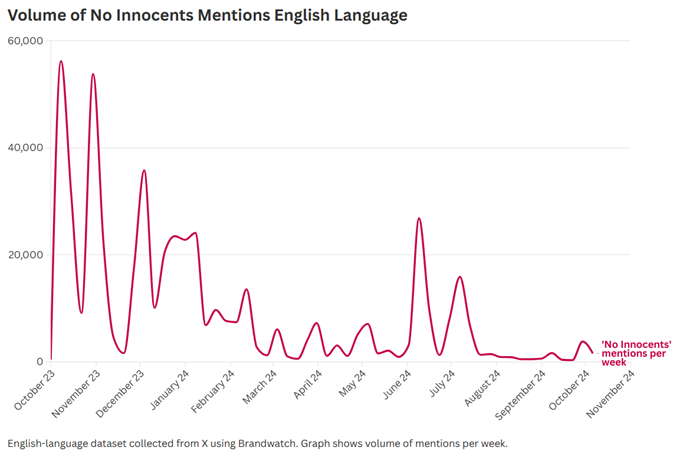
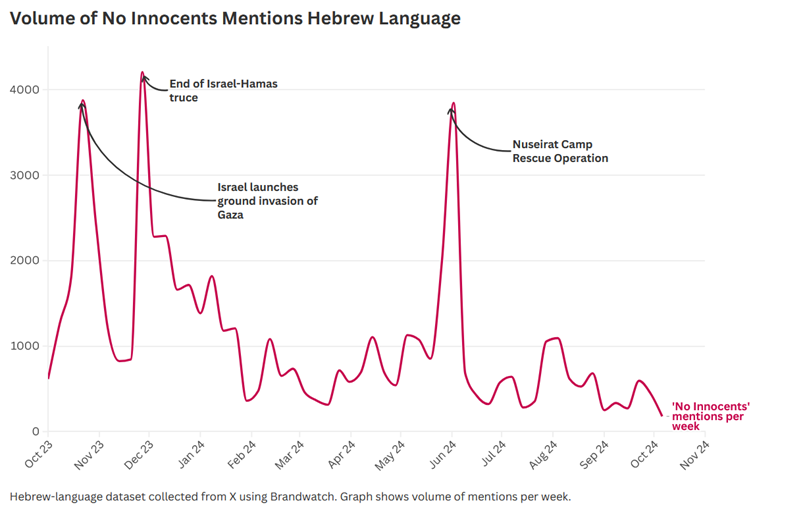
There were three peaks in Hebrew-language posts discussing ‘no innocents’ discourse on X:
- The first was on the week of 23 October 2023, when Israel launched its ground invasion of Gaza following intense airstrikes followed by a second on the week of 27 November 2023 at the end of a four-day truce which was briefly extended.
-
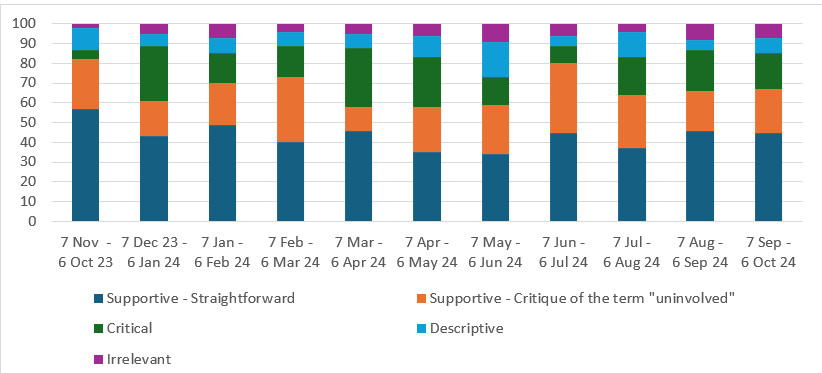
- During both peaks, the share of high-traction posts supportive of ‘no innocents’ rhetoric likewise rose, reaching 90 percent during the week of 23 October and 75 percent during the week of 27 November compared to 68 percent overall.6 This indicates that Hebrew-language dehumanising discourse spiked directly before/ following Israeli military escalations, encouraging and pre-emptively justifying civilian casualties.
- The third peak followed the Israeli operation around Nuseirat Camp on 8 June which rescued four hostages and killed at least 274 Palestinians. Israeli journalist Almog Boker argued that all of those killed in the operation were “fully involved” because they did not inform the Israel Defense Forces (IDF) of the hostages’ location.
When examining English-language posts, we found that posts discussing ‘no innocents’ rhetoric peaked during the first month of the Israel-Hamas war, mostly criticising it. Generally, these posts increased in response to supportive statements about ‘no innocents’ rhetoric by Israeli or pro-Israel politicians, commentators or TV interviews. This included statements by Israeli President Isaac Herzog,7 former Prime Minister Naftali Bennett, former Deputy Prime Minister Avigdor Lieberman, MK Merav Ben-Ari and Mia Schem, a hostage freed during the temporary ceasefire between Israel and Hamas in late November 2023. There was another peak in English posts on 10 June, following the Israeli rescue operation around Nuseirat Camp.
Types of ‘no innocents’ narratives
Among posts supportive of ‘no innocents’ rhetoric in the dataset collected, analysts found three main narratives:
- “There is no such thing as uninvolved”: Palestinians in Gaza are not innocent because they all celebrated, supported or were involved in the 7 October attacks.
- “Democratic liability”: The idea that Palestinians in Gaza are not innocent because they democratically elected Hamas.
- “Intrinsic guilt”: The idea that Palestinians in Gaza are not innocent because they are intrinsically inclined towards terrorism and present a threat to Israel.
“There is no such thing as uninvolved”
One of the most prominent types of ‘no innocents’ rhetoric in the dataset centered on the idea of the mass involvement of Palestinians in the terrorist attacks on 7 October as alleged by Israeli public figures. On 11 November 2023, journalist Ishay Friedman claimed on X that “an absolute majority” of Gazans had information about Hamas and Palestinian Islamic Jihad (PIJ) members. On 16 October 2023, MK Boaz Bismuth (Likud) argued on X that even “innocent citizens” of Gaza took part in “the systematic murder of Jews”, calling on Israelis not to be apologetic about the need to strike civilians.
Democratic liability
Another key narrative is that Palestinians are responsible for Hamas as they elected them in 2006.8 In a CNN interview on 18 November 2023, former Mossad official Rami Igra claimed that “all of the Gazans voted for Hamas” and “most of the population in the Gaza strip are Hamas.” In a post on X from 24 October 2023, US Senator Tom Cotton stated “anyone who claims to support the people of Gaza but not Hamas should remember that Gazans elected Hamas.”
While Hamas won the 2006 Palestinian legislative election, there have been no subsequent elections, meaning an overwhelming majority of Gazans have never been enfranchised: just under half of the population in Gaza are under 18 years old with three quarters under 359. One independent analyst estimated only eight percent of Gazans alive today voted for Hamas in 2006.
Intrinsic guilt
The third narrative argues that all Palestinians are responsible for terrorist activity, implying that they are intrinsically inclined towards terrorism and violence, mirroring common anti-Muslim tropes. During a TV interview on 30 October 2023, independent Israeli researcher Eliyahu Yossian described the Gazan population as “2.5 million terrorists”, negating a need for advance warning of air strikes and implying there were no civilians worth protecting. In September 2024, during the Israeli invasion of Lebanon, Israeli Minister of Education Yoav Kisch similarly claimed there was “no difference” between Hezbollah and Lebanon.
Some posts argue that children will grow up to join Hamas or otherwise commit acts of terrorism, making them fair targets despite their special protections under the Geneva Convention and other international protocols. One controversial Orthodox influencer stated that it was more important to focus on the “ultimate victim this child will grow up to kill” rather than Palestinian children themselves. On 13 November 2023, MK Nissim Vaturi (Likud) claimed Gazans should be deported to Scotland “because a 10 year old boy is a terrorist in 6-7 years.”
‘No innocents’ rhetoric fuelled by politicians
ISD’s findings show that politicians played a key role in the discourse. 3 of 10 most reshared posts in the overall Hebrew dataset were posts by Israeli politicians supportive of ‘no innocents’ rhetoric including a sitting MK. Just 1 of the 10 most reshared Hebrew posts was not supportive of ‘no innocents’ rhetoric.
While the inverse was true for English, we still found supportive comments from high-profile politicians in the top 10 most reshared posts. Senator Tom Cotton expressed support for the democratic liability narrative as noted above; in a speech, Congressman Brian Mast of Florida criticised those describing Gazan civilians as “innocent”. High-profile politicians’ use of such language is particularly concerning during a conflict, potentially justifying and normalising violence against civilians.
Support for ‘no innocents’ rhetoric is higher in Hebrew language posts
Quantitative analysis shows 817 (67.8 percent) of the most shared 1,200 Hebrew-language posts supported ‘no innocents’ rhetoric. Approximately two-thirds featured straightforward ‘no innocents’ discourse (538 posts, 44.8 percent of the total dataset) while the remainder sought to extend guilt to Gazans beyond those directly involved with Hamas (279, 23 percent of the total dataset). 202 Hebrew posts (16.8 percent) were critical, although this increased as a percentage of overall volume over time.
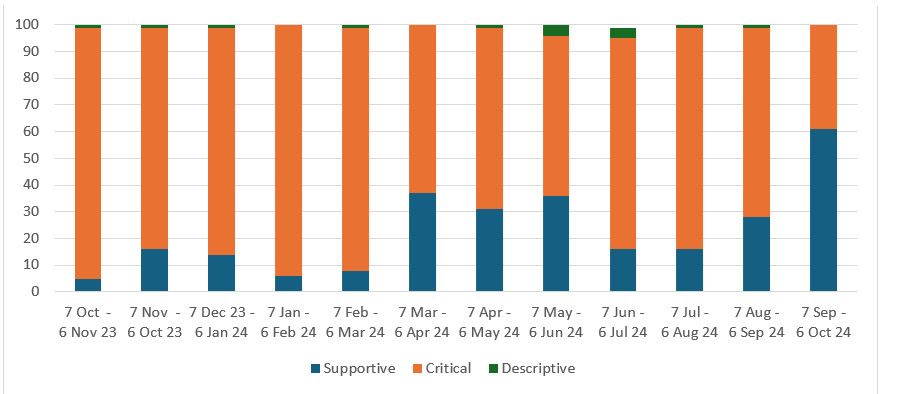
By contrast, most English-language posts were critical. Between October 2023 and February 2024, 76 percent of posts criticised supporters of ‘no innocents’ rhetoric, especially high-profile Israeli decision-makers and commentators, military forces and commentators from the US and Germany. One notable exception was September 2024, when the share of critical posts fell sharply to 39 percent while 61 percent of posts were supportive.
Posts critical of ‘No Innocents’ rhetoric
In many cases, posts criticising ‘no innocents’ rhetoric were framed around human rights concerns and a clear desire to protect civilians. In some cases, however, such posts promoted antisemitic or dehumanising narratives themselves, e.g. mocking Israeli hostages captured by Hamas. Those criticising ‘no innocents’ rhetoric came from a broad variety of backgrounds, including pro-Palestinian and human rights activists, Muslim voices, anti-Zionists, liberal journalists, far-left commentators, right-wing extremists, supporters of anti-Western dictatorships, influencers known for promoting conspiracy theories and disinformation, and Islamist extremists. The opposition to dehumanising rhetoric of Palestinians clearly seems to have been a relevant issue for a counter-intuitive combination of groups and individuals.
Platform policy inconsistencies
Posts supportive of ‘no innocents’ rhetoric often appear to violate multiple, distinct policies on X including hate speech, violent speech, and abuse and harassment. However, the level of enforcement of these posts is limited, potentially reflecting issues such as under-resourcing of non-English moderation teams.
The incitement sub-category of X’s hateful conduct policy forbids “inciting fear or spreading fearful stereotypes about a protected category, including asserting that members of a protected category are more likely to take part in dangerous or illegal activities, e.g., ‘all [religious group] are terrorists’”; this language directly echoes some of the language found by ISD. ‘No innocents’ rhetoric would also likely fall under another subcategory of hateful conduct policy, “dehumanisation”, although X does not provide a clear definition of the policy. The discourse also appears to violate sub-categories of X’s violent speech policy such as “desire for harm”, “incitement to violence” and “glorification of violence”, and the platform’s policy on abuse and harassment.
Given the broad cross-section of violations, the prevalence of these posts suggests an inconsistent enforcement of X’s policy. This was particularly evident in Hebrew, potentially reflecting a broader platform issue: under-resourcing of non-English language moderation teams, which has significant ramifications during crises and conflicts.
Conclusion
By extending the category of ‘guilty’ or ‘involved’ beyond combatants, ‘no innocents’ discourse undermines basic norms and distinctions, encouraging and justifying violence and hatred. The impact of ‘no innocents’ rhetoric is most acutely felt in Gaza but it supports reciprocal violence: previous ISD research has documented the ‘myth of the Israeli civilian’ narrative, which characterises Jewish Israeli civilians as legitimate military targets.
The promotion of dehumanising rhetoric also risks inflaming tensions and polarisation beyond the region. The conflict has triggered a surge in reported anti-Muslim and anti-Arab hate online, while antisemitic hate incidents have risen dramatically in the UK and US. Examples include the killing of a Palestinian-American child in October 2023, the shooting of three Palestinian students in Vermont in November 2023, the fatal shooting of two Israel Embassy staff in Washington D.C. in May 2025, and a firebombing attack targeting a June 2025 rally for Israeli hostages in Gaza which killed a woman.
Framing Palestinians as an alien ‘other’ and undermining basic norms around the equality of human lives compounds the risk of violence against Muslim, Arab and Jewish communities globally. Defending universal human rights and norms while combatting dehumanising rhetoric is not just critical for Israel and Palestine, but also for the peaceful co-existence of different communities outside of the region.
[i] Protection of civilians is among the most basic elements of international law as it pertains to armed conflict. This means that the intentional targeting of non-combatants is strictly prohibited and that, wherever possible, parties to the conflict are required to minimise civilian casualties. The obligation to distinguish between combatants and non-combatants also implies that collective punishment of civilians for actions beyond their control is prohibited under international law.
[ii] The exact number of civilians involved on 7 October has not been determined. Israeli military investigations have claimed that for some 2,200 people (of 6,000 involved in the attack overall) their status was not clear, but that they were likely made up of both members of armed groups other than Hamas (including individuals wearing civilian attire) and civilians. https://www.timesofisrael.com/report-new-idf-assessment-shows-some-6000-gazans-invaded-israel-on-oct-7/
[iii] Hamas itself has blamed civilians who joined the 7 October attacks for attacking civilians, claiming that it had instructed its fighters not to target civilians. This claim was strongly rejected by Human Rights Watch. https://www.hrw.org/report/2024/07/17/i-cant-erase-all-blood-my-mind/palestinian-armed-groups-october-7-assault-israel
[iv] Significant public debate has emerged on whether the figures produced by the Ministry of Health (which is an agency of the Hamas government in Gaza) are credible, as news organisations are not able to independently verify them due to Israeli reporting restrictions around the current conflict in Gaza. While some politicians and journalists have argued that Hamas has a clear propaganda incentive to inflate the death count, figures by the Ministry of Health have previously been used by the US State Department and were judged to be ‘generally reliable’ by human rights organisations in the past.
[v] In a 13 September 2023 interview with Kan, from 8:05 minutes, Eliyahu Libman advocates the razing of all Arab/Palestinian residences near any terrorist incident in order to deter future attacks: “even if there is a price to those that are often called innocents… and most of them, I tell you Suleiman, are not innocents, they who are raised from a young age to kill Jews, who hand out baklawa, who at the moment are supporting…” https://x.com/SuleimanMas1/status/1701984451629084937
Libman is the head of the Kiryat Arba town council, a West Bank settlement associated with extremism. Security Minister Itamar Ben-Gvir is a resident, and Baruch Goldstein, who killed 29 Palestinians in the Ibrahimi Mosque in Hebron in 1994, lived in and is buried in Kiryat Arba.
One month after the 13 September interview, Libman’s son Elyakim was killed on October 7. https://www.bbc.co.uk/news/world-middle-east-68953413
[vi] Based on the analysis of the 20 posts with most shares during those two weeks, 70 percent were straightforward ‘no innocents’ discourse while 20 percent criticised the use of the term ‘uninvolved’ during the week of 23 October. In the week of 27 November, 60 percent were straightforward ‘no innocents’ discourse and 15 percent criticised the use of the term ‘uninvolved.’
[vii] It should be highlighted that Herzog has since claimed his words had been misrepresented. Herzog argues that by referring to “an entire nation that that is responsible”, he did not mean to imply innocent civilians were legitimate targets and maintained that Israel would uphold international law. https://www.timesofisrael.com/a-blood-libel-herzog-says-icj-twisted-my-words-to-support-unfounded-contention/
[viii] The logic presented in these statements mirrors arguments used by some Salafi jihadists against the West, who often justified terrorist attacks against civilians in the West by arguing that, since citizens in democracies can vote and pay taxes, they are personally liable for the actions and policies of their elected governments and therefore become legitimate military targets. See: Maher, Shiraz. Salafi-Jihadism: The history of an idea. Oxford University Press, 2016, p. 56-59
[ix] Baconi, Tareq. Hamas contained: The rise and pacification of Palestinian resistance. Stanford University Press, 2018, p. 92-96
In the media
ISD Contributors