Digital Dispatches
January 27, 2026
ISD UK, ISD-US
Foreign Information Manipulation and Interference
Hostile state responses to US action in Venezuela
27 January 2026
Executive summary
The US operation to capture and exfiltrate Nicolas Maduro and his wife from Venezuela signaled a turning point in President Donald Trump’s efforts to restructure the existing global order. For adversaries (particularly Moscow, Beijing and Tehran), the operation marks the potential loss of a key ally in the region and the prospect of facing off against a US administration unrestrained by global norms and international law. However, this operation also provided all three countries with an opportunity to promote anti-US narratives.
This Digital Dispatch examines how Russian, Chinese and Iranian state-affiliated media and diplomatic accounts were relatively united in their criticism of the US, including a shared apprehension over the ramifications for the international status quo. Though such arguments often mirrored those advanced by US allies, it is important to note that Moscow, Beijing and Tehran have consistently sought to upend the global order for their own ends.
Key findings
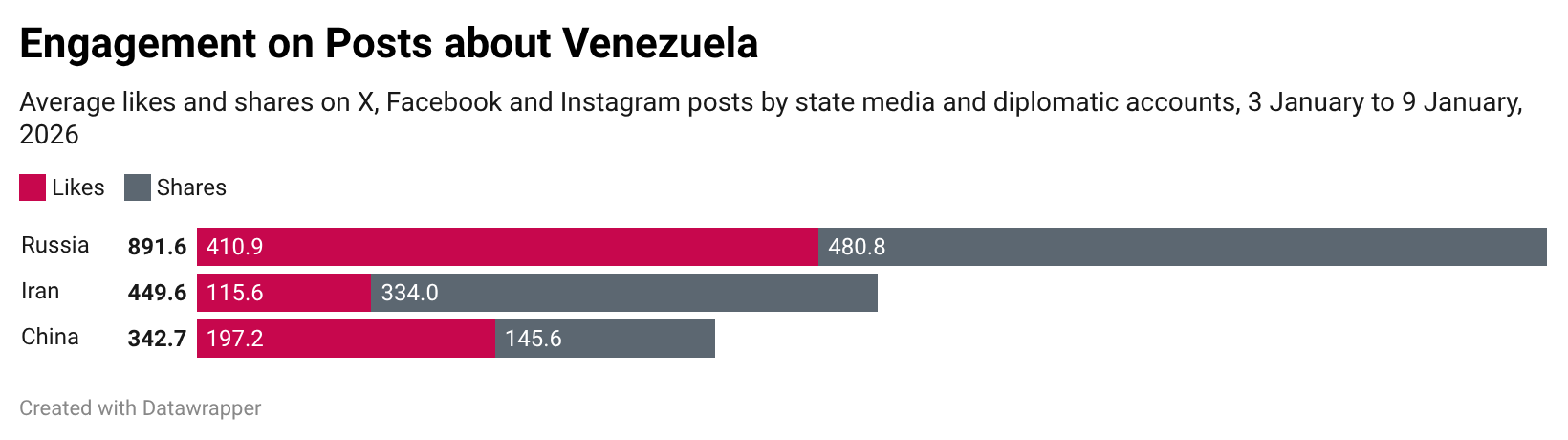
- Accounts linked to Russian state media generated the highest average engagement on its posts of the three countries. Russian X, Facebook and Instagram posts averaged nearly 900 likes and shares, close to double Iranian accounts and almost triple that of their Chinese counterparts.
- Despite Chinese state media using provocative cartoons and memes in relation to the Venezuelan operation, state-backed accounts largely avoided comparisons to a Chinese intervention in Taiwan, a topic that gained significant attention from Chinese social media users.
- Although Russian state media commentators accused the US and the broader West of hypocrisy, they were more reticent to discuss the US seizure of a Russian-flagged oil tanker linked to Venezuela.
- CGTN (China Global Television Network) en Español and RT (Russia Today) en Español posted more Venezuela-related content on X than any other Chinese or Russian state media account, suggesting that both countries prioritized Spanish-language audiences.
- Although Russian accounts posted more often in Spanish than English, their English-language content generated 63 percent more likes in total.
- Iranian messaging highlighted Maduro’s support for the Palestinian cause to suggest possible Israeli involvement in his arrest. Iranian accounts also focused on oil as the motivating factor for the US operation.
Methodology
ISD analysts used an existing list of attributable Russian, Chinese and Iranian state media and diplomatic accounts created by the Alliance for Securing Democracy for its Hamilton 2.0 dashboard, which is now housed under ISD-US following the January 2026 merger.
Data from X, Telegram, Facebook, Instagram, YouTube and TikTok accounts from 3 January 2026 to 9 January 2026 was collected using monitoring and analysis tool Junkipedia and analyzed by ISD analysts. In total, we found more than 4,900 Venezuela-related posts from Chinese-linked accounts, 2,600 from Russian-linked accounts and 900 from Iranian-linked ones. Some non-European language posts may have been missed due to translation issues. Differences in Venezuela-related outputs also reflect differences in total outputs: Chinese and Russian accounts posted far more often than Iranian accounts.
RUSSIA
Moscow condemns “hypocritical” US but stops short of escalation
Russian diplomatic and state media accounts criticized US actions in Venezuela as illegal, dangerous, hypocritical and unpopular domestically and globally. Common Russian narratives were that the US violated international laws and norms that it had championed for decades, eroding the rules-based system it helped build, isolating itself diplomatically and undercutting moral objections to Russia’s invasion of Ukraine.
Russian diplomats focused on the norm-breaking effects of the US operation. In a Telegram post, Russia’s Mission to the UN condemned the US seizure of Maduro as a “criminal operation” that violated “all norms of international law” and “given new impetus to neocolonialism and imperialism.” The same post called for the US to immediately release Maduro, whom it described as the “legitimately elected president” of Venezuela (Venezuela’s 2024 election results received widespread condemnation. Some governments, including the Biden Administration, publicly recognized the opposition candidate).
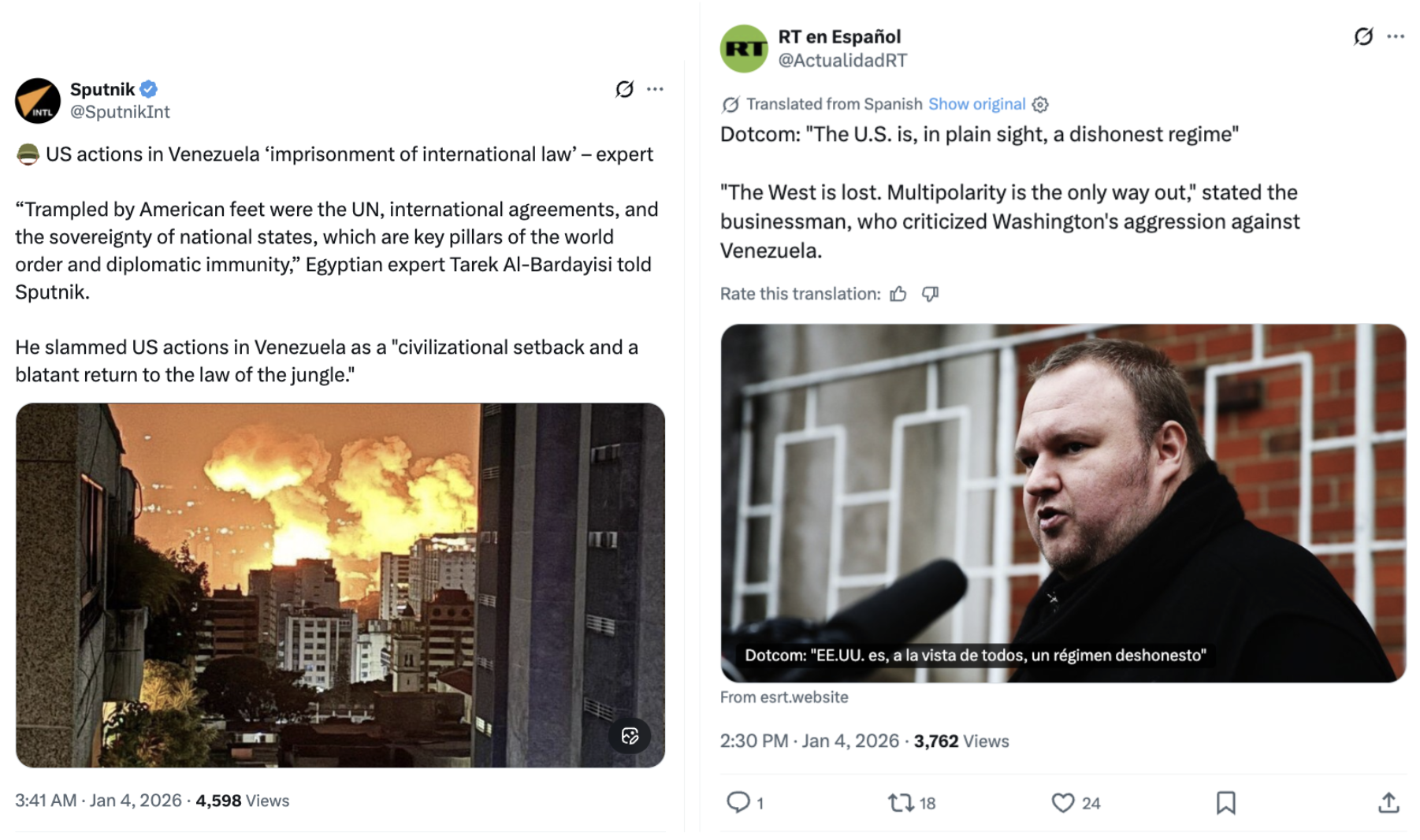
Russian state media accounts similarly framed the US arrest of Maduro as a geopolitical turning point. In an X post, Sputnik asserted that the United States had “trampled… key pillars of the world order,” ushering in “the law of the jungle.” RT en Español posted that events surrounding Venezuela proved “the West is lost. Multipolarity is the only way out.” This is in line with Russian state media’s long-standing efforts to legitimize a world in which great powers dominate spheres of influence, unconstrained by the institutions, rules and norms that the US and its allies have supported for decades.
Russian state media also used this framing to accuse the US and the broader West of hypocrisy for opposing Russia’s war in Ukraine. One state media commentator on Telegram asserted that the “US invasion of Venezuela will nullify all Western claims against Russia regarding Ukraine.” Another commentator on X compared the EU’s response to the Russian invasion in February 2022 with its reaction to Venezuela, joking that the EU would sanction the US for its “‘full scale, unprovoked attack.’” Other accounts framed US involvement in Venezuela as “the end of Ukraine,” suggesting that Washington could no longer credibly oppose Russia’s war based on international law.
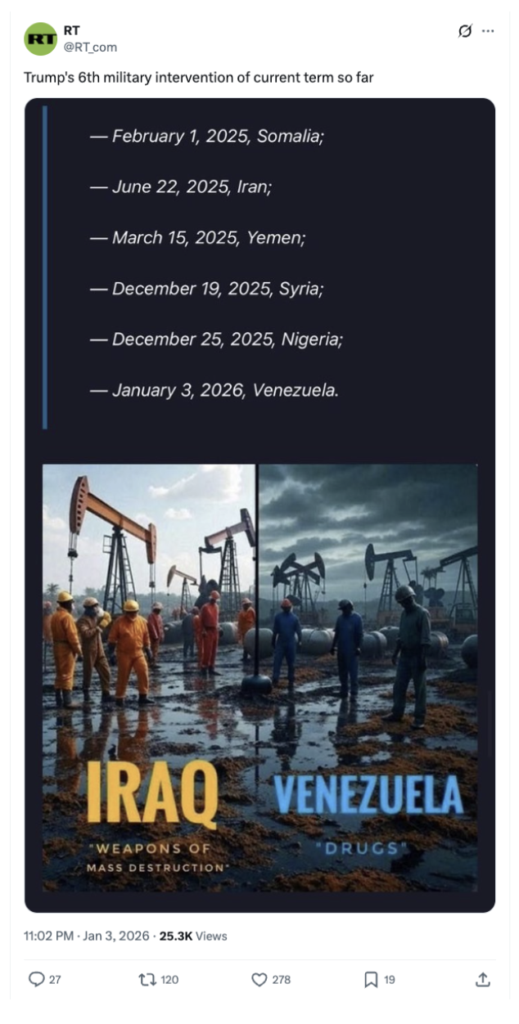
Russian state media accounts referred to Trump as a “filthy animal” and a “primate in a suit,” while others mocked his “bone spurs” in an apparent reference to the medical condition that prevented him from serving in the Vietnam War. They also criticized Trump for styling himself as “the President of Peace”: RT alleged that Trump had instigated or continued conflicts in Somalia, Iran, Yemen, Syria, Nigeria and Venezuela since taking office in 2025. Other accounts speculated about whether Trump would soon order military action against countries or territories including Greenland, Colombia or Iran.
Russian state media accounts also drew on criticism of US actions from officials and civilians across Europe, Africa, Asia and South America. On X, Russian diplomat Mikhail Ulyanov reposted an unverified claim that there were demonstrations in “75 cities” in opposition to the Trump administration. These posts were likely meant to portray Washington as an isolated rogue actor without moral authority to criticize Russia.
State media accounts also amplified domestic criticism of Trump’s actions, including quotes from Republican lawmakers that disagreed with the Maduro’s capture. One commentator claimed Trump had “betrayed his MAGA base once again for an imperialist regime change operation.” RT and other accounts also showed Democrats deriding US actions in Venezuela and raising questions about Trump being impeached.
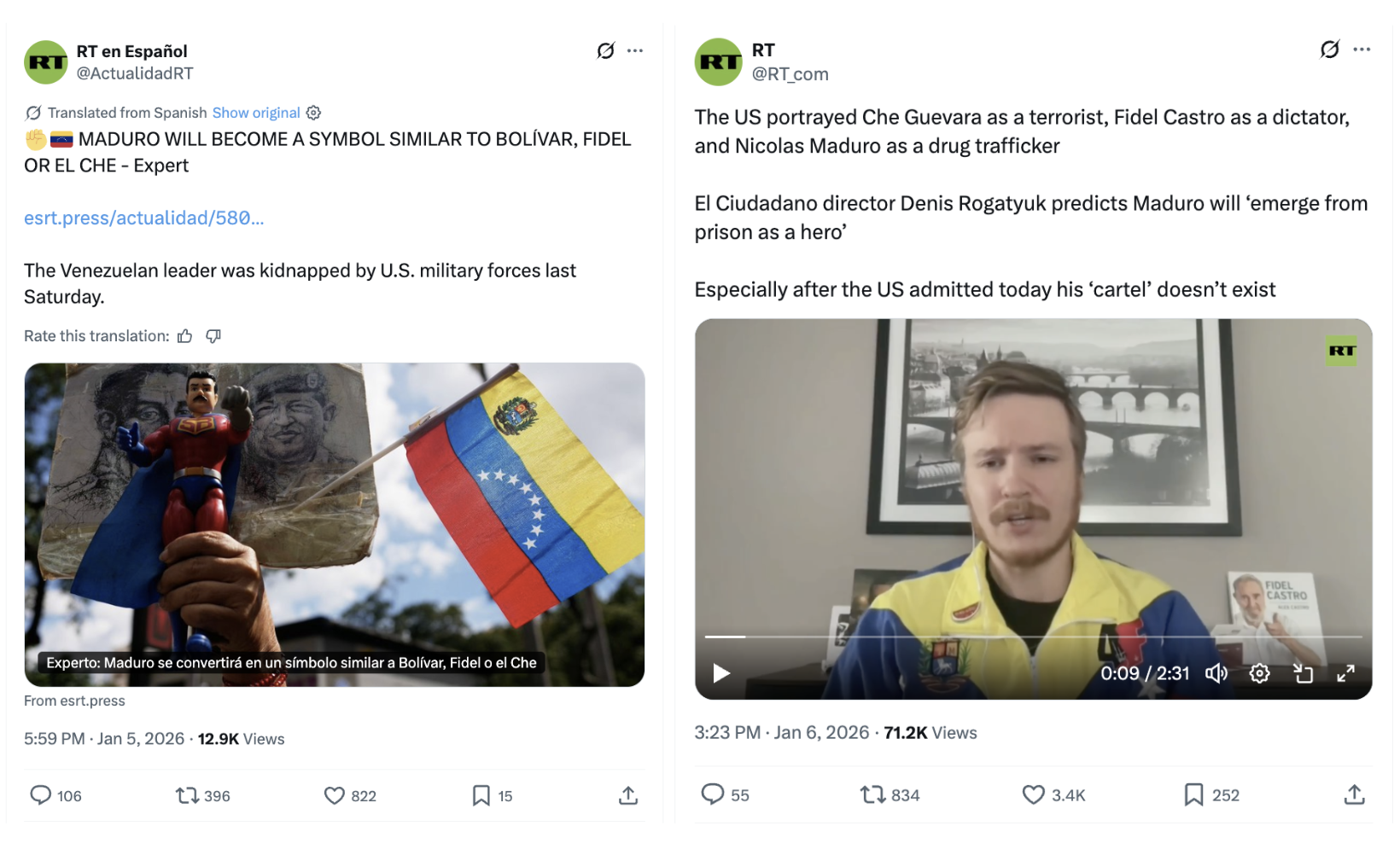
At the same time, Russian state media accounts portrayed Maduro as a hero with broad support in Venezuela and abroad; the Russian state has invested significant resources into the country under both Maduro and his predecessor Hugo Chavez. RT showed Venezuelans flooding the streets, carrying portraits of Maduro and demanding his release. Other accounts claimed he would “emerge from prison a hero” who would become a symbol akin to “[Simon] Bolivar, Fidel [Castro], and Che [Guevara].” These narratives were likely designed to signal that Russia stands with regimes around the world against US pressure.
Russian state media and diplomatic accounts were more circumspect when discussing the US seizure of a Venezuela-linked oil tanker flying Russia’s flag on January 7. On Telegram, the account for Russia’s Minister of Foreign Affairs condemned the action as “a serious violation of the fundamental principles and norms of international maritime law,” reflecting Moscow’s official protest against what it characterized as “illegal use of force.”
State media provided factual updates on the situation but largely refrained from portraying the incident as an escalation or a direct step toward war between the United States and Russia. This restrained coverage suggests an effort to signal disapproval without further inflaming tensions.
CHINA
Beijing worries about a “systemic shock” to the international order but dodges comparisons to Taiwan
China’s state-backed messengers presented the US as a hegemonic, imperialist country whose actions threaten peace and global security. In posts from YouTube, Telegram, Facebook, Instagram and X from 3-9 January these accounts mentioned “imperialism” 144 times and “hegemony” 159 times in reference to the US. Those numbers, however, likely represent an undercount because non-Indo-European languages were not included in our search queries. The prevailing narrative was that the US action was a “blatant violation” of international law motivated by oil. Chinese accounts also claimed events in Venezuela were a warning for other countries (notably Greenland and Colombia) in the crosshairs of US “hegemonic unilateralism.”
Chinese state media’s more editorialized coverage focused on the impact of the arrest on global stability. For example:
- The Global Times claimed it had delivered “a systemic shock to the international order,”
- CGTN en Español declared that the operation was evidence of a “breakdown of international rules,”
- Xinhua en Español called it a “forced alteration” of Venezuela’s “political order,”
- The Global Times labelled it a “subversive blow to the international order and established rules,”
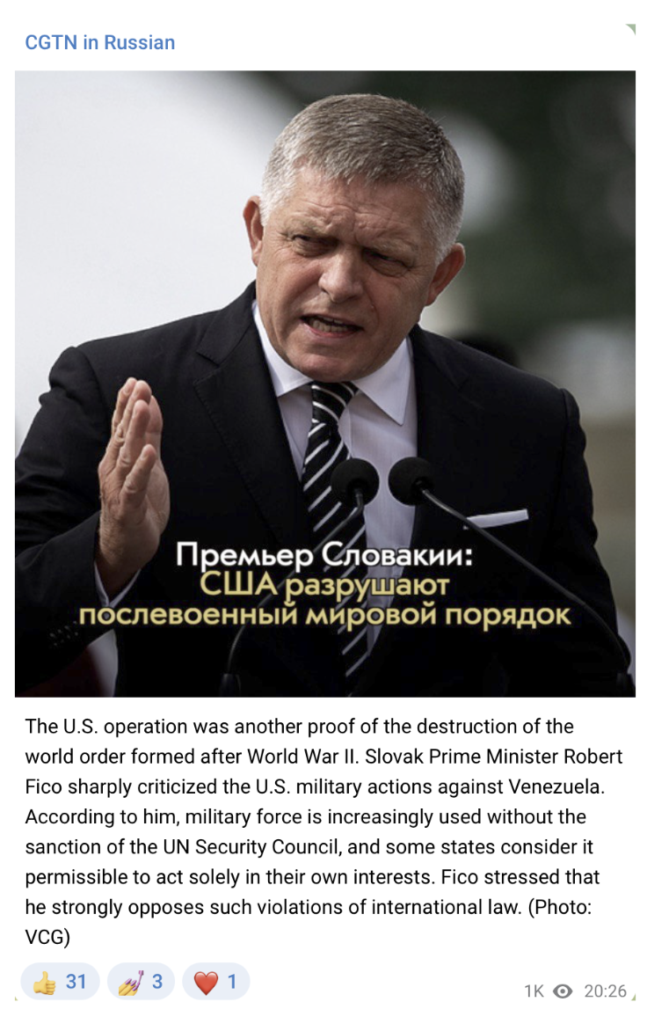
- CGTN’s Russian-language outlet observed that it was “yet more proof of the destruction of the world order established after World War II.”
Much like their Russian counterparts, several Chinese state media outlets highlighted global condemnation and criticism of the operation, including from US allies such as South Korea, Japan and Slovakia.
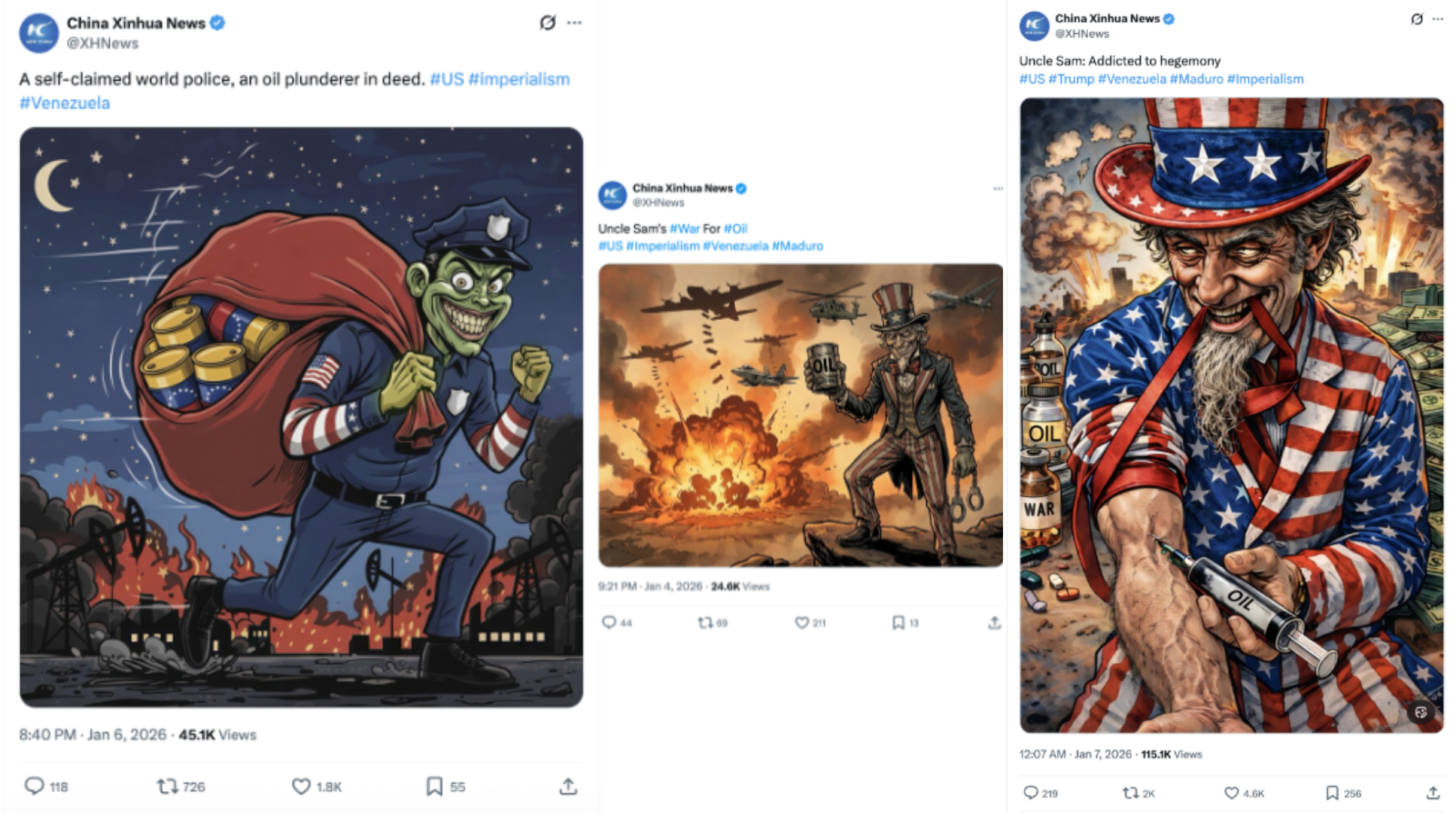
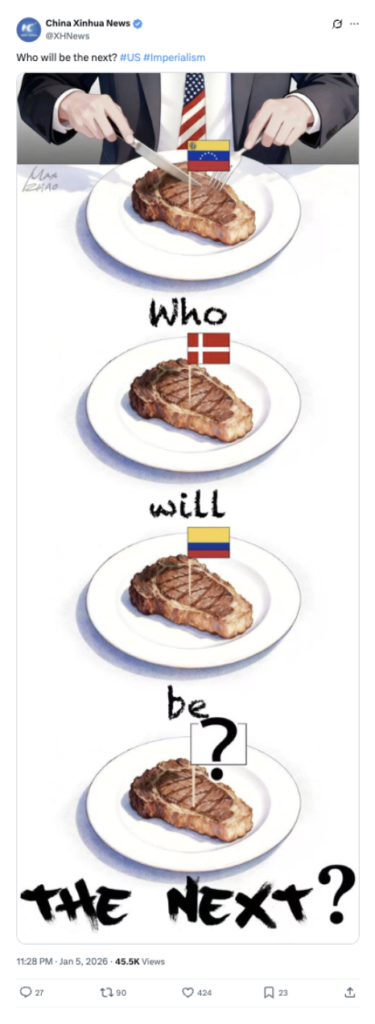
The most explicit and provocative commentary was relayed through cartoons and memes. In several images posted by Xinhua, demonic figures representing the US plunder barrels of oil while a city (presumably Caracas) burn in the background. Another Xinhua cartoon depicts Uncle Sam as an addict injecting oil into his bicep. This image has been viewed more than 85,000 times and received more than 4,500 likes on X.
Several Chinese state media posts featured the question “who will be the next?” alongside images or names of countries that the Trump administration has mentioned as possible targets.
Chinese diplomats, who have largely eschewed the more assertive messaging style deployed during the era of so-called “Wolf Warrior diplomacy” (roughly 2020-2023), were generally less active and less confrontational than Chinese state media on social media. Between 3-9 January, the diplomatic accounts monitored by ISD mentioned Maduro in 93 posts and Venezuela in 283 posts, representing just 3 percent and 8 percent of their respective total outputs. By comparison, monitored Chinese state media accounts mentioned Maduro in 1,637 posts (6 percent) and Venezuela in 4,157 posts (16 percent). Again, posts in non-Indo-European languages may not have been included.
Most Chinese diplomatic posts about Venezuela simply repurposed or rephrased official statements from China’s Ministry of Foreign Affairs (MFA) – most commonly a post condemning the “hegemonic act” and accusing the US of “threaten[ing] peace and security in Latin America and the Caribbean region.” Only a handful of Chinese diplomatic accounts engaged with more forceful messages, usually reposting the provocative Xinhua cartoons.
Both diplomatic and state media accounts largely avoided explicit discussions of how the situation in Venezuela might impact China’s calculus on Taiwan or other geopolitical issues. ISD analysts uncovered only one example of a Chinese state-affiliated account mentioning Taiwan in relation to Venezuela: a Facebook post from a Xinhua journalist who stated that “Taiwan becomes an increasingly available target [after the operation]” and that “voices on Chinese social media have grown louder, calling for similar decapitation operations against Taiwan’s leader, Lai Ching-te.”
At least four different outlets also took the opportunity to publish editorials that directly or indirectly positioned China as a more benign partner than the US in the so-called “Global South.” An editorial in the Global Times suggested that Latin American resistance to “U.S. aggression, intervention, economic colonization and ideological control” would create a sense of urgency “that pushes more countries to strengthen solidarity, coordination, and cooperation”; the article was circulated on its various social media accounts. China Daily Asia published a similar op-ed that labeled deepening ties between China and Latin America “a ‘win-win’ for all.”
IRAN
Tehran slams US imperialism and searches for a Zionist link
Official Iranian accounts also lambasted the military operation as a flagrant violation of Venezuela’s sovereignty and evidence that the US is a threat to global security. They called out the US for lecturing the world about the rules-based international order when it does not respect it themselves, comparing the operation in Venezuela to the Trump administration’s strikes against Tehran last year. Iranian Foreign Minister Sayed Abbas Araghchi characterized Maduro’s capture as “state terrorism” and state media in English-language posts were more than twice as likely to refer to Maduro’s capture as a “kidnapping” than an “arrest” (301 posts to 124).
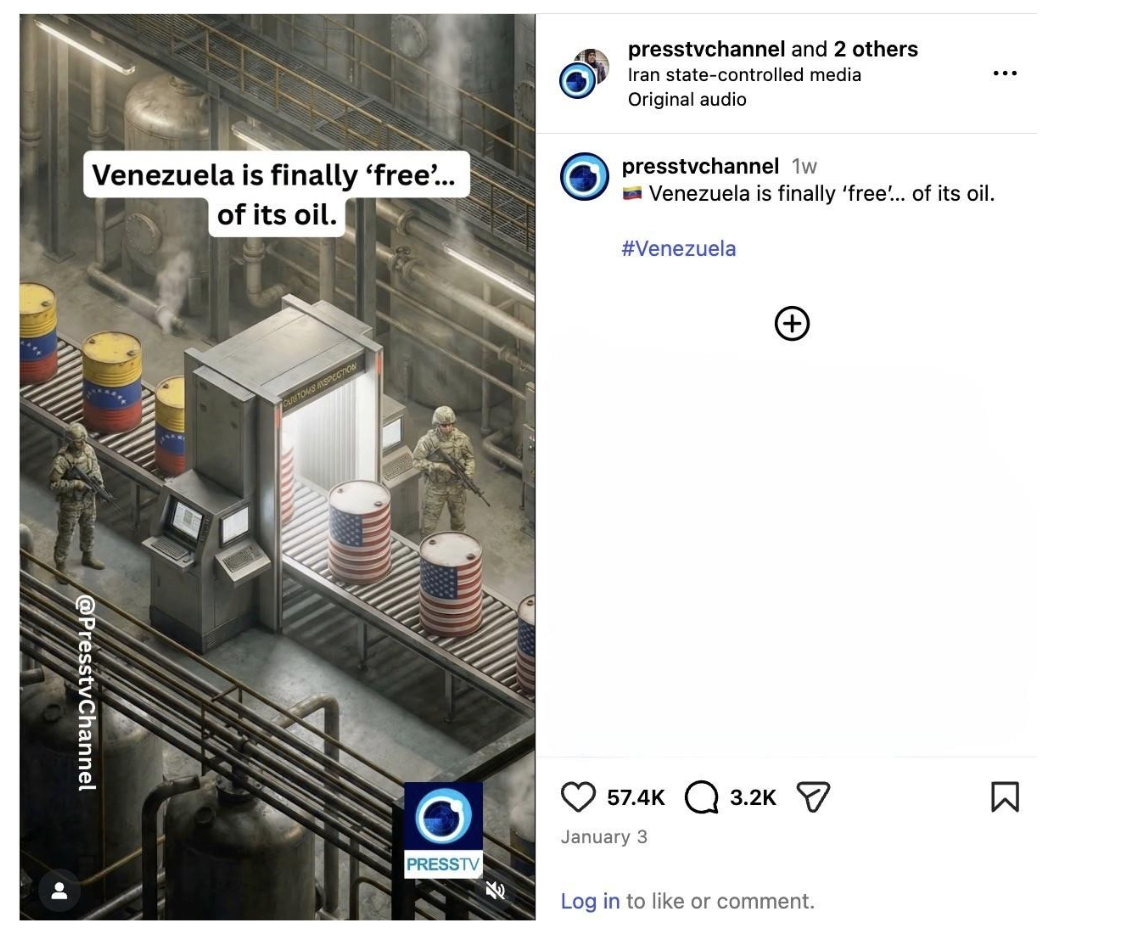
These narratives were buttressed by content framing the US as an imperialist power. Iranian state media outlets claimed the US military operation in Venezuela marked the return of “colonial seizure politics,” suggesting that the US set its eyes on Venezuela after discussing colonizing Gaza. Iranian state-affiliated accounts also amplified accusations that the military operation was motivated by Venezuela’s oil reserves: Press TV published a computer-generated video of a factory line of Venezuelan oil barrels being repainted with the American flag alongside the caption “Venezuela is finally ‘free’… of its oil.”
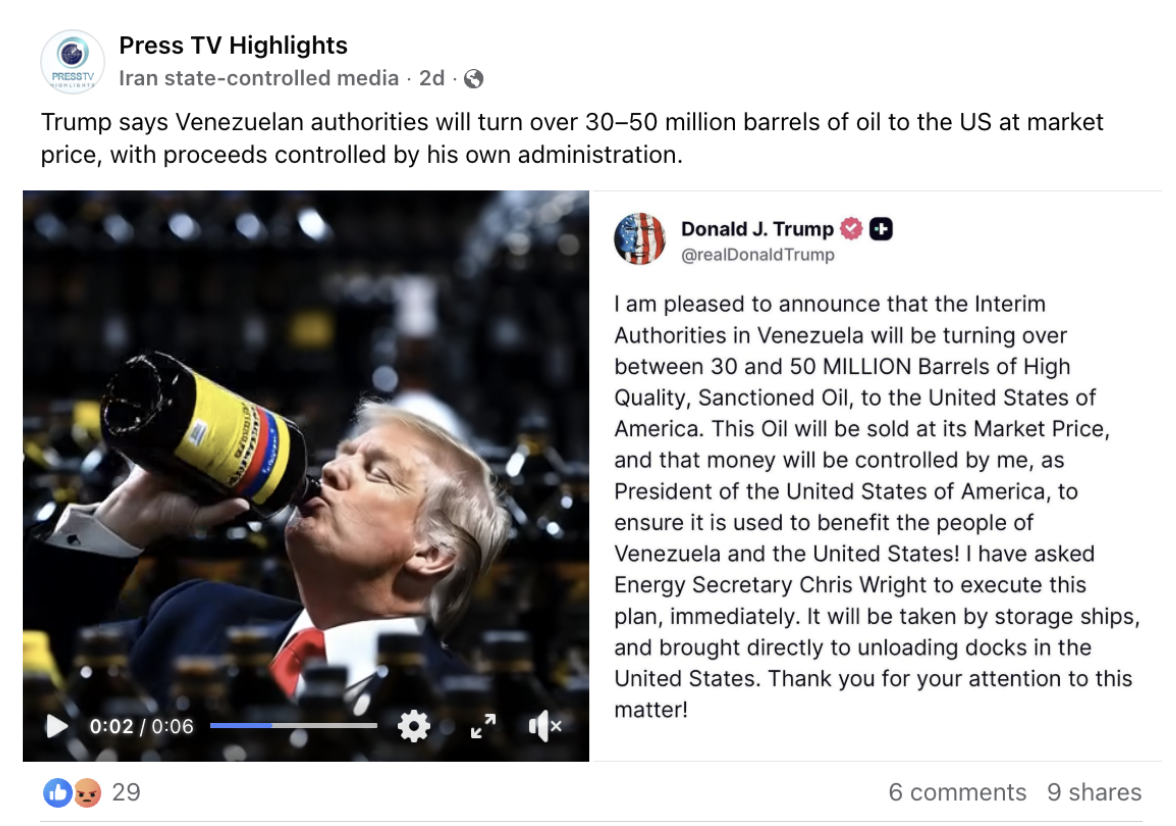
Iranian state-affiliated messengers also focused on Trump directly. A Press TV op-ed called Trump a “gangster in a suit” who weaponizes US power for his own profit, ridiculing his political mantra: “Trump didn’t drain the swamp. He turned it into open water for pirates.” Other accounts posted an AI-generated video of Trump guzzling a bottle of Venezuelan oil, claimed the president launched the operation to distract the public from the Epstein files and challenged his assertion that he is a “president for peace.”
In typical fashion, Iranian-linked accounts also tried to link Maduro’s capture to the Israeli government. Multiple state outlets amplified comments by Venezuela’s acting President Delcy Rodríguez that Maduro’s capture had “Zionist undertones.” Press TV posted a video on Instagram implying Israel was complicit in the attack because of Maduro’s support for the Palestinian cause. A Press TV pundit similarly drew parallels between the operation and Israeli attempts to “decapitate” other foreign governments. He also smeared a hedge fund proprietor, claiming that he works for Mossad—the Israeli intelligence agency—and is set to make “massive profits” from Maduro’s capture.
Conclusion
The common thread in the collective messaging of the three countries is that Maduro’s arrest signals an end to the rules-based order that has governed the post-World War II period. While clearly a rhetorical opportunity to denigrate the US and the West, there was an undertone of anxiety about what this would mean for the global balance of power. There is a certain irony in this: all three powers have made consistent efforts to upend that balance, including, in the case of Russia, through military force.
Hypocrisy aside, the criticism of alleged US “imperialism” and “colonialism” is likely to resonate with many audiences—not least because comments made by some Trump administration officials seem to bolster rather than dispute that narrative. This presents an opportunity for Russia, China and Iran to take advantage of international wariness over the US’s motives to position themselves as an alternative, particularly in places with longstanding or newfound concerns about US interventionism.