Digital Dispatches
April 22, 2026
ISD-US
Antisemitism, Targeted Threats, Hate and Abuse, Tech Accountability and Safety
The impact of the war with Iran on antisemitic discourse
The 28 February US and Israeli strikes on Iran and subsequent conflict prompted a surge in antisemitic conspiracy theory content online. Across YouTube, X, BlueSky, Telegram and 4chan, ISD identified a 68 percent increase in antisemitic posts over the following week. This escalation preceded an increase in offline antisemitic attacks in March—targeting synagogues and Jewish institutions in the US, Canada, Belgium and the UK—indicating an elevated threat environment affecting the global Jewish diaspora. To understand how this type of hate might be impacting Jewish communities, we conducted a state-of-the-art narrative segmentation to assess how antisemitic hate online has shifted around the Iran war.
Key Findings
- Following the 28 February launch of US and Israeli military operations against Iran, ISD observed a 68 percent increase in online content classified as antisemitic, with at least 57,133 posts in the week immediately following the outbreak of war, compared to 34,060 the prior week. For the remainder of the month of March, the volume of antisemitic content remained elevated, contributing to a sustained heightened threat environment. .
- Following the strikes, previously disparate antisemitic activity coalesced into more focused and event-driven narratives, with increased volumes of conspiracy content about alleged Jewish political control. The United States’ and Israel’s joint involvement fueled allegations that the conflict was a “false flag,”[1] and that Western leaders serve a manipulative Jewish elite. Rhetoric originating in white nationalist communities, such as references to a “Zionist occupied government,” filtered through comment sections and reactions to headlines about the strikes.
- The conflict prompted a wave of conspiratorial backlash against the state of Israel and Zionism. Not all backlash to Israel’s involvement in the war is considered antisemitic, and criticism of Israeli policy constitutes legitimate public debate when not holding the Jewish people collectively accountable for the actions of the state of Israel. However, recurring themes within this cluster framed the criticism in antisemitic tropes, including assigning collective responsibility to the Jewish diaspora for the actions of the Israeli government.
- User-to-user antisemitic hate speech saw a significant boost in volume. These clusters of content consisted of public social media posts containing antisemitic slurs or insults, largely targeting Jewish commentators or individuals with perceived ties to Israel.
- The escalation in online rhetoric targeting Jewish individuals correlates with the recent increase in offline antisemitic attacks, contributing to an overall heightened threat environment for Jewish communities. In March alone, at least eight antisemitic attacks were recorded in five countries, some attributed to a previously unknown militant Islamist group.
- Beyond conspiracies about Jewish political control, antisemitic backlash to the state of Israel, and interpersonal antisemitic hate speech noted above, ISD also assessed other antisemitic narratives whose volume remained relatively consistent during the period of interest. Classic antisemitic tropes, white nationalist content, and media control allegations continued to circulate across multiple social media platforms, receiving a modest boost in the wake of the strikes. By contrast, historical antisemitic conspiracy content—such as claims of a secret alliance between Jews and Freemasons—declined slightly, as social media users directed their attention towards political influence claims and more modern forms of antisemitism.
Methodology
We collected data from YouTube, X, BlueSky, Telegram and extremist forums (e.g. 4chan) between 12 February and 6 March 2026. In total, we collected approximately 275,000 posts across platforms using a broad set of hundreds of keywords associated with antisemitic discourse.
Next, ISD developed a custom large language model (LLM) to identify social media content containing antisemitic rhetoric. Model performance was validated against a human-coded dataset, providing a benchmark for assessing accuracy and identifying potential sources of classification bias.
The model, built using Claude Haiku 4.5, achieved an F1 score of 0.87. F1 score is a standard measure of model performance that combines two metrics:
- Precision: the proportion of posts labelled as hateful by the model that were in fact antisemitic.
- Recall: the proportion of antisemitic posts that the model correctly identified.
After using our model to identify antisemitic rhetoric, we ended up with 91,193 total posts, which we applied to Nomic Atlas. In this process, semantically related messages are placed into topic clusters which are then manually assessed and broken into themes (e.g. “Backlash against Israel or Zionism”) and sub-themes (e.g. “Zionist False Flag Allegations”). Topic modelling represents each message numerically such that messages with similar (mathematically close) representations have similar semantics.
The project included a quantitative analysis of these narrative themes across two separate time intervals: the week immediately prior to the US and Israeli strikes on Iran on 28 February, and the week immediately afterward. The significant spike in volume on 28 February suggests a point of sudden change in the narrative landscape. ISD analysts assessed changes in the narratives’ volume in absolute terms, as well as changes in the narratives’ percentage share of the overall volume of antisemitic content during each period.
Figure 1: Volume of social media posts classified as antisemitic in the two-week period around the February 28 strikes.
Narrative Evolution
The 28 February strikes corresponded with a 68 percent increase in online content classified as antisemitic. For multiple weeks after this initial spike, the volume of antisemitic content remained elevated compared to pre-war averages, suggesting that the event had a sustained impact on the shape of extremist narratives.
The significant volume of content on the 28th can be primarily attributed to two narratives. The first, and the largest across both time intervals, consisted of antisemitic allegations of Jewish political control. The second, which experienced a sudden increase on the 28th, was a variety of content expressing backlash to Israel and Zionism. While criticism of Israel’s involvement in the conflict constitutes legitimate discussion, much of the content sorted into this cluster employed specific antisemitic framing, contributing to the narrative’s growth.
Jewish Political Control
The largest relevant narrative by volume both before and after the February 28 strikes was the antisemitic trope of Jewish political control. Relying on a historic antisemitic conception of Jews as a self-serving and politically domineering people, this narrative focused on allegations that global governments—particularly in the West—serve the interests of their manipulative Jewish elite. Posts blaming Jewish warmongering for the outbreak of conflict featured prominently in the second half of the dataset, including unfounded claims that certain strikes were “false flags” serving Jewish interests.
This content also included conspiratorial framing of Zionist political influence worldwide. For example, the term ZOG, or “Zionist occupied government,” circulated widely in online conversations about the United States’ political motivations to enter the war. A longstanding strain of antisemitism with origins in white nationalist communities, “ZOG” has served as a rallying term for accelerationist movements advocating violent action against purportedly illegitimate leaders. Iterations of this language are also evident in conspiratorial far-left criticisms of “occupied governments” in the West.
Political influence content nearly doubled in volume in the period after the war; however, the narrative’s percentage share of the overall volume only modestly increased and was counterbalanced by the surge in backlash against Israel, a related but distinct cluster in the online conversation. The political influence narrative resonates across a spectrum of online communities who apply it to a diverse array of political grievances, contributing to its prominence both before and after the strikes.
Figure 2: Chart showing key narratives’ share of the broader antisemitic conversation in the week before and after February 28
Figure 3: Chart showing the volume of antisemitic content amplifying key narratives in the week before and after February 28
Backlash Against Israel and Zionism
The most drastic observable change was a sharp increase in online backlash to Israel. While the pre-war narrative environment was previously marked by a significant volume of miscellaneous, thematically dissonant clusters, the post-28 February saw much of this conversation converge into backlash to Israel’s involvement in the regional conflict. Not all of the criticism of Israel observed in the dataset was explicitly antisemitic, and critiques of Israeli policy constitute legitimate political discourse. In particular, the outbreak of war prompted valid online discussion of the United States’ reliance on Israeli intelligence. Programmatic topic modeling is limited in its ability to capture the nuanced ways in which criticism of Zionism may be framed with antisemitic tropes or applied indiscriminately to the Jewish diaspora. However, hateful and conspiratorial posts featured prominently in these clusters and contributed to the overall spike in volume. Antisemitic strains of this narrative included implications that the global Jewish diaspora are collectively responsible for the policies of the state of Israel, the use of Holocaust-related language in criticism of Zionism or Zionists, and characterizations of Israel’s actions that invoke classic antisemitic tropes like blood libel.
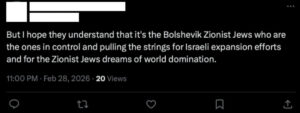
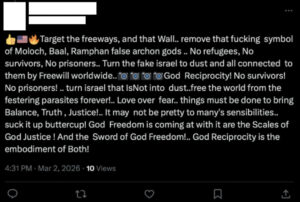
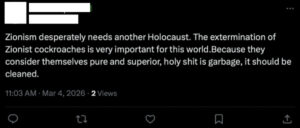
The proportion of this narrative within the broader dataset jumped from about 15 percent before the war to about 28 percent afterward—the highest increase among all narratives assessed. This narrative’s significant jump in volume in both absolute and proportional terms underscores the sudden circulation of content about Israel’s strikes across a diverse array of online communities. When this backlash employs hateful or conspiratorial rhetoric, it can have a mainstreaming effect on antisemitism on these communities.
Interpersonal Antisemitic Hate Speech
The third largest relevant topic in the wake of the outbreak of war consisted of antisemitic insults and slurs directed toward other social media users, contributing to an increasingly hostile online environment for Jewish social media users. Many of the relevant posts in these clusters weresimple, one-word comments employing a slur. These posts included longstanding antisemitic slurs as well as insults forged from more recent internet culture, such as “zogbot.”
The increase in the use of antisemitic slurs online in the wake of the war follows a familiar pattern in which the outbreak of conflict involving Israel leads to elevated risks of targeted harassment of Jewish individuals in the diaspora. At times, this content emerged from discussions about the war, as public figures offering commentary about the conflict attracted antisemitic backlash in the comment sections of respective posts. Some were also employed to insult non-Jewish users with a perceived affiliation with Jewish people or the state of Israel.
The increase in antisemitic attacks in March 2026 underscores the correlation between this escalation in online rhetoric and a rising offline threat environment. While exact motivations behind many of the recent attacks on Jewish communities remain unclear, the pattern of behavior suggests a scalable model of terrorist activity designed to maximize psychological impact at low cost. Moreover, multiple perpetrators or attempted perpetrators of past antisemitic attacks—including that of the 2018 mass shooting at Tree of Life synagogue in Pittsburgh—were active in extremist social media communities or expressed a worldview steeped in online conspiracy content. Spikes in antisemitic rhetoric risk further agitating extremist actors and inspiring plans for offline action, impacting the physical security of Jewish communities in addition to creating a hostile online environment for Jewish individuals.
Other Key Narratives
In addition to the marked narrative shifts above, the outbreak of war saw slightly elevated volumes of other familiar antisemitic narratives, including classic antisemitism, white nationalist content, and media control claims. While the volume of these narratives increased in absolute terms, their share of the overall antisemitic conversation decreased, as they were ultimately eclipsed by much more significant increases in political interference narratives and backlash to Israel.
- Classic antisemitism refers to medieval antisemitic tropes commonly emerging from Christian tradition or interpretations of biblical texts. This can include characterizations of Jews as “Christ killers” or use of the phrase “Synagogue of Satan.”
- White nationalist content in the dataset consisted of longstanding racist allegations that Jewish interests lead to the denigration of white societies, especially through allegations of forced race-mixing or “white genocide.” These clusters also included explicit praise of Hitler as well as the use of slogans and symbolism associated with Nazi Germany.
- Media control allegations commonly circulate in antisemitic communities expressing backlash to popular culture or perceived censorship in the news. Examples of content observed in the dataset included claims that Jewish elites control Hollywood.
- Forum terminology refers to slang terms that emerged from forum communities with a strong extremist user base; in particular, vocabulary innovated by anonymous 4chan users has encroached into other social media communities, and in some cases has become established slang in mainstream culture. The antisemitic term “goyslop”—a reference to food or media content that is allegedly employed by Jewish elites to manipulate the masses—first circulated in hateful forums before becoming a recurring feature of the antisemitic landscape across multiple platforms.
The only narratives to receive slight decreases in absolute volume were allegations of Jewish financial control and historic antisemitic conspiracy theories—here referring to false or misleading claims about Jewish history that are common in modern conspiratorial communities, such as claiming there is a secret coalition of Jews and Freemasons, or referring to modern Jews as “Khazarians.” It is likely that these narratives were simply less directly applicable to the discussion of conflict with Iran, as antisemitic communities instead directed their attention towards political influence claims and more modern forms of hate speech.
Conclusions
The escalation of antisemitic rhetoric in the wake of the 28 February US and Israeli strikes on Iran reinforces a pattern in which Jewish communities face an increasingly hostile online environment following conflict involving Israel; technology companies should take proactive measures in such scenarios to counter the use of their platforms in expressing hateful antisemitic rhetoric against Jewish communities. This hostile environment correlates with elevated physical security risks. This predictable pattern offers an opportunity to inform law enforcement efforts and allocation of security resources for Jewish community organizations. Relatedly, the elevated risk of targeted harassment suggests a need for protections against doxing; this risk impacts not only Jewish individuals and organizations, but also those with perceived ties or allegiances to Jewish communities.
The swelling of political influence narratives—and the relative decline of other historic antisemitic narratives—may inform communications strategies taken by public figures in the wake of conflict events. Public statements during periods of heightened antisemitic rhetoric pose risks of unwanted conspiratorial scrutiny and may present physical security considerations for public-facing individuals. The interplay of online hate with offline violence underscores the need for thoughtful, respectful and strategic communications during moments of international crisis.
In the media
ISD Contributors