Digital Dispatches
April 28, 2026

ISD-US
Tech Accountability and Safety, Tech Legislation and Regulation
Pathways to parlays: Analyzing youth exposure to online gambling & prediction market advertising
Executive Summary
New forms of gambling, including sportsbooks, financial exchanges and online casinos are surging in popularity,[1] contributing to a rise in youth gambling addiction, particularly among young men.[2] This research identifies a significant gap in the moderation of gambling and financial exchange advertisements pushed to minors on three major social media platforms: TikTok, Instagram and YouTube.
Today, medical experts identify online gaming as a public health crisis,[3] particularly amoung young people. Studies show a particular problem among men aged 18-49, 46 percent of whom, according to one survey, are active bettors.[4]
Experts warn that prediction markets also pose threats to democratic integrity and public health.[5] ISD’s work includes a focus on safeguarding against digital health risks circulating on digital platforms and that impact society off- and online.
ISD found that despite content moderation policies against advertising gambling and gambling-related services to underage users, all three platforms failed to limit gambling advertisements from appearing in search results. Platforms also do not appear to limit ads pushing financial exchanges, including well-known prediction markets. This finding exposes a gap in policy that mirrors the legal and regulatory discrepancies between prediction markets (which are subject to different laws) and traditional gambling, but fails to account that most Americans view such platforms as no different from traditional gambling.[6] Nearly all advertisements came from influencers, celebrities, athletes and brand partners promoting these services, rather than direct company advertising. This promotion strategy reflects a concern parents have raised about gambling and prediction market advertising, particularly when it blurs the line between promotion and entertainment.[7]
ISD research shows a significant content moderation gap, one that these platforms must update to truly limit the reach of gambling-related advertisements to minors. This report does not aim to provide an exhaustive overview of all gambling or prediction market advertisements across platforms. Due to the general rise in such advertisements, this report identifies key trends in the online ecosystems of gambling and prediction markets.
Key Findings
- Social media platforms popular with young men—including TikTok, YouTube and Instagram—are failing to protect minors from advertisements for gambling platforms and prediction markets.[8] Gambling, sports betting and prediction market companies are exploiting a known loophole within social media moderation guardrails: partnering with influencers, athletes and other brand partners to create user-generated promotional content to sell these companies’ services.
- Platforms struggle to moderate user-generated advertisements that blend promotional intent with entertainment or other content on minor accounts. These posts promote services without explicitly framing them as ads or centering the product. Platforms fall short in automatically detecting this content, verifying and enforcing disclosure by creators, and penalizing those who evade these requirements. These failures leave minor accounts potentially exposed to undisclosed promotional content.
- Existing content moderation policies fail to limit the promotion of alternative gambling and prediction market services to minors. The social media platforms discussed in this study have moderation policies to limit minors’ exposure to some forms of gambling content, including online casinos and sportsbooks, and often do so effectively. However, the rise of prediction markets, which are subject to different laws and regulations, and other alternative platforms, like offshore crypto casinos, pose a new challenge. As this research demonstrates, advertisements for these platforms appear to operate outside existing moderation policies, despite most Americans viewing them as akin to traditional gambling.
Introduction
Data from the US shows that gambling is increasingly affecting young people: public reports from middle and high schools detail instances of minors increasingly developing addictions.[9] One 2026 study found that 36 percent of boys aged 11 to 17 gambled in the last year; among those aged 16-17, the percentage rises to 50 percent.[10]
This growth partially stems from the increasing role played by social media platforms in delivering and normalizing gambling and prediction market content. The same survey found that 45 percent of respondents said they watched gambling related content in the last year, mostly delivered through recommender systems (algorithms which underpin what content is recommended to users automatically). Those who watched gambling content bet more than twice as much as those who did not.[11]
A further complication comes from the emergence of prediction markets: platforms where users can trade contracts tied to the outcomes of real-world events like elections and sports results. While prediction market executives insist their platforms are not gambling,[12] a different survey found that most Americans view prediction markets as more like gambling than investing (61 percent versus 8 percent).[13] As prediction markets continue to grow, lawmakers are debating regulatory measures, including a bipartisan proposal to ban sports wagers on the platforms entirely.[14]
While most social media platforms currently prohibit gambling-related advertisements targeting minors, this study identifies numerous ways in which gambling and prediction market advertisements still make their way to minor accounts, including, most notably, via promotions posted directly to the accounts of athletes, influencers, podcasters and other brand partners.
The Federal Trade Commission (FTC) has also outlined the risks to minors posed by “blurred advertising,” content that combines entertainment and influencer content with promotional advertising. According to the FTC, minors “do not have the skills or cognitive defenses to identify or sufficiently evaluate blurred advertising.”[15] Researchers in the UK found that young people, compared to adults, significantly struggled more to identify blurred advertising as promotional content.[16]
While social media platforms appear to be mostly successful in limiting the distribution of targeted and official gambling ads to minor accounts, user-generated content (including blurred advertising) often goes unmoderated. Although platforms bear primary responsibility for closing this gap in their moderation policies and practices, influencers and the gambling and prediction market companies that partner with them also share some responsibility. Knowing their audiences often include minors, they promote these services in formats designed to evade platform safeguards and disclose requirements. If unchecked, such advertisements heighten the risk of increased gambling addiction among minors.
Methodology
Analysts created new accounts registered as a 15-year-old user on TikTok, YouTube and Instagram. These ‘minor accounts’ were all located in cities in the US where online gambling, sports betting and prediction markets are only legal for adults.
Over an initial two-week period in March 2026, analysts searched gambling and prediction market-related terms and reviewed the query results, collecting screenshots, links and pertinent information about the ads that appeared. Analysts then performed qualitative analysis on this dataset and logged each example by platform if they appeared to bypass the platform’s content moderation policies (which are explained below). Analysts collected additional examples in April 2026.
This research is not designed to be an exhaustive overview of all examples of gambling and prediction market advertisements available to minor accounts on these platforms.
Findings
TikTok
Tiktok’s content moderation advertising policy states that it does “not allow gambling ads to be shown to minors” and “gambling ads may not feature or appeal to young people.” The platform’s policies do not explicitly mention prediction market ads as a separate category from traditional gambling, creating a content moderation gap. However, popular prediction market platforms like Kalshi and Polymarket block access for minor users.
ISD analysts found user-generated ads accessible to minors despite this policy. TikTok failed to filter gambling, sports betting, and gambling-related sweepstakes advertising content posted by current and former athletes and influencers.
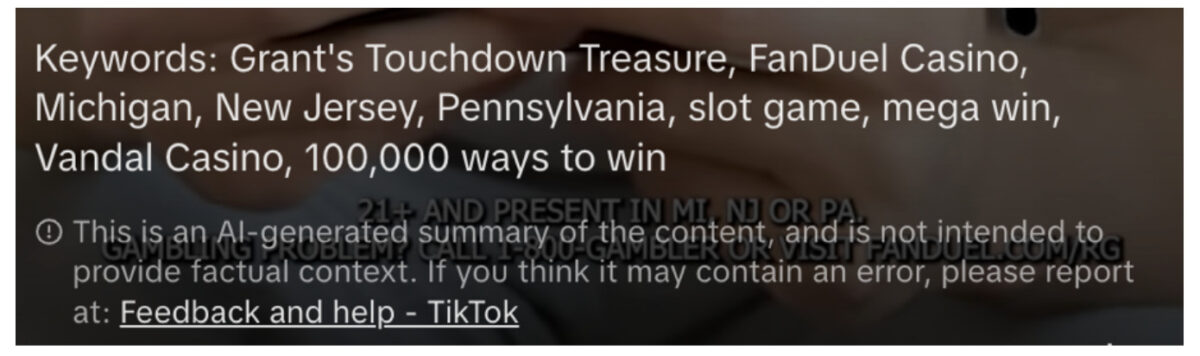
Notably, TikTok’s AI can identify gambling content, but this does not stop these videos from being blocked for minor accounts. On desktop, TikTok provides an AI-generated list of keywords based on the video’s content (see example below).
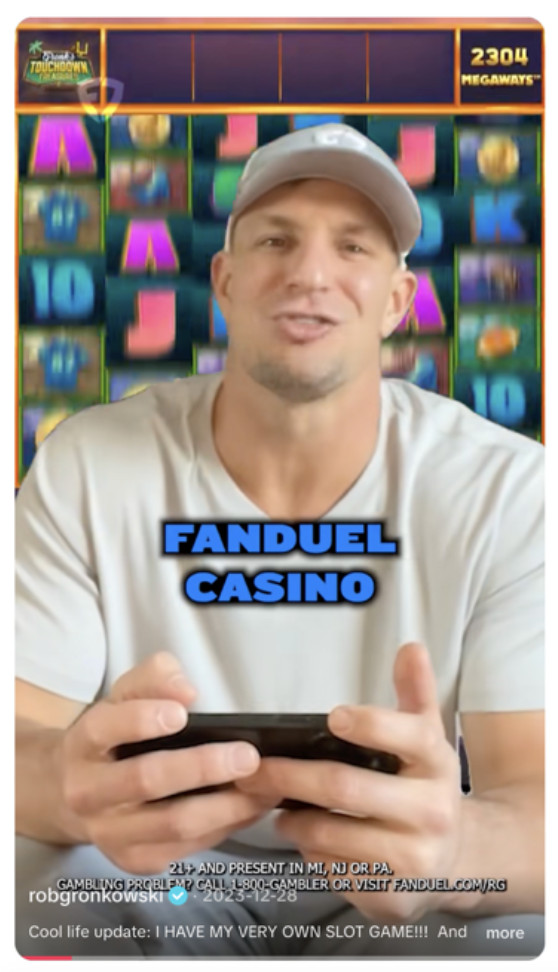
ISD analysts found that TikTok failed to filter advertisements promoting FanDuel’s gambling services. In one video, a former professional football player encouraged viewers to “get your bets in” and “place your bets” on touchdown scores. In another TikTok video, the same individual promoted a slot machine game in partnership with FanDuel Casino. For the slot machine video, TikTok’s AI was able to pull keywords and label the video with phrases including “FanDuel Casino,” “slot game,” “mega win,” “Vandal Casino” and “100,000 ways to win.”
Influencers, many of them young men themselves, also promote gambling and prediction market platforms via user-generated advertisements. These videos are sometimes more “blurred” than brand promotions from celebrities, making it more difficult for users, including minors, to identify these videos as ads. For example, some of these promotions are framed around comedy, entertainment, music and cooking.
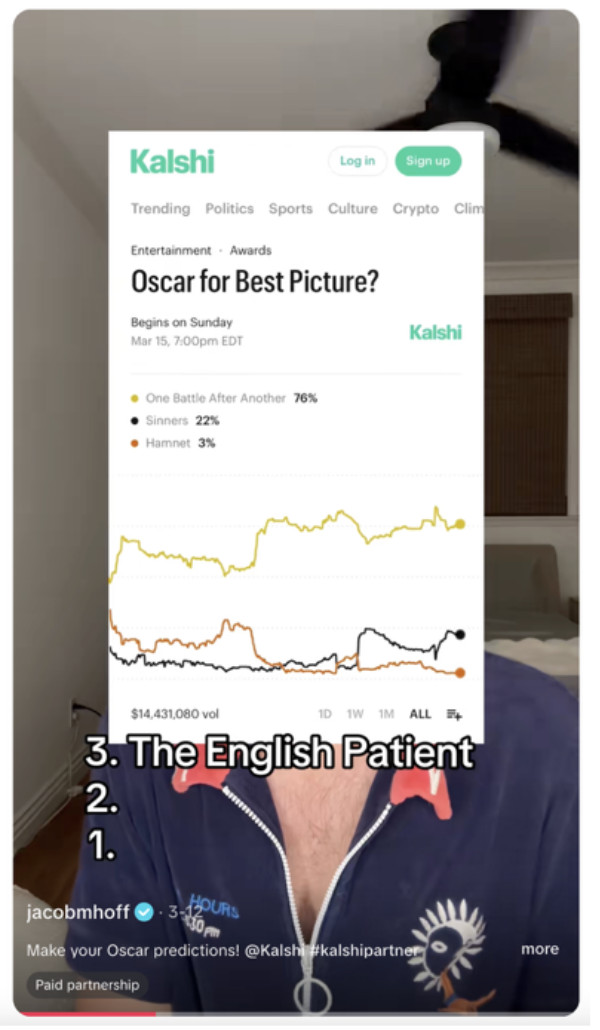
TikTok’s moderation shortcomings around prediction markets and user-generated advertising content were evident when the platform failed to filter an influencer’s advertisement for prediction market service Kalshi posted ahead of the 2026 Academy Awards, which was accessible to an account registered as a minor. In the video, the influencer discusses and displays screenshots of Kalshi’s Best Picture predictions and promotes other events users can trade on, blurring the line between entertainment discussion and prediction market advertising.
TikTok’s own advertising policies restrict minors’ exposure to age-restricted services like gambling, and prediction markets represent a gap these policies have yet to address. While influencers and the companies behind these services share responsibility for transparent disclosure, TikTok bears the primary responsibility for identifying and filtering this content to protect minor accounts.
This research expands on earlier findings that Kalshi saturated TikTok with ads appearing to target youth audiences, marketing the platform as an income opportunity or “side hustle.”[17]
According to Instagram’s content policy for users under 18, the platform restricts “the visibility of certain restricted goods and services including content related to alcohol, tobacco, bladed weapons, weight loss products, cosmetic procedures, sex toys, sexual enhancement products, gambling or entheogens.” Meta’s advertising policies say that online gambling and games advertisements may not be targeted to people under 18 years of age. Despite these restrictions, ISD analysts located several user-generated gambling service ads available to minor accounts.
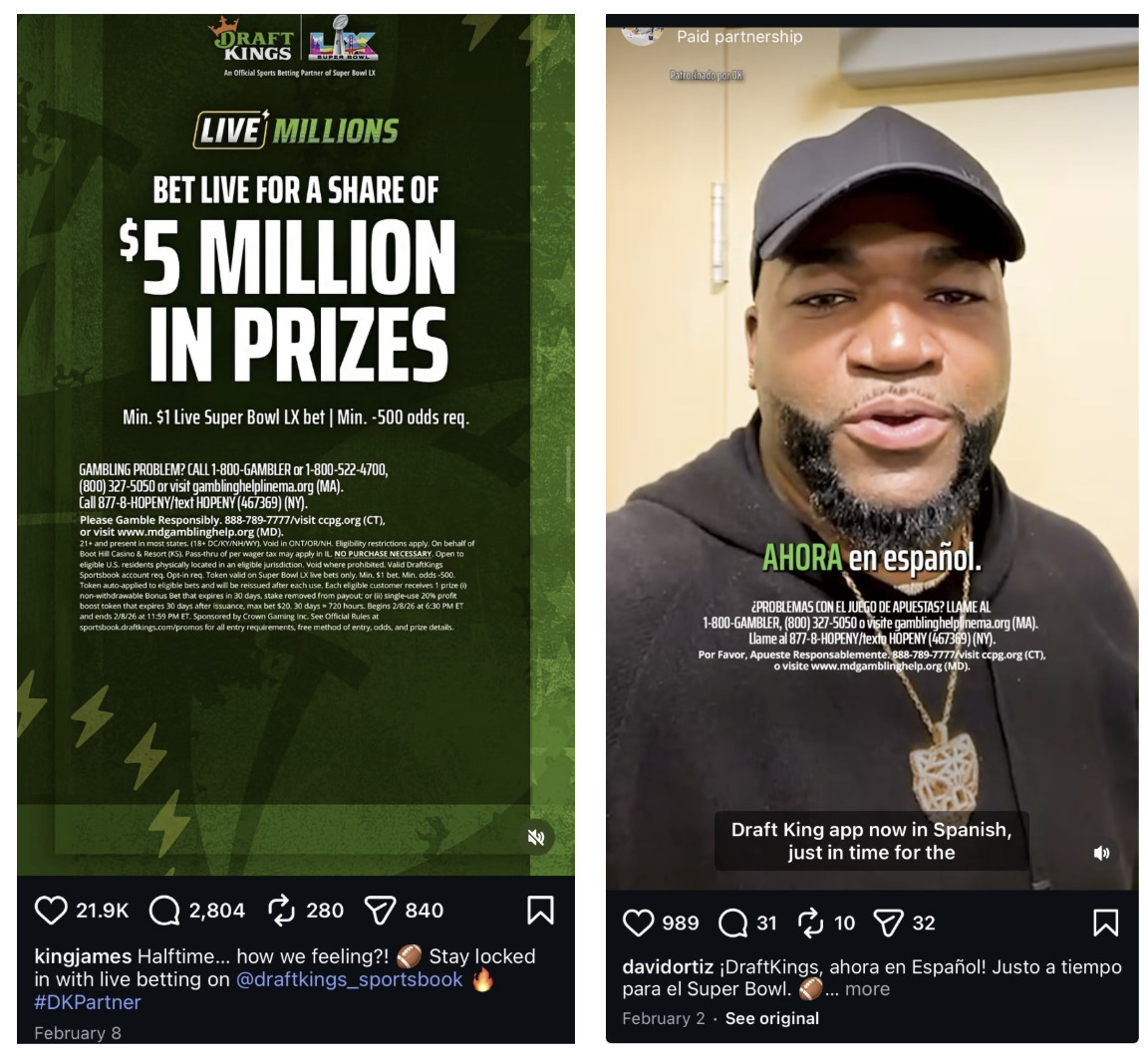
For example, the platform successfully blocked the minor account from viewing the official DraftKings page. However, analysts using the account were still able to view multiple advertisements posted directly to the accounts of prominent athletes, including promotions of the sportsbook ahead of Super Bowl LX in February 2026. Analysts were also able to view the official accounts of prediction markets like Kalshi and Polymarket, which do not appear to be covered by the platform’s policies for more traditional online gambling such as sportsbooks.
A current, well-known professional basketball player, who is an official DraftKings partner, posted a video directly to his personal Instagram page without the platform’s “paid partnership” label. In the video, the athlete discusses his affiliation with DraftKings and urgers viewers to engage in live betting as part of their Super Bowl promotions. Similarly, a former professional baseball player posted a DraftKings Super Bowl promotion to his personal page. In the Spanish-language post, the former player tells his followers that the service is now available in that language. Unlike the former post, the latter carried Instagram’s “paid partnership” label and was still available to the minor account.
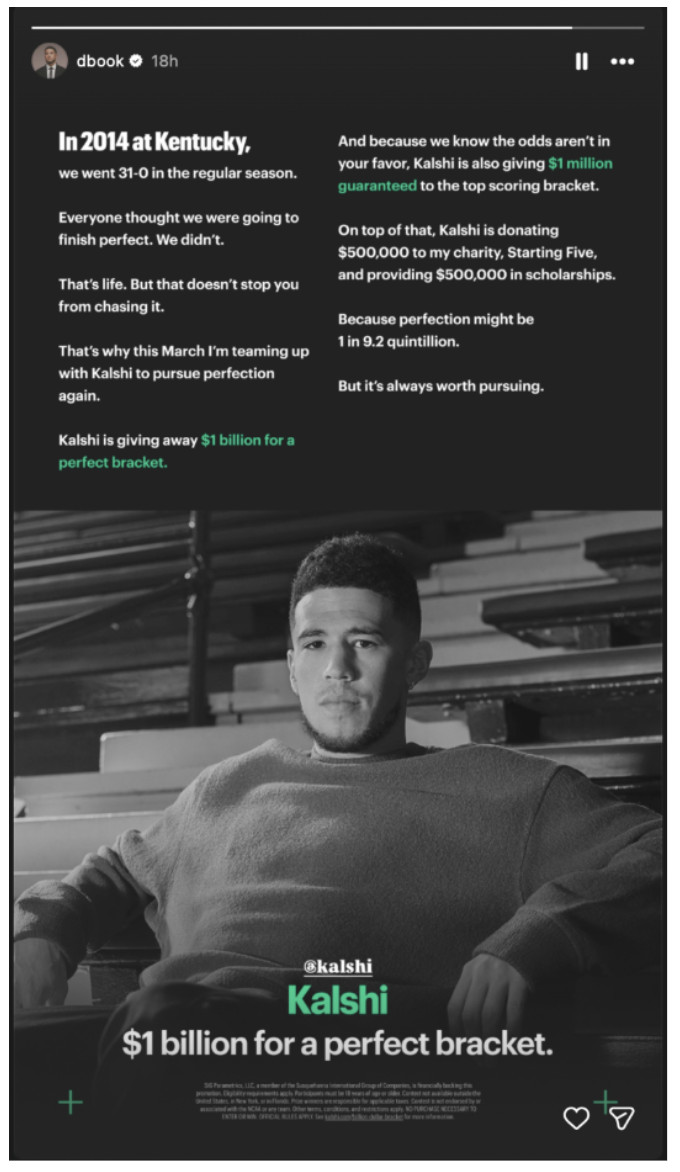
Analysts also viewed advertisements for prediction market promotions via minor accounts. On 16 March, Kalshi announced a partnership with a current professional basketball star ahead of March Madness, the NCAA Division I men’s basketball tournament.[18] On Instagram, the athlete posted the promotion to his personal account’s story, which analysts viewed via the minor account. Instagram stories are temporary posts that vanish after a 24-hour period. This post included an offer of $1 billion to a user who submitted perfect bracket predicting the outcome of the tournament, and $1 million to the top bracket.
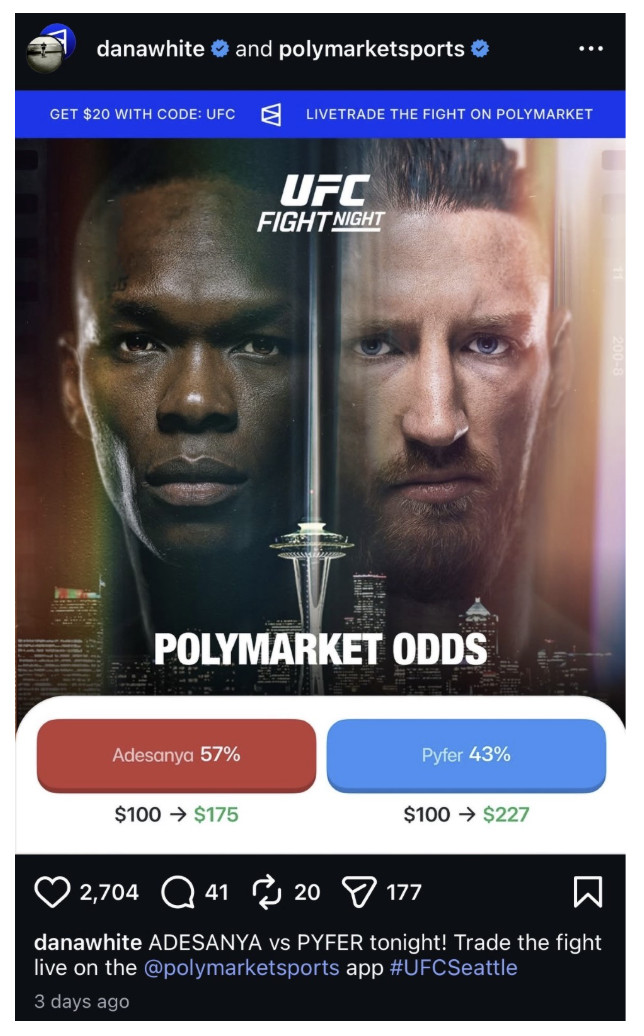
Similarly, analysts were able to view a promotion about a fight posted on March 28 to the personal account of Ultimate Fighting Championship Head Dana White in partnership with Polymarket. The post featured the Polymarket odds and offered users a $20 promo code with the caption, “Trade the fight live on the @polymarketsports app.”
Instagram also allowed the minor account to view posts promoting offshore crypto casinos, including popular betting platform Stake. A well-knwon rapper posted a video highlighting his best personal moments and wins from Stake to his personal Instagram page.
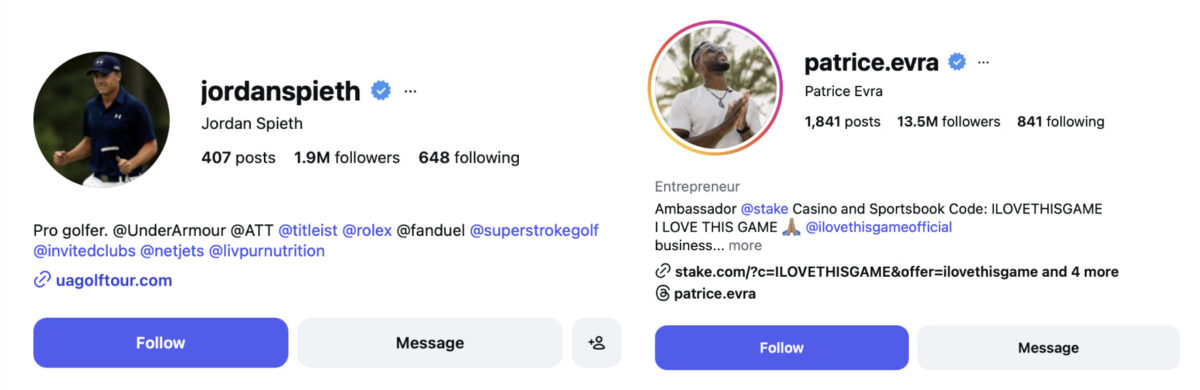
Analysts also viewed a December 2025 reel from a former professional soccer star and current Stake partner, promoting his picks for the 2026 World Cup. In his Instagram bio, the athlete calls himself an “Ambassador” for the platform and includes a promo code. A professional golfer similarly promotes his affiliation with FanDuel on his Instagram account. However, the FanDuel page is blocked from view while Stake remains visible to minors.
The ability of analysts to view official pages for platforms like Stake, Kalshi and Polymarket on minor accounts marks a notable contrast with companies like FanDuel and DraftKings. This discrepancy mirrors how gambling platforms are regulated by law but fails to address the public’s perception of all platforms as a form of gambling. Therefore, this content may fuel underaged gambling.
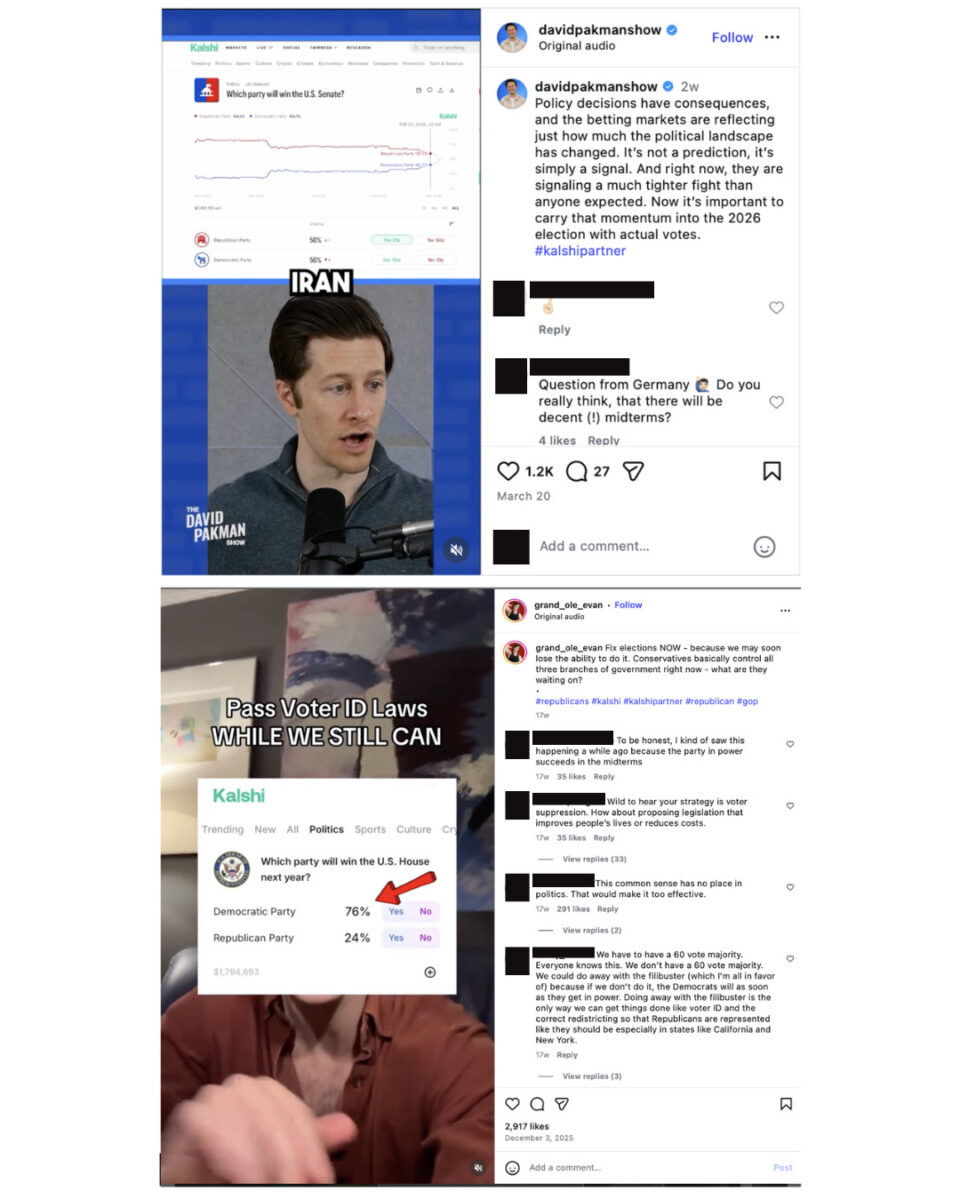
Like on TikTok, analysts were also able to view multiple examples of blurred advertisements, including promotions for Kalshi tagged “#kalshipartner.” Some were marked as a “paid partnership,” while others carried no indication they were advertisements beyond the content and the subsequent #kalshipartner. These advertisements present in numerous styles, including as trick shot content, entertainment and political news, and comedy sketches riffing on current events, including extreme weather and major sports games.
Analysts also viewed videos featuring blurred ads from influencers sharing election-related news. One influencer account opened a post, accessible to minor accounts, stating: “This depressing update is brought to you by Kalshsi” before sharing the market odds for the 2026 Midterm Elections. Similarly, analysts found that minor accounts could view content from a prominent online political show where the host celebrates the Democrats’ improved Kalshi odds of taking the US Senate following the start of the 2026 Iran conflict. Neither of these posts were officially marked as “paid partnerships.” That minors were able to view these advertisements demonstrates a gap in the platform’s content moderation policies.
YouTube
Google’s ad policy against gambling-promoting content claims that ads of this nature should “never target minors.” Additionally, YouTube’s specific policy states that “online gambling content (excluding online sports betting and depictions of in-person gambling) won’t be viewable to signed-out users or users under 18.” Despite these policies, gambling-related user-generated advertisements are still accessible to minor accounts.
In January 2026, Google updated its policies to make explicit the parameters for prediction markets advertisements. The policy includes location restrictions and an approval process for such ads but does not mention age restrictions. The discrepancy between gambling platforms and prediction markets demonstrates another gap in the platform’s moderation of advertisements to minors.
By contrast with Instagram and TikTok, YouTube features both long and short-form content. Video podcasts are among the most common examples. On popular sports podcasts, for example, gambling advertisements are often featured as part of the uploaded video. Analysts observed instances where ads were delivered verbally by the host during the show, featured in an on-screen graphic and/or were included in the video description. These ads often feature a promo code or more information about an online betting platform, typically a sportsbook.
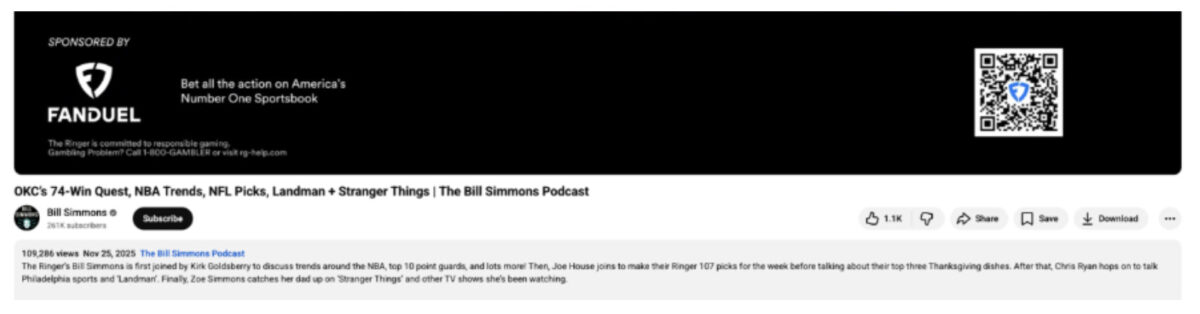
Known brands are also posting short-form content on YouTube to promote gambling. Personalities employed by one digital-first media company popular with young men posted multiple short videos promoting DraftKings around key events including the 2026 Super Bowl, the start of the 2025-26 NBA season and the end of the 2025 NHL season. These clips are not “blurred advertising,” but direct calls to create a sportsbook account and begin betting, often coupled with specials designed to entice prospective users around big events. In other cases, content from this company, including, for example, clips from its most popular podcast, featured included “#dkpartner” or tagged the company directly in the description although gambling was not discussed in the video. All of this content was available to the minor account.
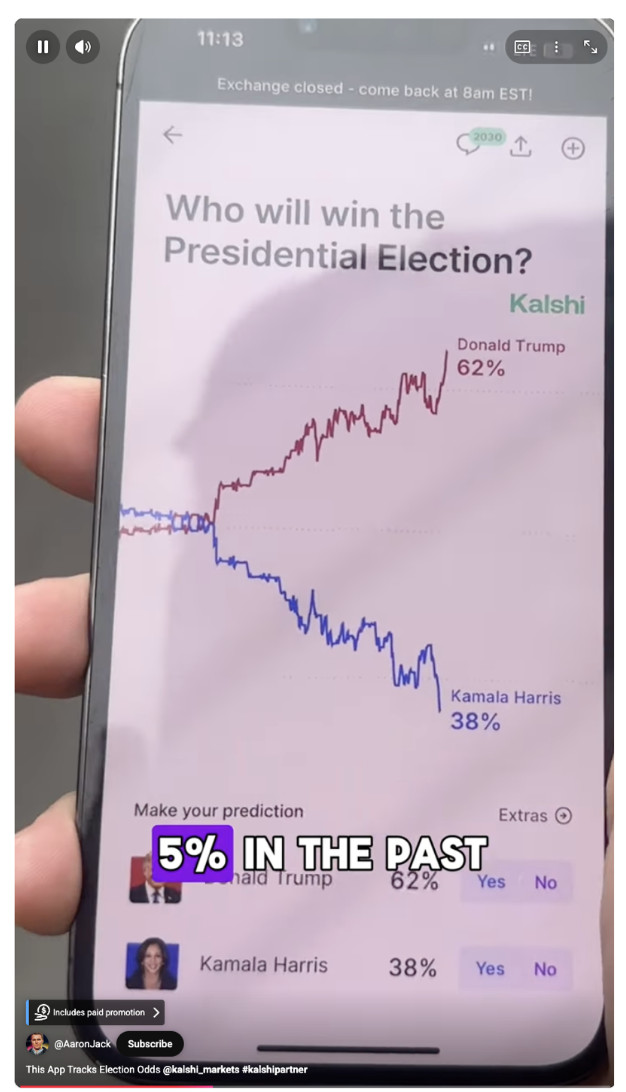
In searching for prediction market content, analysts found examples of influencer-driven advertisements using the hashtag, “#kalshipartner.” These advertisements were primarily delivered via YouTube Shorts, the platform’s short-form content delivery feature. As on TikTok and Instagram, analysts found blurred advertising promoting Kalshi using real-world events. For example, analysts viewed YouTube Shorts promoting Kalshi odds on the Video Music Awards, discussion of the 2024 elections and professional sports news. All content was viewable via the account registered as a minor, again exposing a gap and inconsistency in the platform’s moderation policies.
Conclusion
These findings highlight the range of ways gambling advertisements are accessible to minors on social media, as well as the gaps in platform moderation policies that allow prediction market advertising to reach underage users. Similarly, user-generated ads easily bypass content moderation policies, demonstrating platform failures to protect minors despite stated policies prohibiting this content.
While influencers and celebrities may partner with gambling companies to reach adult audiences, platforms bear responsibility for updating and enforcing their policies to keep pace with emerging forms of risks and prevent underage exposure to gambling. Social media platforms popular with minors should add advertising policies around prediction markets and strengthen content moderation policies to better regulate user-generated advertising content for addictive or age-restricted products and services. Future research should also investigate how minors understand user-generated gambling advertisements that blur promotional content with entertainment.
End notes
[1] Nathan Bomey, “”Everything is gambling now”: How betting is taking over America,” Axios, February 8, 2026, https://www.axios.com/2026/02/08/polymarket-kalshi-draftkings-fanduel-betting.
[2] Atharva Yeola, et al, “Growing Health Concern Regarding Gambling Addiction in the Age of Sportsbooks,” JAMA Internal Medicine, Vol. 185, No. 4, February 2025, https://jamanetwork.com/journals/jamainternalmedicine/fullarticle/2830019; Isaac Rose-Berman, “The rise of sports betting is a growing public health crisis,” STAT, November 11, 2025, https://www.statnews.com/2025/11/11/sports-betting-apps-public-health-crisis/.
[3] Lucien Bruggeman and Tonya Simpson, “’Public health crisis’: Experts weigh the stakes of youth gambling in America,” ABC News, March 27, 2026, https://abcnews.com/US/public-health-crisis-experts-weigh-stakes-youth-gambling/story?id=131328317.
[4] “Siena/St. Bonaventure Annual Sports Fanship Survey: Part 2 – Sports Betting,” April 13, 2026, https://sri.siena.edu/wp-content/uploads/2026/04/ASFS2026-Release-2-Sports-Betting-Final.pdf.
[5] Nizan Geslevich Packin and Sharon Rabinovitz, “Prediction Markets as a Public Health Threat,” Science 392, 2026, https://www.science.org/doi/10.1126/science.aee3932.
[6] Jonathan D. Cohen, “Most Americans see prediction markets as more like gambling than investing, new AIBM/Ipsos poll finds,” American Institute for Boys and Men, March 17, 2026, https://aibm.org/research/most-americans-see-prediction-markets-as-more-like-gambling-than-investing-new-aibm-ipsos-poll-finds/.
[7] Vani Sanganeria, “‘I was hooked’: California lawmakers target gambling addiction in youth,” EdSource, March 20, 2026, https://edsource.org/2026/online-gambling-minors-california/754087.
[8] Young Mens Research Institute, “YMRI May 2025 Toplines,” https://static1.squarespace.com/static/682624879442926a5204ee2d/t/6871861c0250657f73fe3e45/1752270364387/YMRP_May+2025_toplines+%282%29.pdf
[9] Suzy Khimm, “He got hooked on betting at age 11. By college he gambled 15 hours a day,” NBC News, March 19, 2026, https://www.nbcnews.com/news/us-news/teens-hooked-sports-betting-apps-rcna264110.
[10] “Betting on Boys: Understanding Gambling Among Adolescent Boys,” Common Sense Media, January 2026, https://www.commonsensemedia.org/sites/default/files/research/report/2026-betting-on-boys-report_final-for-web.pdf.
[11] Ibid.
[12] Steven Levy, “How Is Kalshi Not Gambling?” WIRED, March 4, 2026, https://www.wired.com/story/big-interview-tarek-mansour-kalshi/.
[13] Jonathan D. Cohen, “Most Americans see prediction markets as more like gambling than investing, new AIBM/Ipsos poll finds,” American Institute for Boys and Men, March 17, 2026, https://aibm.org/research/most-americans-see-prediction-markets-as-more-like-gambling-than-investing-new-aibm-ipsos-poll-finds/.
[14] Jared Perlo, “Senators introduce bipartisan bill to ban sports betting on prediction markets,” NBC News, March 23, 2026, https://www.nbcnews.com/tech/tech-news/sports-betting-gambling-prediction-market-kalshi-polymarket-ban-senate-rcna264734.
[15] “FTC Staff Paper Details Potential Harms to Kids from Blurred Advertising, Recommends Marketers Steer Clear,” Federal Trade Commission, September 14, 2023, https://www.ftc.gov/news-events/news/press-releases/2023/09/ftc-staff-paper-details-potential-harms-kids-blurred-advertising-recommends-marketers-steer-clear.
[16] Adam Luck and Jon Ungoed-Thomas, “‘Sneaky’ social media ads are luring young into gambling, say campaigners,” The Guardian, March 17, 2024, https://www.theguardian.com/society/2024/mar/17/sneaky-social-media-ads-are-luring-young-into-gambling-say-campaigners.
[17] Olivia Little, “Kalshi is aggressively advertising on TikTok, seemingly targeting young people while promising ‘money hack, ‘” Media Matters for America, March 30, 2026, https://www.mediamatters.org/tiktok/kalshi-aggressively-advertising-tiktok-seemingly-targeting-young-people-while-promising.
[18] March Madness is a single-elimination college basketball tournament and one of the most watched sports events each year in the United States, where millions of fans fill out brackets trying to correctly predict the outcome of each matchup all the way to the championship game.
In the media
ISD Contributors