Digital Dispatches
April 23, 2026
ISD-US
Foreign Information Manipulation and Interference, Information Warfare and Online Manipulation
Iran’s diplomats launch a meme war
Executive Summary
Since the start of the Iran war in February, X accounts for Iranian embassies and officials have embraced “shitposting” as a form of statecraft. Shitposting is known to be low-effort, provocative content meant to drive engagement online. In this context, the content has included AI-generated videos of US President Donald Trump being slapped by Jesus and controlled by a symbiote Venom-version of convicted sex offender Jeffrey Epstein, alongside jabs ridiculing US threats and administration officials, including Secretary of Defense Pete Hegseth.
This irreverent, provocative and ironic content has repeatedly gone viral. In the first 50 days of the war, posts from Iranian embassy and official accounts collectively gained approximately 900 million views and 22 million likes—a 30-fold increase in likes compared with the preceding 50 days. When comparing those same timeframes, total shares also rose from 4.3 million to 76 million, and total comments on posts jumped from 191,000 to 870,000.
This shows a stark reversal in Iran’s messaging, which was often viewed by researchers as unsophisticated and unimpactful. It also demonstrates how state actors can gain massive audiences by reframing high-stakes geopolitical issues in informal, platform-native ways.
Key Findings
- Since the war began, X accounts for Iranian diplomats and officials have pivoted from traditional messaging strategies to “shitposting,” an approach based on posting provocative, absurd or humorous content to generate reactions. They have routinely posted overtly AI-generated content, including memes, references to pop and internet culture, and jokes—mostly at the expense of the United States, particularly President Donald Trump.
- Posts by Iranian diplomatic and official X accounts collectively gained hundreds of millions of views throughout the first 50 days of the conflict. When comparing the 50 days before and after the war began, those accounts nearly quadrupled their number of posts, from roughly 10,500 to 40,000. More strikingly, likes on posts jumped 30-fold, rising from approximately 660,000 to 22 million. Shares, comments and views on posts also spiked dramatically.
- This heightened engagement suggests that Iranian diplomatic accounts have reshaped perceptions of the country, moving from a repressive theocratic image toward that of an irreverent, witty underdog confronting the United States. This messaging strategy could also be used as a blueprint for other governments seeking to shift global perceptions of their domestic and foreign policy.
Methodology
ISD analysts used an existing list of roughly 150 X accounts attributed to Iranian diplomatic and government actors. Using social listening and data analysis tools, analysts collected and analyzed posting activity and engagement trends across these accounts.
The study combined quantitative and qualitative methods. Analysts manually reviewed content posted by Iranian diplomats and officials to assess their messaging strategy, including their use of satire and AI-generated content. Analysts also compared data from those accounts in the 50 days before (9 Jan to 27 Feb 2026) and after (28 Feb to 18 April 2026) the onset of the war to determine how engagement patterns—such as post volume, views, likes and shares—have changed since the conflict began. Because Ali Khamenei—Iran’s Supreme Leader at the time—was killed at the start of the conflict, accounts associated with him were not included in the dataset.
Troll Diplomacy and the Meme War
Since the start of the war, many of Iran’s embassy and consulate accounts on X have shifted away from formal diplomatic rhetoric to a messaging style driven by provocation and a keen understanding of internet culture. Their posts, which now often include memes, pop culture references, and AI-generated content, do not have characteristics common to traditional war propaganda. Rather, they embrace the spirit of the internet and rely on content and language that can connect with and attract general online audiences.
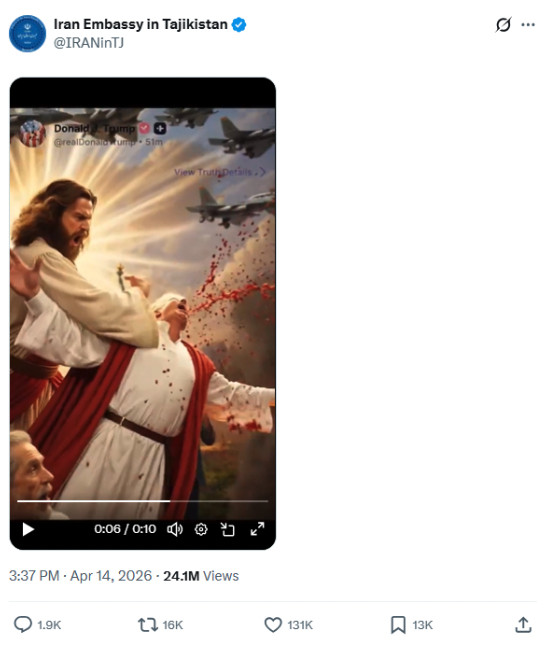
The most effective accounts have captured massive online engagement with viral memes and AI-generated content. For example, after Trump posted an image that appeared to depict himself as Jesus, the Embassy in Tajikistan shared an AI-video of Jesus jumping into the scene and slapping Trump into a pit of fire. The post, which was the most viewed post by all embassy accounts in the first 50 days of the war, received over 24.1 million views.
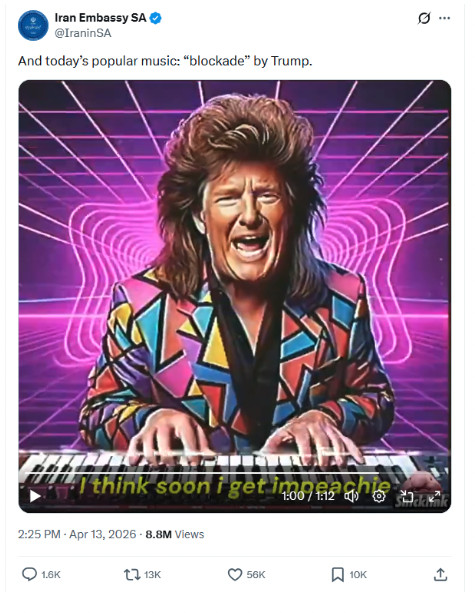
In another viral post, the Iranian Embassy in South Africa posted an AI-generated video of Trump–with bouffant hair and all–singing a spoof on the 80s pop ballad “Voyage, voyage” renamed “Blockade, blockade.” The song included lyrics such as “I thought this was easy-peasy” and “I think soon I get impeachie.” The embassy’s post containing the video, which was made by a German content creator, received 8.8 million views and 58 thousand likes.
Much of this content demonstrates a fluency in Western and, more broadly, Internet culture. While Iran’s Lego-inspired rap videos have made headlines, its diplomatic accounts have also incorporated American pop culture references, including but not limited to the Pirates of the Caribbean, Spiderman, Forrest Gump, and Tom and Jerry.
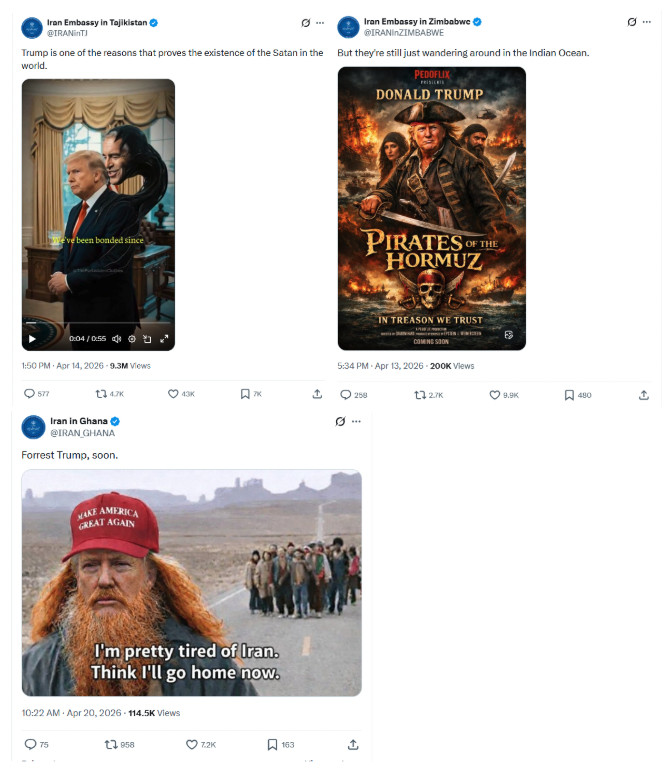
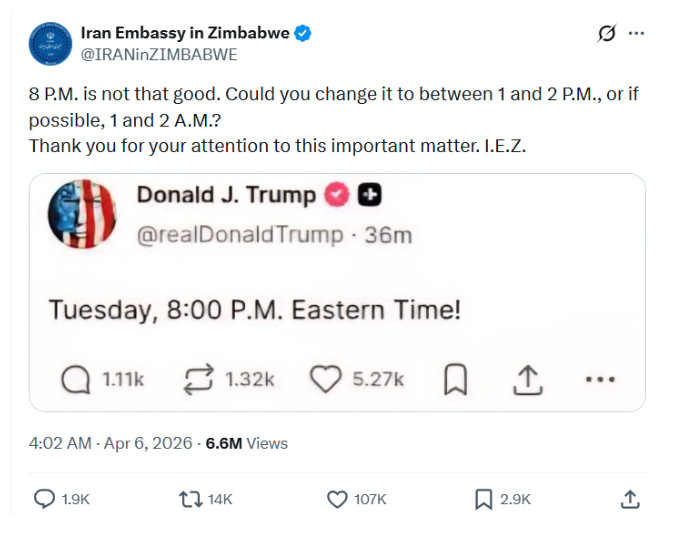
Iranian diplomats have also embraced the art of the “clapback,” routinely firing back at comments from the Trump administration with sharp, combative and often sarcastic responses. For example, in a viral post (see Image 6) mocking Trump’s 8:00 p.m. deadline to destroy Iranian civilization, the Embassy in Zimbabwe teasingly replied, “8 P.M. is not that good. Could you change it to between 1 and 2 P.M., or if possible, 1 and 2 A.M?”
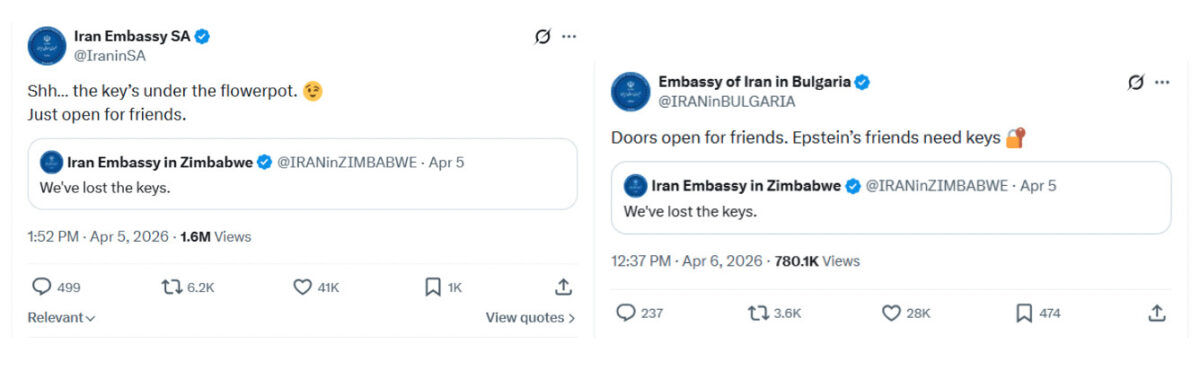
Many of these clapbacks serve as launching pads for collaborative trolling attacks, with accounts reposting one another or setting up jokes for other accounts to engage with. Following Trump’s expletive-laden threat on X for Iran to open the Strait of Hormuz, the Iranian embassy in Zimbabwe playfully remarked “We’ve lost the keys” in a post that received 6.9 million views and over 93,000 likes. Other embassy accounts quickly chimed in to take the joke further. The embassy in South Africa commented “Shh… the key’s under the flowerpot. Just open for friends.” The embassy in Bulgaria added, “Open for friends. Epstein’s friends need keys.”
Trolling Drives Explosive Engagement
Iran’s trolling tactics have effectively captured users’ attention, elevating Iranian diplomats and officials to the frontlines of the information war, at least on X. These accounts have seen dramatic spikes in both output and engagement.
When comparing the 50 days before and after the conflict began, the number of posts by Iranian diplomats and officials nearly quadrupled, jumping from roughly 10,500 to 40,000. Total likes on all posts increased more than 30-fold, soaring from roughly 660,000 to 22 million. Total shares also grew more than 16-fold, from 4.3 million to 76 million, while total views climbed 14-fold, from 55 million to 896 million. Comments on all posts also rose sharply, from 191,000 to 870,000.
The scale of this engagement becomes even more stark when examining metrics for individual accounts. Six accounts (those of Foreign Minister Seyed Abbas Araghchi, Parliament Speaker Mohammad-Bagher Ghalibaf, the embassies in South Africa, India, and Zimbabwe, and the consulate in Hyderabad, India) individually received more likes during the first 50 days of war than all monitored accounts combined in the pre-war period. A similar dynamic played out with views and shares.
Those engagements also led to sharp increases in followers for embassy accounts. For example, the Iranian embassy in South Africa saw its followers rise from roughly 4,000 pre-war to more than 150,000 within 50 days. Similarly, the embassy in Zimbabwe gained more than 71,000 followers in the week following the viral X posts, “We’ve lost the keys” and 8:00 p.m. deadline change request.
Top performing posts also jumped to levels unseen before the war. Analysts reviewed the individual posts with the most likes, shares and views in the 50 days before and after the war began. The most-liked post during the post-war period gained roughly 216,000 likes, compared to just 22,000 likes in the pre-war timeframe. The most-shared post rose from 4,000 pre-war to 46,000 during the war. Similarly, the post with the most views before the war had 3.3 million views; the post with the most likes in the 50 days after the war had 24.1 million. Notably, only two posts gained one million or more views in the pre-war period, whereas 200 posts crossed that threshold in the first 50 days of the conflict.
Conclusion
While wars or other conflicts often result in a moderate spike in audience interest in diplomatic messaging, the dramatic gains made by official Iranian accounts on X cannot be explained by the war alone.
The success of Iran’s new messaging strategy therefore raises questions about the future of diplomatic communications itself, especially that of authoritarian countries. While diplomats using social media to provoke target audiences is not new–China’s “Wolf Warrior” diplomats regularly used X to aggressively promote Beijing’s geopolitical agenda in the early 2020s, often pushing conspiracies or trolling Americans–the positive reception and engagement levels Iran’s diplomatic accounts are currently receiving is unparalleled.
What’s most startling about the success of this new messaging strategy is the fact that it has helped netizens to forget, or at least ignore, Iran’s past human rights abuses. Tehran’s diplomatic accounts and other propaganda channels have helped shift the narrative, with Iran increasingly being framed not as a villain but as an underdog opposing the U.S., a narrative that many online audiences can’t help but want to root for. While US policies have contributed to the shifts in audience perception, Iran’s strategic communication has also seized on the opportunity. This rebranding is arguably Iran’s most notable win in the war thus far.
In the media
ISD Contributors