Digital Dispatches
September 4, 2025
ISD UK
Democratic Integrity, Information Warfare and Online Manipulation
Investigation | An anti-Ukrainian community on X: A gateway for Russian propaganda in the Czech information space
4 September 2025
Executive Summary
This ISD Investigation examines a Czech-language community on X that acts as a conduit for Kremlin-aligned propaganda. Based on an in-depth study of 70 presumably pseudonymous accounts, ISD found that the community promotes content that reinforces hostility towards Ukraine and Ukrainian refugees, portrays Russia as unfairly demonised, and seeks to erode support for Czech foreign policy positions.
Although individual accounts have limited reach, their quick responses to current events help the community shape online discourse for its audiences. By repeatedly circulating content from Russian state media and openly pro-Russian X accounts, they introduce Russian propaganda into the Czech information space years after official channels (such as news site Sputnik CZ) were banned in response to the full-scale invasion of Ukraine.
Little research has examined X’s role in spreading pro-Kremlin propaganda in the Czech Republic, where only 7 percent of the population use the platform to access news. However, this report demonstrates how communities on the platform can amplify foreign influence operations—a trend observed on other social platforms such as Facebook. This finding is particularly concerning in the lead up to the Czech Republic’s parliamentary elections in October 2025, with foreign policy and the integration of Ukrainian refugees likely to be topics of high importance for voters.
Key Findings
- ISD identified a loose community of 70 presumably pseudonymous Czech-language accounts that systematically share anti-Ukrainian content, pro-Russian propaganda and conspiracy theories.
- The community includes a core group of micro-influencer accounts (that post original content multiple times a day in response to ongoing events) and amplifier accounts that primarily repost content.
- Reposted content includes material from Russian state media and other sources promoting pro-Kremlin messages. Material is frequently repackaged for Czech audiences and redistributed throughout the community.
- Despite limited reach, the community functions as a conduit for Russian propaganda. By aligning messaging with anti-establishment and populist parties, it could play a role in online political discourse around the October 2025 parliamentary elections.
Methodology
ISD analysts used a snowball sampling method, starting with accounts known for disseminating pro-Russian or anti-Ukrainian content in the Czech language. Using automated tools, the team extracted and quantified frequent interactions between accounts (e.g. reposts, replies and mentions) in the initial seed list to identify additional accounts. Candidate accounts were manually reviewed for relevance before inclusion in the final dataset.
This process identified 70 accounts that regularly interacted with each other and consistently shared pro-Russian and anti-Ukrainian content. They typically used generic names or pseudonyms, lacked personal profile photos, and posted little to no nonpolitical material.
Between February and May 2025, accounts were manually coded for posting frequency, ideological alignment, engagement patterns and key narrative themes in their content. Analysts paid particular attention to reactions to events likely to be exploited by Russian propaganda, such as Victory Day commemorations and President Volodymyr Zelenskyy’s visit to Prague in May 2025.
To study the connection between the accounts, analysts examined behavioural signals including posting patterns, shared links and hashtag usage. While the accounts demonstrated narrative and rhetorical overlap, there was insufficient evidence to conclude coordinated inauthentic behaviour. We hence classify them as a loose community of like-minded actors operating independently.
Types of accounts within the community
The community consistently disseminates anti-Ukrainian messages, disinformation and pro-Kremlin narratives. Themes and topics change over time in response to ongoing events, but negative sentiment towards Ukrainians remains consistent and explicit in the content posted by these accounts. For example, the name of one account labels the Ukrainian government as “Banderite junta”, a reference to Stepan Bandera, a leader of the Organisation of Ukrainian Nationalists who collaborated with the Nazis during WWII in an attempt to establish Ukrainian sovereignty. Another account includes “Bandera’s sons, get out of my homeland!” in its description, negatively referring to Ukrainian refugees. Accounts repeatedly post hostile and extreme language or spread allegations about criminal or problematic behaviour of Ukrainian refugees, though they avoided posting explicit violent threats during the data collection timeframe.
This hostile rhetoric exploits existing fears and uncertainty in Czech society related to the mass influx of refugees from Ukraine. As the country became one of the most frequent destinations for Ukrainian refugees after the start of Russia’s full-scale invasion in 2022, the number of Ukrainians living in the Czech Republic tripled in a few months and currently stands at around 600,000 people. According to the Czech Centrum pro výzkum veřejného mínění (Centre for Public Opinion Research), while almost three-quarters of Czechs approve of the decision to accept refugees, 60 percent of the population also believes that the country hosts more Ukrainians than it can integrate. As a result, hostile commentary and occasional disinformation targeting Ukrainians promoted by this X community may resonate among certain segments of the Czech population.
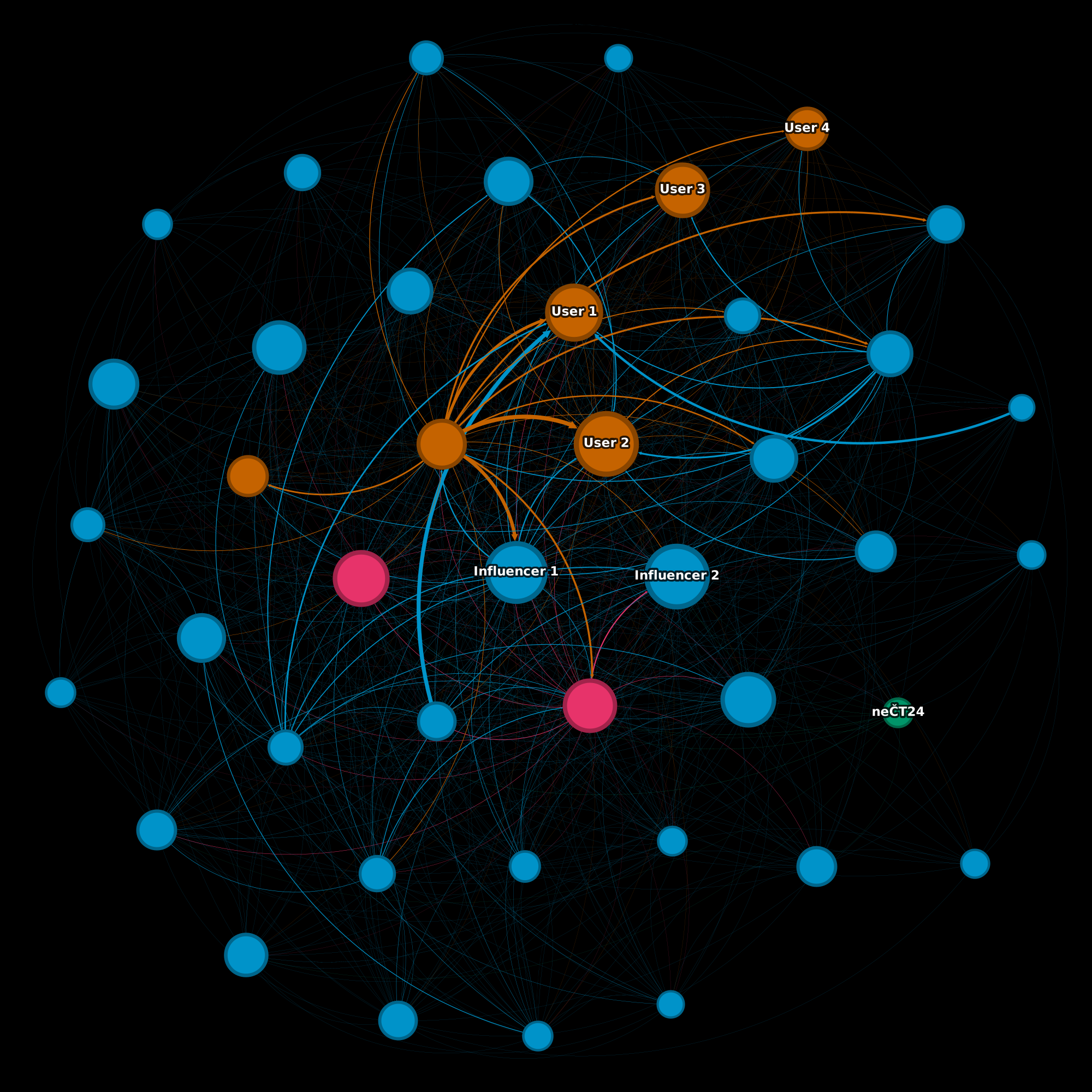
In the centre of the community are a small number of accounts with several thousand followers each. These accounts post multiple times a day, mostly about domestic and international political events. This constant activity allows the micro-influencer accounts to quickly react to ongoing events, framing them in line with ideological positions hostile to Ukraine and sympathetic to Russia. These accounts also reshare content from abroad; often English and Russian material that they translate to Czech for a domestic audience.
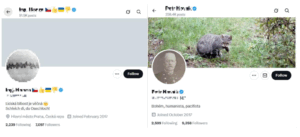
The social media account marked as Influencer 1 above was created in October 2017 and has 9,800 followers. Aside from describing itself as ‘bohemian, humanist and pacifist’, it does not share any personal information. The name is generic (making use of two common Czech names) and the profile picture is of a black and white photograph of an elderly man dressed in a 19th-century-style uniform with a medal, old-fashioned glasses and a moustache. Views presented by the account often correspond with Kremlin perspectives. For example, the account translated a Telegram post by Russian politician Elena Panina titled “Ukraine’s new government is unconstitutional and not-sovereign”, which referred to personnel changes in the Ukrainian government in July 2024.
Another of these micro-influencers from Figure 1 (marked Influencer 2), was created in February 2017, claims to be based in Prague and has around 7,000 followers. The bio for this account includes a thumbs up next to the Czech flag and a thumbs down next to the Ukrainian one, meanwhile its pinned post includes a list of documentaries ‘proving’ that the US provoked war in Ukraine as a proxy conflict against Russia. As shown in Image 1 below, both accounts also carry a blue checkmark, meaning they subscribe to X Premium, a paid version of the platform.
These micro-influencer accounts are surrounded by a second group of users with fewer followers (ranging from tens to a few hundred) acting as amplifiers, marked in Figure 1 as Users 1-4. For example, one amplifier account created in June 2024 has only 10 followers but posted more than 2,400 times in its first year on X. Although amplifiers usually just repost content, some have also posted inflammatory comments targeting journalists, politicians and public figures in the Czech Republic and abroad.
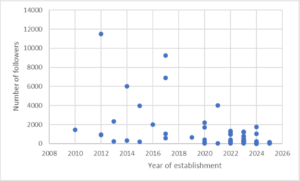
As shown on the chart below, the number of amplifiers increased significantly after 2022. Although the identities behind these accounts remain unknown, it is plausible that some were created to reinforce the community’s messaging, particularly after the surge in account creation observed after 2022.
In addition to the 70 pseudonymous accounts, which are the primary focus of this Investigation, several identifiable users also play a prominent role in the community and are visible in Figure 1, including:
- A well-known spreader of hoaxes about Ukrainian refugees (User 1),
- An esoteric blogger (User 2),
- A local politician from an opposition party (User 3),
- An anti-establishment activist (User 4).
While these accounts are more readily identifiable, they are not named to avoid giving them greater exposure. The presence of such users suggests that the community’s messaging may reach diverse segments of Czech society, particularly those predisposed to anti-establishment narratives, and increase susceptibility to Kremlin propaganda.
Community as a conduit for Kremlin-aligned propaganda
The only member of the community directly affiliated with Kremlin media is the account neČT24 (“no ČT24”), which presents itself as the antithesis of the Czech public broadcaster ČT24. The Czech intelligence service Security Information Service claimed that this account is “directly associated with Russian state institutions.” As with many such accounts, it appears to target audiences with anti-establishment views who see mainstream outlets as corrupt or manipulative.
This account is also linked to a Telegram channel launched in March 2022. An investigation by fact-checking organisation Demagog.cz concluded that the Telegram channel is operated by the same editorial team behind Sputnik CZ, the Czech-language version of the Russian state media outlet that was suspended following the full-scale invasion of Ukraine.
The fact that neČT24 is followed and shared by accounts in this broader pro-Kremlin X community suggests it may serve as a gateway for Kremlin propaganda into the broader Czech information space. As Kremlin-backed news outlets (like RT and Sputnik) have been banned in the European Union since the start of the full-scale invasion of Ukraine, the Kremlin has weaponised the desire to associate with like-minded communities to facilitate the spread of Russian propaganda.
Accounts in the community regularly share content from Russian state media, as well as reposting statements by Russian politicians and officials. Other reposted content also comes from overtly pro-Russian X profiles, mostly those posting in English. Accounts include self-proclaimed military correspondents focused primarily on conflict in Ukraine; one of which claims to have ties to the Wagner Group in its profile description. Others provide Russian-sympathetic perspectives on international affairs in general. By reposting and localising content from these sources, the community acts as a conduit for Kremlin-aligned narratives, disseminating Russian propaganda to Czech audiences.
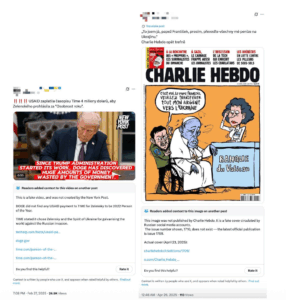
The community also disseminates fabricated and debunked material. This includes a fake Charlie Hebdo cover mocking Ukrainian President Volodymyr Zelenskyy and a fake New York Post video alleging that USAID bribed TIME Magazine to name Zelenskyy its Person of the Year. Despite Community Notes on X identifying these claims as false, they continued to circulate widely through the Czech-language community.
To illustrate how this X community reinforces pro-Russian narratives, there are a series of case studies below.
Case study 1: Commemorative events as propaganda opportunities
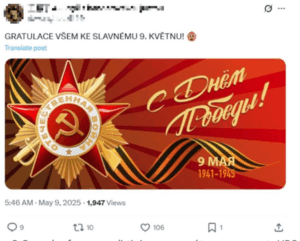
Narratives glorifying Russia were particularly prominent around 9 May, which is when the country celebrates the end of the ‘Great Patriotic War’; known in Europe as VE Day. Posts from this day praised the Soviet Union’s role in World War II with images (such as the Red Army flag raised over the Reichstag in Berlin) as well as symbols commonly used in Russian propaganda (including the ribbon of Saint George). In one post showing the Soviet conquest of Berlin, one account commented: “It will be necessary to repeat it”, reframing the commemoration of a historic event as a future threat.
The Czech community in question responds with hostility to anything perceived as undermining the Red Army’s role in World War II. A post shared by an account in the dataset studied claimed that those questioning the Red Army’s liberation of Czechoslovakia are “probably descendants of Nazis and Aryans.” Meanwhile, the attendance of the Slovak Prime Minister Robert Fico at Moscow’s Victory Day parade was praised by accounts in the community, with one describing him as a “real statesman” in comparison to Western leaders.
Case study 2: Zelenskyy’s visit to Prague
A frequent target of accounts in the community was Ukrainian President Volodymyr Zelenskyy. Common pro-Russian narratives portrayed him as corrupt, incompetent, a puppet of foreign interests, a Nazi sympathiser, a drug addict and accused him of holding power illegitimately as his presidential term had ended.
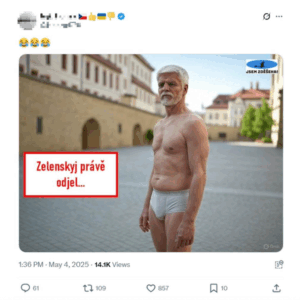
Criticism intensified during President Zelenskyy’s visit to Prague in May 2025, during which time accounts in the dataset compared him to Adolf Hitler. At the same time, they portrayed Czech leaders as subservient. One popular image of Czech President Petr Pavel stripped to his underwear was captioned “Zelenskyy just left”, an effort to delegitimise Ukraine’s leadership and Czech political support. A post with this picture shared by one of the micro-influencers mentioned above received more than 14,000 views.
Comments targeting Ukraine’s First Lady Olena Zelenska and Czech First Lady Eva Pavlová used gendered language to similarly depict Czech leadership as submissive to foreign powers: a post by another micro-influencer described Zelenska as a “bored princess” and Pavlová as an “old maid” and received over 20,000 views.
Case Study 3: Amplification of the Tulsi Gabbard interview
Members of the community also extensively posted about global political developments, often drawing on niche information sources. These posts included a clip from 1 May of US Director of National Intelligence Tulsi Gabbard on the Megyn Kelly Show. During the clip, Gabbard makes a vague reference to US-funded biological laboratories in Ukraine, suggesting that they could pose future pandemic risks.
Gabbard’s comments were quickly decontextualised by members of the community as ‘proof’ that the US had developed biological weapons in Ukraine, echoing long-discredited claims. Within 48 hours of the clip being posted, neČT24 posted a 47-second version featuring Czech subtitles, a logo-style watermark and text falsely claiming that Gabbard had “acknowledged that Washington financed the development of biological weapons.”
Although the video received only 670 views on X, it was also amplified on other platforms. On Facebook, an anti-establishment politician posted the clip and received 12,000 views. A second version, over a minute long and subtitled in Cyrillic, was posted by a micro-influencer in the community. This clip similarly framed Gabbard’s comments as definitive admission of US bioweapons activity in Ukraine; it received nearly 9,000 views and did not receive a Community Note. This example demonstrates the ability of the community to identify stories supportive of long-term Russian narratives, repackage them for a Czech audience and disseminate them into the Czech information space.
Recommendations
Based on this research and in light of the upcoming Czech election in October, ISD offers the following recommendations:
- Governments, political parties, platforms and other relevant stakeholders should remain vigilant to sustained efforts by Russian and pro-Kremlin actors to foster negative sentiment and undermine public support for Ukraine and across the EU.
- Governments must create robust avenues for ongoing interaction between oversight bodies, social media platforms and researchers. This is vital for the continued exchange of knowledge related to potential self-radicalisation, hate crimes and incitement of violence that might occur within these communities.
- The Czech government has a responsibility to protect vulnerable groups, including refugees and ethnic minorities, from targeted online abuse and hate campaigns. Under the Charter of Fundamental Rights of the EU and the Czech Constitution, it must enforce DSA obligations (together with the European Commission). Obligations include requiring the largest platforms to assess and mitigate systemic risks to fundamental rights, including risks related to the dissemination of illegal hate speech (Articles 34–35). This responsibility also entails supporting the EU Code of Conduct on Countering Illegal Hate Speech Online, which complements these obligations.
- Governments should invest in national media literacy and prebunking programmes at educational institutions and workplaces. Other measures include strengthening the capacity of law enforcement and relevant public institutions to recognise and appropriately respond to online harms targeting vulnerable groups, in cooperation with platforms and civil society.
- The European Commission and Parliament should consider stronger transparency and accountability rules for influencer activity. Influencers increasingly serve as key vectors for hostile state propaganda to enter mainstream discourse, but their activity is not comprehensively regulated, particularly when outside of formal commercial arrangements. It is essential that upcoming legislative processes, such as the Digital Fairness Act or Advertising Code of Conduct, address this vulnerability.
Conclusion
This Investigation demonstrates how, by consistently promoting pro-Russian and anti-Ukrainian narratives, this community acts as a conduit for pro-Kremlin propaganda into the Czech information space. Though a May 2025 opinion poll showed that only 11 percent of the Czech population supported Russia in the conflict in Ukraine, such online communities can provide an ideological safe haven and impact the future uptake of false and misleading content.
This community’s reach is likely limited due to general anti-Kremlin sentiment in Czech society and relatively low usage of X. However, these posts are likely to resonate more strongly among groups who have existing criticisms or distrust of mainstream media, political elites, or Czech support for Ukraine, and could easily extend to other social media platforms. These posts are particularly likely to resonate when framed through populist narratives such as economic hardship or resentment towards refugees, both of which are often key issues during election campaigns.
The lead-up to the October 2025 parliamentary elections presents an opportunity for this community to align with anti-establishment and populist campaigns who are already trying to exacerbate anti-Ukrainian sentiment. There is potential precedent in Poland, where Russian-aligned campaigns amplified negative messages about Ukrainians ahead of the 2025 presidential elections. While this Czech online community is currently focused on Ukraine, its messaging could shift to other divisive topics including migration, EU regulation, and pandemic-related conspiracy theories. This underscores the strategic role the community plays in the broader digital ecosystem.
The sole responsibility for any content supported by the European Media and Information Fund lies with the author(s) and it may not necessarily reflect the positions of the EMIF and the Fund Partners, the Calouste Gulbenkian Foundation and the European University Institute.