Digital Dispatches
April 15, 2026
ISD-US
Foreign Information Manipulation and Interference, Information Warfare and Online Manipulation
How pro-Iran networks gained a billion views on war propaganda
Summary
Over the first month of the Iran war, posts from two coordinated pro-Iranian networks on X generated more than a billion views. This staggering figure resulted from sustained engagement with false, misleading and AI-generated content the networks shared about the war. ISD identified the networks, naming them BRICS4CLICKS and Verified4War, by studying account metadata, reposting patterns and similarities in the content they shared.
Accounts in both networks purchased X’s Premium subscription to gain blue check verification, and had their posts amplified by X’s algorithmically curated “For You” feed. Thousands of accounts with more than 50,000 followers shared or replied to posts from these networks, including accounts belonging to Iranian and Russian diplomats. However, ISD has no further evidence that either network is state-backed, and it also remains unclear if the underlying motivations are financial or ideological.
During the time between the data collection period and the writing of this analysis, X has taken down many, but not all, accounts from both networks. However, it is unclear whether the platform was aware that the accounts it deactivated were linked to coordinated networks. Moreover, while this study only looked at X, it is likely that similar inauthentic networks have surfaced on other social media platforms. As debate about the responsibilities of social media platforms in conflicts and crises deepens, these networks demonstrate how a small number of accounts can potentially shape public opinion through coordination and algorithmic amplification.
Key findings
- ISD identified two similar but distinct networks of pro-Iranian X accounts whose posts received a total of more than 1 billion views in the first month of the war, as well as approximately 16 million likes and 3.5 million reposts. Both networks, which we dubbed BRICS4CLICKS and Verified4War, had roughly 20 accounts. However, that number frequently changed as X removed accounts and new accounts were created.
- Multiple Iranian embassies, a Russian diplomat, and commentators for both Iranian and Russian state media shared BRICS4CLICKS content. However, there were no other indications that either network was linked to state-affiliated actors.
- The networks shared false and AI-generated content that exaggerated the success of Iran’s war effort and denigrated the United States and Israel. They circulated AI-generated videos of war scenes along with videos and images intended to undermine US and Israeli leaders, including variations of widely circulated claims that US President Donald Trump was attempting to distract attention from the Epstein files and Israeli Prime Minister Benjamin Netanyahu was killed in Iranian strikes.
- Using engagement patterns and metadata, ISD identified links between accounts that revealed clear in-network coordination. Both networks engaged in a high degree of in-network reposting, with at least 80 percent of reposts originating from other accounts within the same network. Accounts across each network also showed consistent patterns in naming conventions, reported location data, and the timing of when they obtained verified status.
- The two networks offer insight into the broader proliferation of misleading content on X related to the Iran war. While conducting this research, analysts observed many influential, out-of-network accounts that regularly posted false and AI-generated war content. This highlights how such tactics are not confined to coordinated networks but are used by a broader, more diffuse ecosystem on X.
Methodology
Analysts manually collected data and used social listening, network mapping, and data analysis tools to identify and analyze account connections and engagement metrics. Analysts found initial accounts in each network via X’s “For You” timeline. They then manually collected account metadata, including handles, usernames, creation dates, verification statuses, account locations and how accounts connected to the platform (via web or mobile applications distributed through region-specific app stores). Analysts used social listening tools to analyze reposting activity, which surfaced new in-network accounts and showed how frequently accounts amplified one another. Network mapping tools sharpened and reinforced findings about each network’s most influential and closely coordinated accounts. Analysts then returned to social listening tools to measure engagement metrics and flag identical posts published within short timeframes by multiple accounts.
Importantly, these networks were not static. ISD captured data on 23 BRICS4CLICKS accounts and 18 Verified4War accounts. However, throughout the review period, X removed accounts, new accounts entered the networks and existing accounts changed their usernames. As a result, ISD did not collect comprehensive data on some removed accounts and did not incorporate data from all new accounts. However, our sample size remained large enough to spot strong coordination patterns and high engagement levels.
BRICS4CLICKS network indicators
The 23 accounts in the BRICS4CLICKS network that ISD identified share a number of similar or identical characteristics and show clear signs of coordination. Since the start of the war in February, 80 percent of accounts in the network changed their usernames at least once. They adopted new handles that often made them appear to be global media outlets or news sources from Iran, Russia, China, India or North Korea. ISD also found that nearly two-thirds of the accounts had purchased X Premium Subscriptions to gain blue check verification since February. Despite claiming to be news sources from around the world, all in-network accounts were based in West Asia (including countries such as Iraq, Lebanon, Syria or Yemen). The accounts were found to have first downloaded the X application via app stores from those regions or through the web. However, both data on where a user is “based in” and how they downloaded X could be inaccurately skewed by VPN use.
Additionally, repost patterns show that BRICS4CLICKS accounts consistently amplified each other’s content. Over the first month of the war (28 February – 27 March), 82 percent of the network’s reposts shared content from other in-network accounts. While all accounts interacted to some degree with others in the network, there was a noticeable effort to boost content from several central nodes. Reposting patterns also revealed clusters of accounts that engaged with each other more frequently than the broader network. For example, accounts with “urgent” in their handles reposted one another’s content more often than accounts with “press” or “tv” in their handles.
BRICS4CLICKS engagements
In the first month of the Iran war, posts supportive of Iran and critical of the US and Israel received more than 772 million views. The network’s posts also received more than 14 million likes and 3 million reposts. Cumulatively, the accounts in the network had slightly less than one million followers at the time of writing.
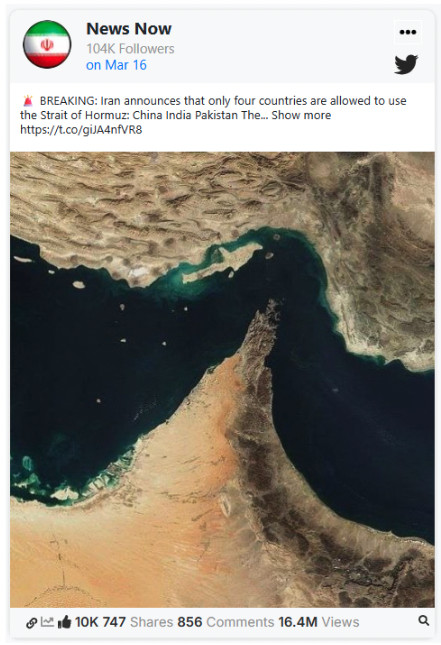
The network has shown sustained, large-scale reach with an average of 27.6 million views per day across roughly 900 posts. At its peak, the BRICS4CLICKS network generated more than 63 million views in a single day. Its most viewed post, which named the countries whose ships were able to pass through the Strait of Hormuz, was seen more than 16 million times. Importantly, no one account was responsible for driving these engagements: 5 accounts each surpassed 1 million views on at least 10 distinct posts, while 11 other accounts produced at least 1 post with over 1 million views.
This exceptional reach appears to be driven by a combination of X’s algorithm and high-profile accounts engaging with the network. Analysts discovered posts from the network in their algorithmically curated “For You” feeds and received browser alerts when an account in the network posted content. Beyond platform amplification, accounts with more than 500,000 followers reposted, quoted or replied to the network’s content roughly 100 times. Accounts with more than 50,000 followers did so over 2,000 times.
Iranian and Russian state-affiliated accounts also reposted and quoted BRICS4CLICKS content. These included accounts representing the Iranian embassies in South Africa and Australia, multiple accounts for individuals working for Iranian state media outlets, Mikhail Ulyanov (Russia’s permanent representative to International Organizations in Vienna) and Russian state TV personalities. BRICS4CLICKS content was also reposted by multiple accounts associated with the Russia-aligned information operation Storm-1516.
BRICS4CLICKS narratives
Although BRICS4CLICKS accounts present themselves as news sources, the network’s content primarily advances pro-Iranian narratives. The accounts regularly post false or misleading content that exaggerates Tehran’s military success while undermining the US and Israel.
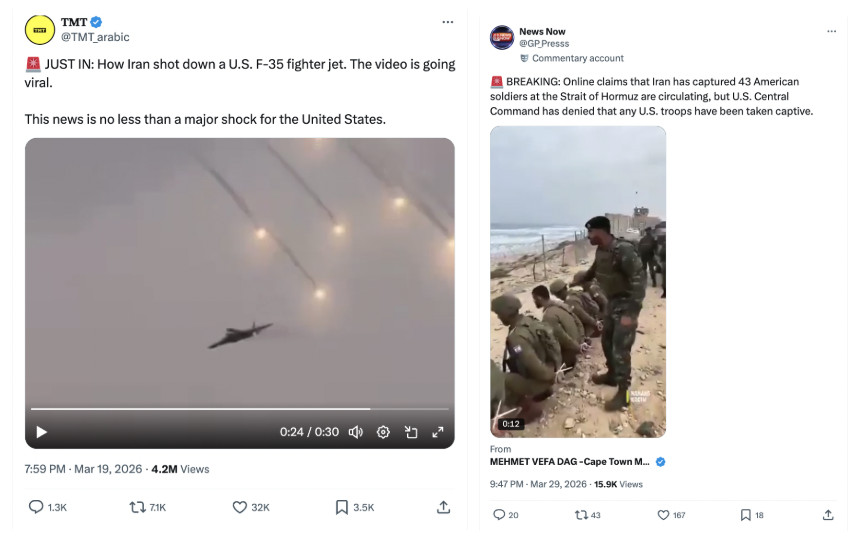
Since the start of the war, the network has generated significant engagement on conflict-related AI-generated images and videos. One of the network’s most viewed posts came from an account using the name “News Now;” the posts featuring an AI-generated video of an Iranian missile attack on Tel Aviv received more than 11 million views. While this video was labeled as AI-generated, other fabricated war-related content shared by the network was not, including AI-generated footage depicting American soldiers captured by Iran, US jets being shot down, and damage to military targets and Israeli cities. This content, which received millions of views, highlights inconsistencies with enforcing X’s recently introduced policy aimed at demonetizing or suspending accounts that share unlabeled AI-generated content depicting armed conflict.
The network also shared content linking convicted sex offender Jeffrey Epstein to the war. In the first month of the war, the BRICS4CLICKS network mentioned “Epstein” in roughly 200 posts, which collectively generated more than 17.7 million views on X. This content echoed official Iranian state messaging that the war was started to distract from revelations contained in the recent batch of Epstein files. One of the network’s most popular post (5.6 million views in total) purported to show a video of the hacktivist group Anonymous announcing it was going to release the full Epstein files. At least 5 other accounts in the network shared the same video. Other posts referred to the war as “Operation Epstein Fury” and suggested Iran is fighting to dismantle a global network of “Epstein elites.”
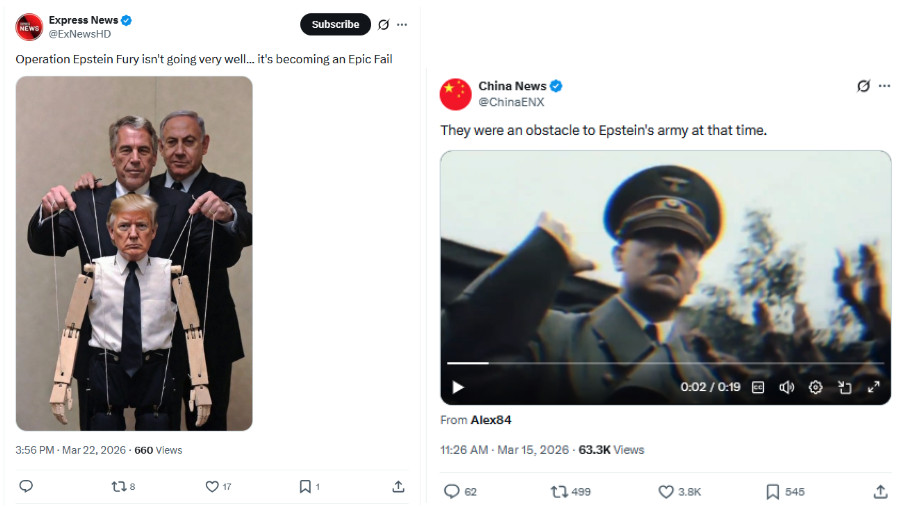
The BRICS4CLICKS network also pushed antisemitic narratives. In one instance, an account called China News made reference to Epstein in a post praising Nazi Germany. It posted a video featuring Adolf Hitler with the caption: “They were an obstacle to Epstein’s army at that time.” Several posts glorified the Holocaust, mocked Jewish people’s supposed physical characteristics and reinforced conspiracy theories about Jewish communities.
Verified4War network indicators
As with the BRICS4CLICKS network, the 18 accounts we identified in the Verified4War network shared similar or identical metadata and strong signs of coordination. All accounts in this network changed their usernames in March 2026. They also all have X Premium subscriptions, with 82 percent of accounts obtaining the blue checkmark in February or March 2026. A total of 14 out of 18 accounts were based in South Asia or Southeast Asia and originally downloaded the application via regional app stores or the web. The 4 accounts that did not match those location indicators were included because other characteristics matched the broader network, and they frequently interacted with in-network accounts. Like with the other network, the data on where the accounts were “based” and how they first joined X could be imprecise due to the potential use of VPNs.
The accounts generally presented themselves as news sources, parody or commentary accounts dedicated to political figures or national militaries. This includes usernames such as Mojtaba Khamenei Parody, Kim Jong Un Parody and Vladimir Putin Commentary, as well as multiple accounts implying affiliation with the US military, including US DEFENCE ARMY and USA ARMY NEWS. The use of parody and commentary accounts is likely a way to evade platform takedowns for violating X’s policy against impersonation.
The Verified4War network centered on promoting an account called “Times of Iran News,” which was created in 2021 and has since changed its name 69 times. X removed “Times of Iran News” shortly after ISD’s monitoring timeframe. However, in the first month of the war, Verified4War accounts reposted Times of Iran News nearly 300 times, accounting for 35 percent of total network reposts. Other accounts within the network also amplified each other heavily: 91 percent of reposts occurred within the network.
Verified4War engagements
Verified4War accounts escalated their posting volume and generated significant engagement throughout the first month of the Iran war. The network’s 18 accounts gained more than 370 million views, 1.5 million likes, and 410,000 reposts across roughly 2,000 posts during that period. On average, Verified4War accounts received more than 13 million views on roughly 70 posts per day. The network’s most viewed post, which amplified a rumor about Netanyahu’s death, was viewed more than 16 million times.
Verified4War’s influence appears to derive from a combination of algorithmic amplification via X’s curated “For You” feed and reposts from prominent accounts. Analysts first identified and routinely discovered the network’s content in their “For You” feeds. Further boosting the visibility of the network, accounts with more than 500,000 followers engaged with accounts in the network more than 30 times. Accounts with more than 50,000 followers did so on more than 1,090 occasions. Accounts belonging to high-profile Iranian and Russian-aligned actors also engaged with Verified4War’s content, including individuals like George Galloway, a former British member of Parliament and a previous contributor for the Russian state news outlet Sputnik, and ultranationalist Russian political philosopher Alexander Dugin.
Unlike BRICS4CLICKS, much of the Verified4War network’s engagement came from a single account. During the first month of the war, “Times of Iran News” accounted for approximately 40 percent of the network’s views, 35 percent of its likes, and 27 percent of reposts. The account also generated more than 1 million views across 40 distinct posts. By comparison, “INN Iran National News,” which had the second-highest number of posts exceeding 1 million views, had only six such posts. While “Times of Iran News” has since been removed from X, other accounts in the network could adopt its tactics to continue reaching large audiences.
Verified4War narratives
Verified4War accounts pushed pro-Iran narratives that were similar or identical to those advanced by the BRICS4CLICKS network. These included fabricated claims about Iran’s battlefield performance, such as assertions that Iran bombed Mossad headquarters, struck an oil tanker in the Strait of Hormuz, and shot down a US B-2 bomber before “kidnapping the entire crew.” However, Verified4War accounts generated greater traction on certain narratives and relied more heavily on clickbait-style posting than BRICS4CLICKS.
Notably, Verified4War’s false claims about Netanyahu’s death generated significantly more engagement than similar posts from BRICS4CLICKS. Although Verified4War accounts posted about his alleged death roughly 20 fewer times, they amassed more than 43 million views, nearly 5 times the total received by BRICS4CLICKS accounts. The most viewed Verified4War post on this topic reached 16.5 million views and was published by an account called “USA ARMY NEWS.” Verified4War accounts also showed clear signs of coordination in amplifying this narrative. At one point, 7 different accounts shared the same image accompanied by similar or identical text all within the same 24-hour time frame.
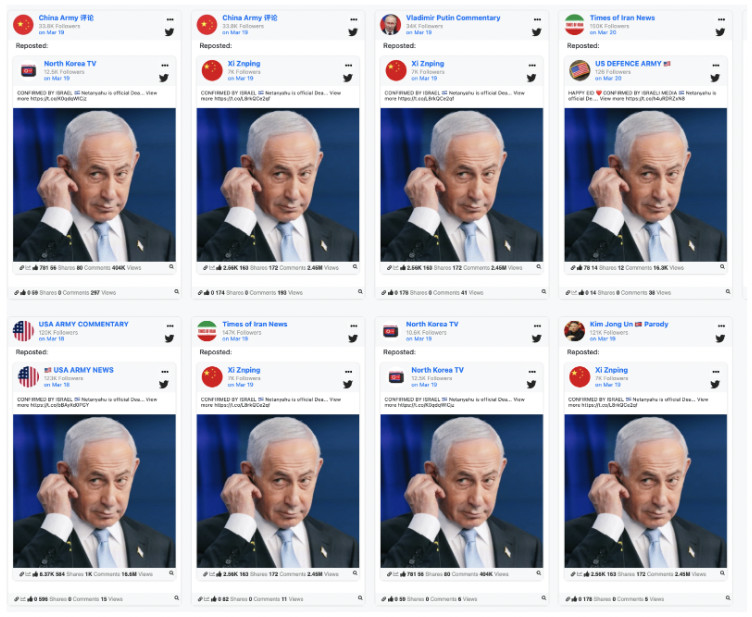
Verified4War accounts also relied more heavily on traditional clickbait-style content than BRICS4CLICKS. They frequently posted engagement-driven questions such as “do you stand with Iran,” “do you support Iran becoming a nuclear state,” and “do you support Iran’s new supreme leader.” At least 5 of these posts received more than 1,000 replies, a potential indicator of inauthentic or automated activity. The network also shared viral videos that initially gained traction through Iranian state media posts on X, including LEGO-style clips criticizing the United States and Israel.
Conclusion
BRICS4CLICKS and Verified4War have played an outsized role in shaping the tone and tenor of pro-Iran online influence operations throughout the first month of the war. Even factoring in the likely use of coordinated inauthentic behavior to artificially inflate their popularity on X, accounts in both networks have generated remarkable engagement. This is partly a testament to a messaging approach that is more attuned to the memetic, snarky culture of the internet than traditional war propaganda. But it is also a result of a more permissive platform environment than the one encountered by pro-Russian influence networks at the start of the war in Ukraine. Despite X’s recent suspension of many of the accounts identified in this report, its lax policies allowed those accounts to purchase blue check marks, impersonate media and military entities, and appear in users’ “For You” feeds, effectively helping them establish legitimacy and grow an audience. This highlights the need to not only evaluate how platforms moderate content but how they curate it.
But perhaps the most significant takeaway from our analysis of BRICS4CLICKS and Verified4War is that both networks have found success by adopting the language and unserious culture of the post-truth era. This is not a propaganda campaign meant to convince or deceive audiences but to amuse and entertain them. The result is an information war that increasingly feels less like a battle for hearts and minds and more like a battle for online clout.