Digital Dispatches
January 10, 2025
ISD UK
Democratic Integrity, Far-Right Extremism, Terrorism and Extremism
An overview of Israeli far-right extremism
Far-right extremism in Israel encompasses a broad spectrum of ideologies and movements, although many share overlapping goals and common features. This Dispatch provides an overview of key ideologies, groups and figures in contemporary Israeli far-right extremism. This is often, though not exclusively, framed within religious Zionism, although religious belief and identity are of course not inherently far-right or extremist.[1]
The article places the rise of the Israeli far-right in a global context,[2] [3] and provides insights into the post-7 October 2023 surge in far-right extremist activity. Following Hamas’s attack on Israel, the deadliest terrorist attack by number of fatalities per capita since 1970 when data collection began, far-right figures have called for the expulsion of Palestinians from Gaza, and far-right policies have gained traction among parts of Israeli society.
We review four key interlinked strands within Israeli far-right extremism:
- Kahanism
- Violent Settler Extremism
- Extremist Far-Right Parties in Contemporary Israeli Politics
- Extremist Far-Right Groups in Israel
Kahanism
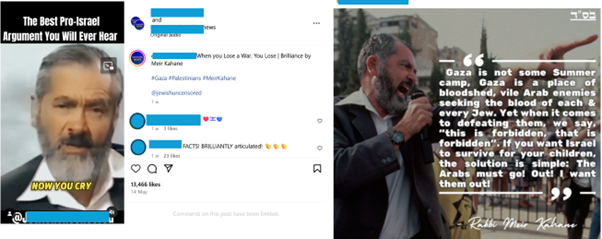
Much of contemporary far-right Israeli extremism, and connected extremism abroad, is inspired by Kahanism, a religious-nationalist Jewish supremacist ideology based on the ideas of Rabbi Meir Kahane. The New York-born rabbi founded the racist and Jewish supremacist Jewish Defence League in New York in the 1960s before emigrating to Israel in 1971, where he created the political party Kach. This was banned in 1988 for incitement to racism; it was designated as a terrorist organisation by Israel and later by the United States after supporter Baruch Goldstein killed 29 Palestinian civilians in 1994.
Kahanism envisions a state governed by an ultra-conservative interpretation of Jewish law (halacha), emphasising segregation and the prohibition of sexual relations between Jews and non-Jews. It also advocates the expulsion of Palestinians and non-Jews from Israel and the occupied territories if they do not submit to secondary status. The state of Israel, in this context, is seen as a means to restore God and the Jewish people through acts of revenge.[4]
Kahane was particularly concerned about secular and liberal Judaism, warning that “this malignancy of gentilised foreign culture”[5] and “born-by-accident Jews” represented the greatest threat to the Jewish state and people. He advocated for violent confrontation with liberal and secular Jews as well as Arabs to achieve his vision of a theocratic, racist and supremacist state in the biblical land of Israel.[6]
Although most of Kahane’s organisations are inactive today, his legacy in Israel is reflected in the increasing presence of Jewish supremacism and calls for the expulsion of Palestinians across far right political parties – policies which remain associated with Kahanism. Contemporary far-right groups labelled ‘neo-Kahanist’ such as the political party Otzma Yehudit, discussed below, now wield considerable political influence[7]. However, Kahane scholar Shaul Magid notes that Israeli ‘neo-Kahanism’ integrates the religious Zionist ideology of Rabbi Rav Kook – which regards the state as holy and secular Zionism as a partner, rather than a threat – and only grew after Kahane’s death.[8]
Violent Settler Extremism
The settler movement refers to Israelis who seek to build and expand Jewish communities within the territories conquered by Israel in 1967. Around 700,000 Israeli citizens live in settlements in the West Bank regarded as illegal under international law, many of which have been recognised by the Israeli government. Although a large number of those who now live in settlements were attracted by economic prospects and government subsidies, the organised settler movement is typically motivated by religious-nationalist ideals.[9]
While the broader movement is neither extremist nor far-right under ISD’s framework, an extremist subset continues to claim new territory in defiance of international and Israeli law emboldened by far-right figures in government. Palestinian communities including Masafer Yatta, Nabi Saleh and Huwara have suffered ‘price tag’ attacks, collective punishment for actions against the settler movement. This manifests in vandalism, harassment, intimidation and even murder, including an act of arson which killed an 18-month-old child.
The vanguard of violent settler extremism is the Hilltop Youth. A movement rather than an organisation, Hilltop Youth activists establish outposts on hilltops in populated Palestinian territory in the West Bank, in the hope of establishing enduring settlements and intimidating local Palestinian communities. They are estimated to number some several hundred but enjoy support from parts of the settler movement.[10] Kahane’s grandson Meir Ettinger is an ideological leader of the movement and was detained in 2015 for founding an organisation named ‘The Revolt’, which aimed to overthrow the Israeli state. The Hilltop Youth have been implicated in a number of killings; despite this, the Israel Defense Forces (IDF) have recruited specifically from the movement since 2020.
Extremist Parties in Contemporary Israeli Politics
The current Israeli governing coalition includes three far-right parties who ran as an alliance called Religious Zionism: Otzma Yehudit (‘Jewish Power’), the National Religious – Religious Zionist party, and Noam. They support the government’s controversial judicial reforms as well as far-right policies. Religious Zionism won 10.8 percent of vote in 2022, accounting for 14 of 120 Knesset seats. This allowed the alliance to play the role of kingmaker in the 2022 Israeli elections when other parties refused to join a Netanyahu-led government due to the corruption charges against him. It also marked a break from the past when mainstream political parties had refused to join a coalition with the far-right.
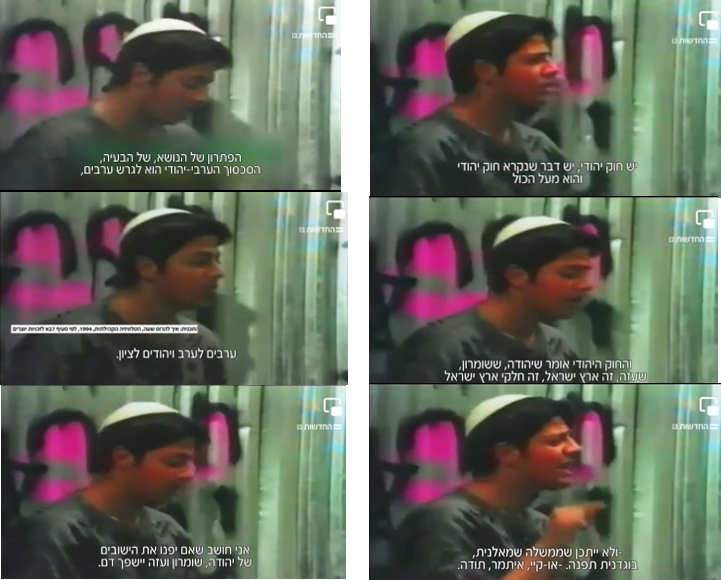
Otzma Yehudit has been described by Israeli media as an “ultranationalist, Jewish supremacist political outfit” and the “ideological successor” of Kach. Their platform includes the “emigration of the enemies of the State of Israel to their respective lands, including both Arab and Western countries”, and expanding Jewish settlement in the West Bank. Leader Itamar Ben Gvir, currently minister of national security, is associated with a movement to arm more Israeli Jewish civilians. He was previously a Kach activist. [11]
In 2007, Ben Gvir was convicted of incitement to racism and supporting a terrorist organization. He has since taken steps to moderate his rhetoric, telling supporters to chant “death to terrorists” rather than “death to Arabs” in 2022.
Ben Gvir is associated with the racist organisation Lehava as well as the Hilltop Youth. Kahane scholar Shaul Magid argues that while the Hilltop Youth want to overthrow the state, Ben Gvir wants to transform it, reflecting ideological divergences within the neo-Kahanist movement.
The National-Religious – Religious Zionism Party is a merger of religious far-right parties led by Bezalel Smotrich, the Israeli finance minister who has broad authority over the Israeli governing body in the West Bank.[13] Like Otzma Yehudit, it advocates for the annexation of a large part of the West Bank with some members supporting a full annexation. Smotrich was detained in 2005 for terrorist offences related to the Gaza disengagement; in 2006, he established pro-settler organisation Regavim, which seeks to prevent the development of Palestinian constructions in the West Bank. He is a religious fundamentalist, and considered the most prominent spokesperson for post-statist, hardline religious nationalist Jews.
Smotrich once described himself as a “fascist homophobe” and has expressed a desire to see Israel operate as it did in the time of King David and King Solomon. In 2023, he called for the West Bank Palestinian town of Huwara to be “erased” by the Israeli state.
Post-7 October, Ben Gvir and Smotrich have been leading advocates for the “population transfer” of Gazans and the Jewish resettlement of Gaza; NGOs and commentators have described this as a euphemism for ethnic cleansing.
Noam was founded in 2019, led by Avi Maoz, deputy minister of the newly-formed Jewish National Identity office. Noam seeks to restrict liberal, feminist and LGBTQ+ influence in the public sphere, prohibit women from the military, and reject religious pluralism including secular and Reform Judaism. The group considers liberal and LGBTQ+ values to be malign foreign influences. The party also wants to limit the Law of Return to exclude non-Orthodox converts and others it deems gentiles, such as those who emigrate to Israel under the ‘grandchild’ clause.
Extremist Far-Right Groups in Israel
Lehava[14] is a far-right religious extremist group established to prevent what it calls “assimilation”, particularly relations between Jewish women and Arabs; it is also antipathetic to Christians, the LGBTQ+ community, Muslims and Arabs. Lehava was founded in 2009 by Bentzi Gopstein, who was convicted of incitement to racism in January 2024, and has espoused support for the burning of churches and mosques. He is considered influential in Otzma Yehudit despite lacking an official position and is Ben Gvir’s “best friend”, according to Israeli pro-coexistence organisation Tag Meir.
In 2013, Gopstein’s daughter’s wedding party became notorious as the “wedding of hate” when a video emerged of guests stabbing the image of an 18-month old Palestinian infant who had been burned to death in a price tag killing. In 2014, two Lehava activists torched a bilingual Jewish-Arab school and sprayed “Kahane was right” on the walls. It has been blamed for the more extremist rhetoric and violence at the annual Jerusalem ‘Flag March’, alongside far-right group La Familia (explained below).
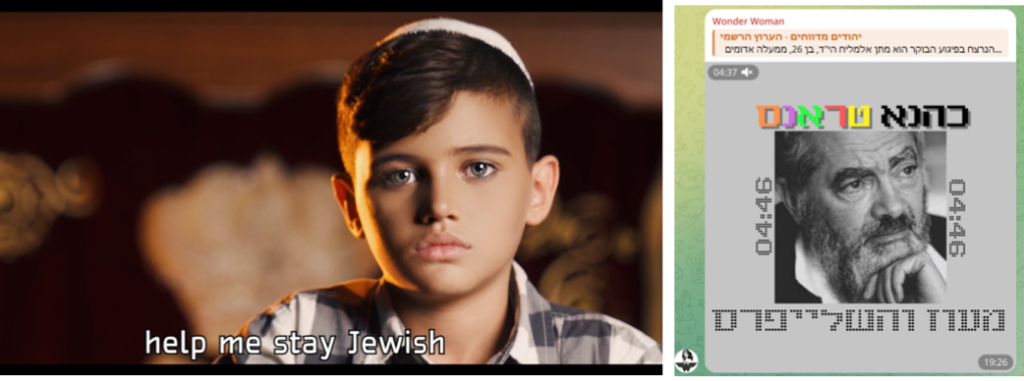

La Familia began as a fan club for the Israeli football team Beitar Jerusalem Football Club[15] which is associated with right-wing political parties and Mizrahi identity. It was described by a former member as a “fascist organisation”, with favoured slogans including “We are the [most] racist team in the country”, “Muhammad is a homosexual” and “Death to Arabs”.
La Familia has been involved in attacks on Palestinian bystanders, journalists and anti-Netanyahu protesters. In 2014, La Familia members were convicted of the kidnap and murder of a Palestinian teen; in 2015, the group chanted the name of the extremist who assassinated Israeli Prime Minister Yitzhak Rabin in 1995. Former President of Israel Reuven Rivlin said the silence of Israeli officials had legitimised extremism amongst fans.
Post-7 October Surge in Far-right Extremist Activity and International Context
Since the devastating terrorist attack on Israel that took place on 7 October, 2023, commentators have raised alarms about the normalisation of anti-Palestinian sentiment in Israeli popular culture and official rhetoric, and evidenced the link between such discourse and the normalisation of war crimes and abuse of detainees. In addition to US condemnation and sanctions, states including the UK, Australia and the EU released a joint statement, criticising the sharp rise in settler violence in the West Bank and Israel’s failure to protect Palestinian civilians.[16]
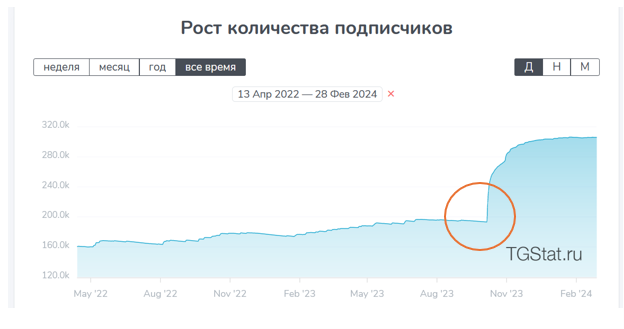
As with other actors involved in the conflict including Hezbollah and Ansar Allah (‘the Houthis’), Israeli far-right accounts experienced significant increases in followers post-7 October. A Telegram account affiliated with prominent far-right rapper Yoav Eliasi (‘the Shadow’), had its follower count increase by more than 100,000 from some 193,300 on 5 October, 2023 to 327,770 by 7 January, 2024.
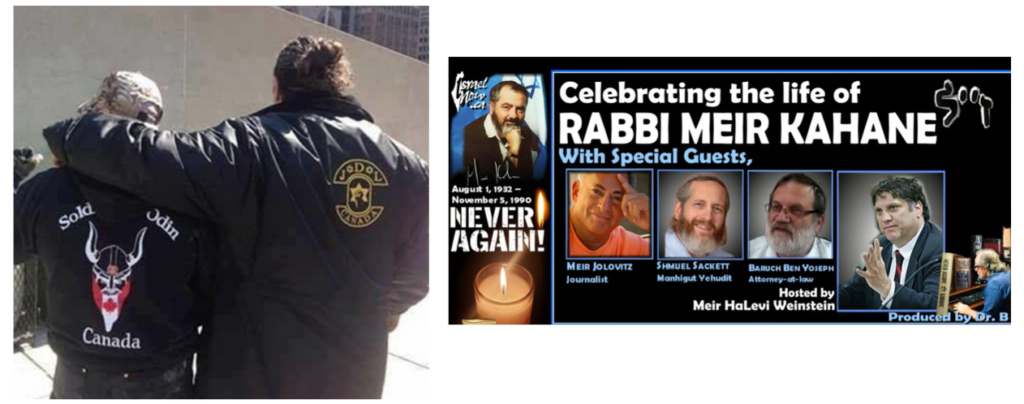
In the international context, pro-Palestinian protests and the Israel-Hamas war serve as a potent flashpoint for ideological cross-fertilisation and coalition building. Diverse far-right groups conceptualise a nebulous and interconnected threat to their idea of the nation or ‘Western civilisation’. This threat combines migrants, Muslims, and anarchists/antifa. The English Defence League (EDL) in the UK and the Soldiers of Odin Canada are among the far-right, anti-migrant, and anti-Muslim organisations to have connected with far-right Jewish extremist groups outside of Israel.
The hybridisation of these narratives mirrors other recent cases identified by ISD, including neo-Nazi accelerationist support for Hamas and Hindutva links with Western far-right groups targeting Muslims. There are also connections between Jewish far-right extremists outside of Israel and far-right extremists within Israel. The example below right depicts an online discussion between former JDL activists from Canada and the US and Israeli politician Shmuel Sackett.
Following the 7 October attack, Israeli disinformation watchdog Fake Reporter documented an uptick in far-right extremist activity as extremist groups in Israel took “advantage of the chaos to organise online to go out and carry out hate attacks”. Both Lehava and La Familia members stormed Israeli hospitals searching for terror suspects.
One extremist Israeli Telegram channel monitored by ISD has 127,268 subscribers; although it was created in April 2022, it has been increasingly active since October 7. The channel is devoted to dehumanising content featuring dead, injured, or detained Palestinians including minors and contains egregious gore content. On 2 April 2024, the channel posted images mocking the World Central Kitchen foreign aid workers killed in an Israeli strike while comments referred to aid workers as terrorists and Nazis. A similar channel run by IDF members expressed support for La Familia activists’ raid on an Israeli hospital.
Since October 7, settler violence has escalated in the West Bank, with over 1,600 Palestinians displaced by settler extremist violence, in addition to at least 21 killed and 650 injured as of September 2024. Following the killing of an Israeli settler minor by a Palestinian on 12 April in a terror attack, hundreds of armed settler extremists, some accompanied by IDF members or wearing IDF uniforms, attacked at least ten villages and towns and killed four Palestinian civilians, including one minor. On 19 April 2024, the EU sanctioned Lehava and the Hilltop Youth, as well as four extremists including Meir Ettinger, while the US sanctioned Bentzi Gopstein and two entities which had fundraised for violent settler extremists. On 3 May 2024, the UK also sanctioned Lehava, the Hilltop Youth and four extremists. On 5 May 2024, JDL Canada’s successor, ‘Israel Now’, hosted and livestreamed a counter-protest the University of Toronto student encampment, in which JDL/Kahanist symbols were clearly visible. On May 24, in a viral video that was shared by Netanyahu’s son, a reservist advocated for mutiny and the permanent occupation of Gaza while backgrounded by Kahanist graffiti.

Conclusion
Israeli far-right extremism, rooted in Kahanist ideology, Jewish supremacism, and racism, have been galvanised by the terrorist attack on Israel on October 7th and the ongoing conflict, triggering alarm domestically and abroad. The trend of increasing accommodation for overtly supremacist and anti-democratic extremist groups in Israel is demonstrated in the flagrant influence of known extremists in government.
It is also apparent in the assertiveness of far-right extremist groups in Israel and the West Bank alike, and explicit hateful rhetoric on social media. Meanwhile, the political mainstream has begun to co-opt extremist far-right rhetoric and policies as far-right narratives become more entrenched in wider Israeli discourse.
The success of these narratives and groups has repercussions for an increasingly interconnected international extremist landscape, as far-right Israeli talking points continue to converge with broader anti-migrant and anti-Muslim views. So long as the Israel-Hamas war and related protests remain a major flashpoint ripe for extremist exploitation, further ideological cross-fertilisation and coalition building is highly likely.
Endnotes:
i. For example, Gil Alexander or Mikhael Manekin.
ii. The understanding of far-right extremism used in this explainer is based on ISD’s definition and draws on Cas Mudde’s definition of far-right. Mudde’s definition frames the far-right as associated with strong-state values, nationalism, xenophobia, racism and anti-democracy, and distinguishes between the radical right, which opposes elements of liberal democracy but works within democratic frameworks, and the extreme right, which wholly rejects democracy. ISD’s definition, meanwhile, situates extremism as a supremacist ideological view which is incompatible with pluralism and human rights, and which can be pursued through political, social, and violent means. For the purpose of this explainer, ‘far-right extremism’ includes both the radical and the extreme right.
iii. For more, see ISD’s previous publications on far-right extremism.
iv. Afterman, A., and Afterman, G. (2015). ‘Meir Kahane and Contemporary Jewish Theology of Revenge.’ Soundings: An Interdisciplinary Journal, 98(2), 192–217. p.203–204
v. The anti-Western, anti-progressive bent of the ideology is analogous to Egyptian Islamist Syed Qutb’s conceptualizations of Jahiliya (the state of ignorance before Islam, which Qutb applied to Muslim majority states and leaders who did not rule by shari’a) and Iranian Jalal Al-e-Ahmad’s concept of Gharbzadegi (Westoxification). Kahane’s designation of secular/liberal Jews as the primary threat and calls for a purge distinguishes his ideology from Qutb’s and Al-e-Ahmad’s, who mostly lambasted a corrupted state rather than ideologically dissident countrymen and called for revolution against an elite rather than ethnic cleansing. Other commentators have noted that Kahanism is closer to Qutb’s revolutionary Islamism than it is to the Western far-right or white supremacists. See ‘Radicalization of the Settlers’ Youth: Hebron as a Hub for Jewish Extremism’ by Geneviève Boucher Boudreau for more.
vi. Afterman, A., and Afterman, G. (2015). ‘Meir Kahane and Contemporary Jewish Theology of Revenge.’ Soundings: An Interdisciplinary Journal, 98(2), 192–217. p.206–207
vii. Where the ruling Likud party once walked out in protest when Kahane spoke in the Knesset, they now accommodate his ideological successors.
viii. Magid, S. (2021) Meir Kahane: An American Jewish Radical. Princeton: Princeton University Press.
ix. The growth of the Israeli settler population – now around 10 percent of Israel’s Jewish population – has also led to increased support and representation for pro-settler parties in government, although being a settler does not universally translate into a vote for far-right parties.
x. Byman, D. (2015) A High Price: The Triumphs and Failures of Israeli Counterterrorism. New York: Oxford University Press, p.292
xi. Ben Gvir first became well-known to the Israeli public in 1995 after removing the hood ornament from then Prime Minister Yitzhak Rabin’s car and announcing: “Just as we got to this hood ornament, we can get to Rabin”. The politician was murdered weeks later by a far-right extremist.
xii. “The solution of the matter, of the problem, the Arab-Jewish conflict, is to expel Arabs… Arabs to Arabia and Jews to Zion*… I think that if they evacuate the settlements in Judea, Samaria and Gaza, blood will spill… There is Jewish Law, There is a thing called Jewish Law and it is above everything… And Jewish Law says that Judea, Samaria, Gaza, this is the land of Israel (Eretz Israel), this is a part of the land of Israel… And it will not be possible, that a left-wing, traitor government evacuates (the settlements).” *Zion here means Israel. “Arabs to Arabia and Jews to Zion” is a quote from Meir Kahane.
xiii. The Civil Administration is a military unit responsible for implementing Israel’s civilian policies, such as construction and infrastructure in the West Bank.
xiv. Lehava is an acronym for LiMniat Hitbolelut B’Eretz HaKodesh, which translates to: ‘For the Prevention of Assimilation in the Holy Land.’
xv. According to Middle East football expert James Dorsey, the “rabidly anti-Palestinian, anti-Muslim” Beitar football club was always political; it was founded in 1936 as an outgrowth of the quasi-militant revisionist Zionist youth group Betar founded by Ze’ev Jabotinsky, who also founded the Irgun terrorist organisation. Betar sought a Jewish state on both sides of the River Jordan and a young Meir Kahane was one of its number. By the 1940s most of Beitar football club’s members were part of right-wing terrorist organisations Lehi and Irgun, and the club was expelled by the British authorities. Later it became associated with the Herut party, precursor to Likud, led by former-Irgun leader and later Prime Minister Menachem Begin. Beitar is now identified with Netanyahu’s right wing Likud party, and in 2018 then Culture and Sports Minister and Likud member Miri Regev was filmed smiling amongst fans who shouted chants deemed “genocidal” at the opposing Arab team. The football club itself and some of its supporters have previously condemned the extremism of La Familia. See the film ‘Forever Pure’ (2016) for more.
xvi. “Australia, Belgium, Canada, Denmark, the European Union, Finland, France, Ireland, Luxemburg, the Netherlands, Norway, Spain, Sweden, Switzerland, and the United Kingdom express their grave concern about the record number of attacks by extremist settlers against Palestinians in the West Bank. Since the start of October, settlers have committed more than 343 violent attacks, killing 8 Palestinian civilians, injuring more than 83, and forcing 1026 Palestinians from their homes. We strongly condemn the violent acts committed by extremist settlers, which are terrorising Palestinian communities. We reiterate our position that Israeli settlements in the occupied West Bank are illegal under international law and remind Israel of its obligations under international law, in particular Article 49 of Geneva Convention IV. This rise in extremist settler violence committed against Palestinians is unacceptable. Israel, as the occupying power, must protect the Palestinian civilian population in the West Bank. Those responsible for the violence must be brought to justice. Israel’s failure to protect Palestinians and prosecute extremist settlers has led to an environment of near complete impunity in which settler violence has reached unprecedented levels. This undermines security in the West Bank and the region and threatens prospects for a lasting peace. While we welcomed the Government of Israel’s statement on this issue on 9 November where it conveyed that action would be taken against violent perpetrators, proactive steps must now be taken to ensure the effective and immediate protection of Palestinian communities. Words are important, but must now be translated into action.”
ISD Contributors