Digital Dispatches
August 16, 2023
ISD UK
Tech Accountability and Safety
Content glorifying the Wagner Group circulating on Meta platforms
Despite Meta labelling the Wagner Group as a “dangerous organisation”, the company has failed to remove posts providing recruitment information and celebrating its brutal activities in Ukraine and beyond.
Content warning: graphic descriptions of violence
In late June, a short-lived mutiny by the Russian paramilitary Wagner Group galvanised global attention to the organisation and its leader Yevgeny Prigozhin. The mercenary group, which has been active since 2014, is notorious for its brutality and human rights violations around the world. These crimes include the murder, rape and torture of civilians in Central African Republic, Mali, Syria and Ukraine.
In recent years, the Wagner group has showcased sadistic violence in an effort to present itself as more ruthless than traditional military units. This public image appears to have attracted the attention of people particularly interested in extremely violent online content.
Previous research conducted by Logically in May of this year revealed that the Wagner Group was actively recruiting individuals using social media platforms, including Facebook and Twitter. Remarkably, this recruitment was happening despite Wagner being designated as a “dangerous organisation” by Meta and being prohibited from having presence on the company’s platforms as a result.
According to Meta’s policies (see Appendix for more details), content that praises, shows substantive support (including fundraising and recruiting) for, or represents a “Tier 1 dangerous organisation” should be removed from its platforms. These are organisations which, by Meta’s own definition “engage in serious offline harm – including organising or advocating for violence against civilians, repeatedly dehumanising or advocating for harm against people based on protected characteristics or engaging in systematic criminal operations”. The same applies to “leaders, founders and prominent members” of dangerous organisations.
Meta has been criticised for its lack of transparency on “dangerous organisations”. The full list has never been made public by the company, despite calls from the Oversight Board. However, by ISD’s assessment, the Wagner Group fulfils the criteria of a “Tier 1″ entity – particularly on account of its involvement in the murder and torture of civilians [1]. There is also evidence that several leaders and founding members of Wagner belong to neo-Nazi groups and organisations or hold ultra-nationalist views. On that basis, content supporting and glorifying the group should not be present on Meta platforms, let alone being recommended to users.
While the future of Wagner after the failed mutiny remains unclear, the mercenary group was not disbanded, and its leader Yevgeny Prigozhin has continued to seek public attention. Most recently, a channel associated with Wagner in the Central African Republic (CAR) published an audio message from Prigozhin about the coup in Niger. In the message he called the coup part of the struggle against Western ‘colonisers’ and praised the Wagner Group as a force that can bring ‘order’ to African countries and fight ‘terrorists’.
On the same day, Prigozhin reportedly participated in the Russia-Africa summit in St Petersburg, meeting representatives of African nations. Remarkably, a picture of Prigozhin in St Petersburg was initially published on Facebook by an account allegedly belonging to Dimitri Sytii, one of the top leaders of the Wagner Group in CAR. Sytii, who was recently sanctioned by the UK, was sanctioned by the US in 2020, and is associated with a “dangerous organisation”, should not be allowed to have a Facebook account under Meta’s own policies.
In light of the recent failed mutiny and the ensuing uncertainty surrounding Wagner’s future, ISD set out to determine whether content praising the group or recruiting for it still exists on Meta platforms, which include Facebook, Instagram, and Threads.
Key findings
This study identified a total of 114 accounts on Facebook and Instagram that were either impersonating or glorifying Wagner or posting recruitment content for the group. This is despite Meta’s designation of the group as a ‘dangerous organisation’, which in theory means it cannot have a presence on their platforms.
Within this total set of 114 accounts, further analysis by ISD found that:
- These accounts post in at least 13 languages: English, French, German, Italian, Spanish, Portuguese, Arabic, Macedonian, Polish, Romanian, Indonesian, Vietnamese, and Russian.
- Of the total 57 accounts on Facebook (including 26 pages, 25 profiles and six groups) posing as and/or glorifying the Wagner group and its activities:
- 15 had more than 10,000 followers or members at the time of writing. These pages and groups were focused not just on Wagner, but on pro-Kremlin content in general, with posts in French, Arabic, and Macedonian.
- 23 of them had posted recruitment material and/or information about how to join the Wagner group.
- A total of 57 accounts on Instagram were found to be impersonating and/or glorifying the group. Combined, these accounts had a followership of 10,175 users. Three of them spread information on how to join the group or posted recruitment material.
Meta’s policies clearly state that violent and graphic content should only be allowed on its platforms in cases where the imagery is used to ‘condemn and raise awareness’. However, much of the content posted to Facebook and Instagram that glorified Wagner featured videos and photos of violent acts committed by soldiers fighting with the group. At times this included depictions of violent murder and/or human corpses.
Additionally, during ISD’s investigations into Wagner content on Facebook (which used a research account that did not actively engage with any posts), the platform’s recommendation systems suggested our account join a pro-Wagner group. This was delivered both as a direct notification and as a recommendation under the ‘suggested groups’ section. This means that not only is Meta failing to detect content supporting the Wagner group on its platforms, but its algorithms may actually be automatically amplifying this content to users.
Methodology
This research employed a combination of qualitative and quantitative techniques. ISD used Method52, a social media analysis tool developed by CASM and the University of Sussex, to analyse data from Facebook and Instagram that was collected through the CrowdTangle API. An initial screening exercise aimed to identify groups, pages, and accounts that both contained the word “Wagner” (spelled in either Latin or Cyrillic alphabet) in their names and had also posted content using Wagner-related keywords. In addition, analysts used phone numbers, a website, and handles of Telegram bots found in Wagner recruitment posters and affiliated channels to locate content providing information on how to join the group.
All data subsequently underwent manual assessment and analysis, and supplementary manual searches were conducted to pinpoint content that glorified Wagner.
Wagner Group Recruitment Content
ISD identified 23 Facebook pages, profiles and groups that have published recruitment posters and videos from the Wagner Group or contact information, including phone numbers, Telegram channels specifically used for recruitment and its website. These accounts span six languages, including French, Arabic, Russian, Spanish, Romanian and Macedonian.
Several accounts posted a short video calling for men to join “the strongest private army in the world”; it features Prigozhin personally who claimed that the “Third World War” was near.
However, the group appears to be conscious of its external reputation. One of these 23 accounts shared an 11-minute video in which a Wagner fighter attempted to persuade viewers that joining the group wouldn’t lead to being mere cannon fodder, but rather, individuals would receive military education and be welcomed into a Wagner “family.”
Recruitment content found on the platform was mostly published before the mutiny and contained seemingly authentic contact details, such as phone numbers, Telegram bots and channels or links to the Wagner official website. However, ISD could not find any credible evidence linking these Facebook pages, groups, and profiles directly to the group. Though these posts appear to have limited engagement – typically between zero and just over one hundred likes – ISD also found individuals with significant audiences posting pro-Wagner content.
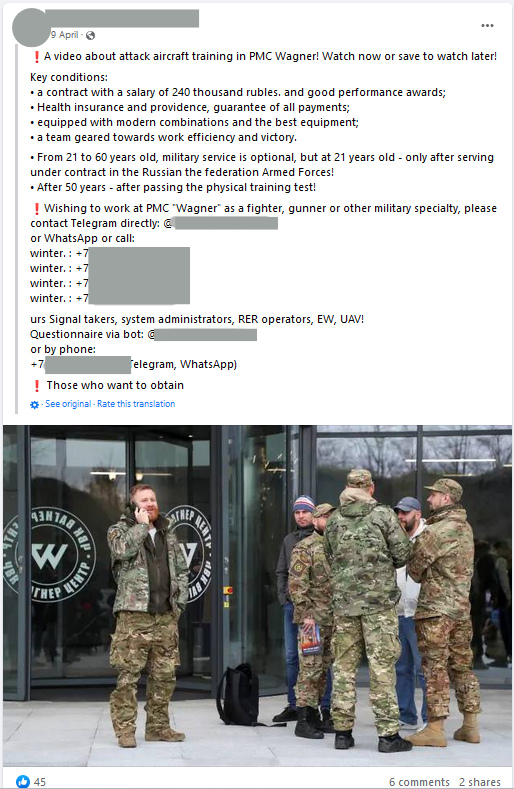
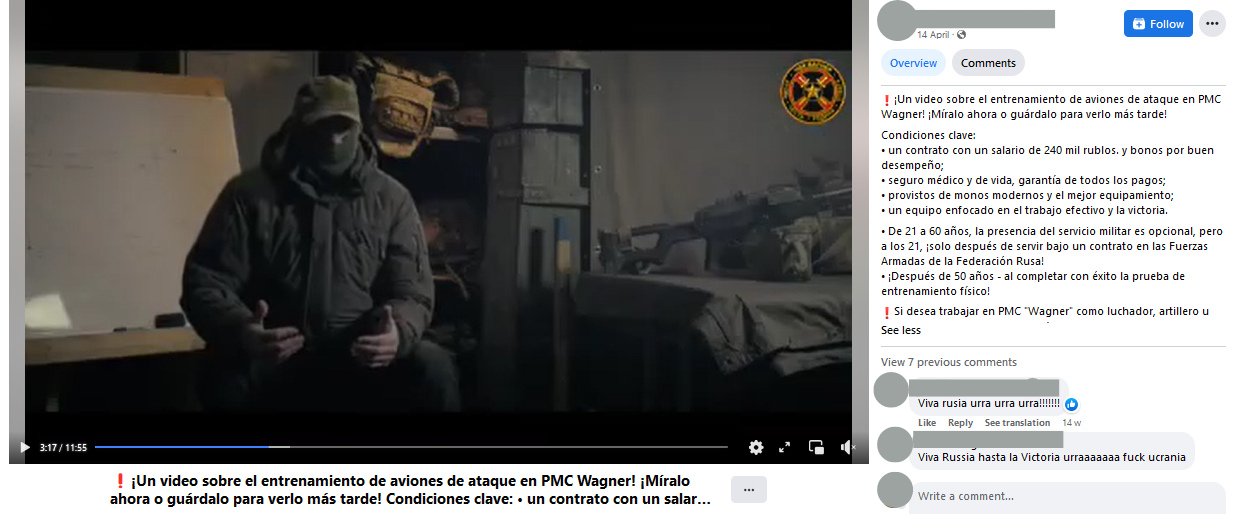
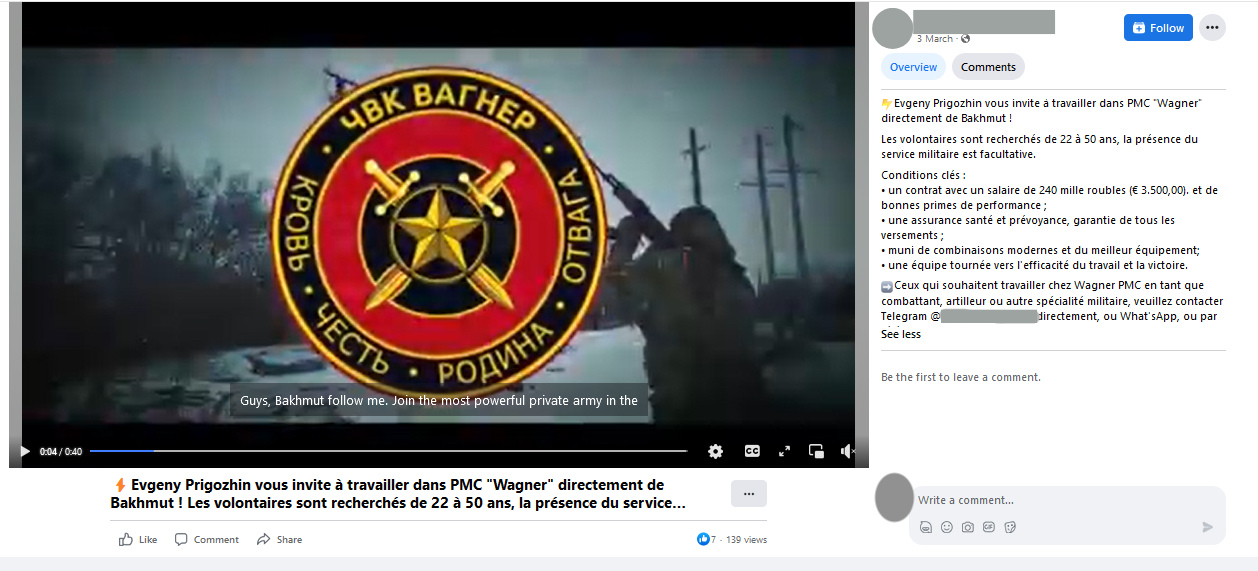
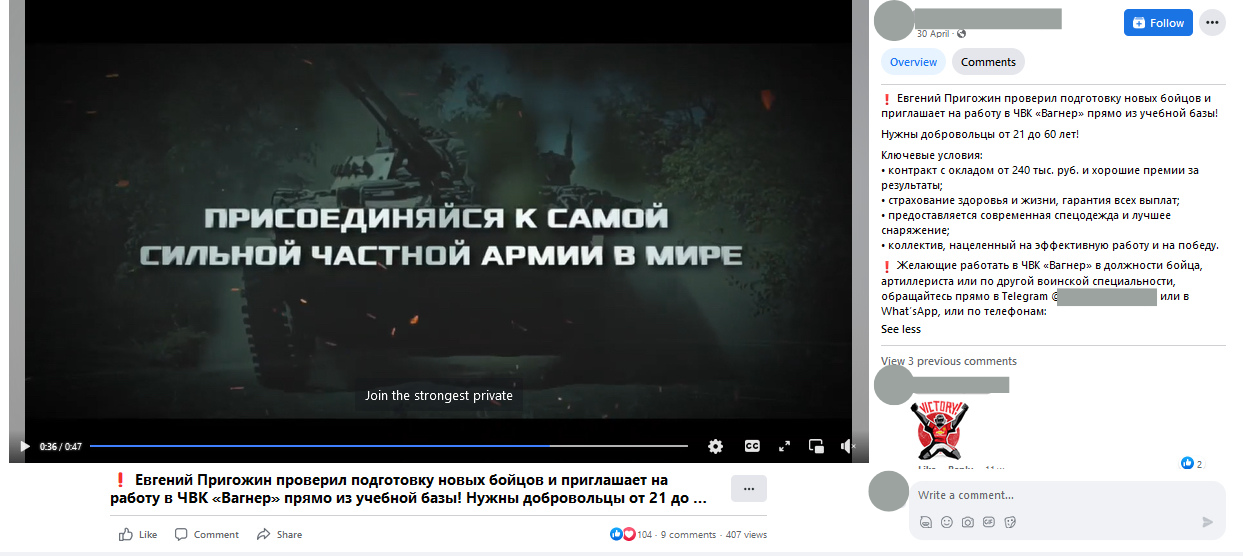
An example of this is Luc Michel, a Belgian far-right and pro-Kremlin activist, who was publicly exposed earlier this year as being behind a pro-Kremlin and pro-Wagner campaign targeting African countries. Despite being exposed, Michel continued to publish content praising and recruiting for Wagner to an audience of more than 71,000 Facebook followers.
Two other popular French-language pages that published recruitment information – one with over 143,000 followers and another one with over 34,000 followers – were also targeting two countries in Africa: Mali and Côte d’Ivoire.
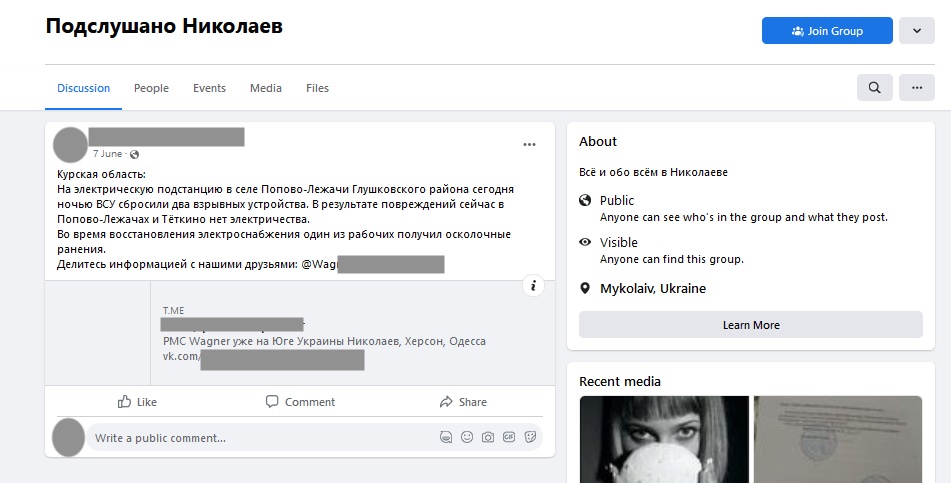
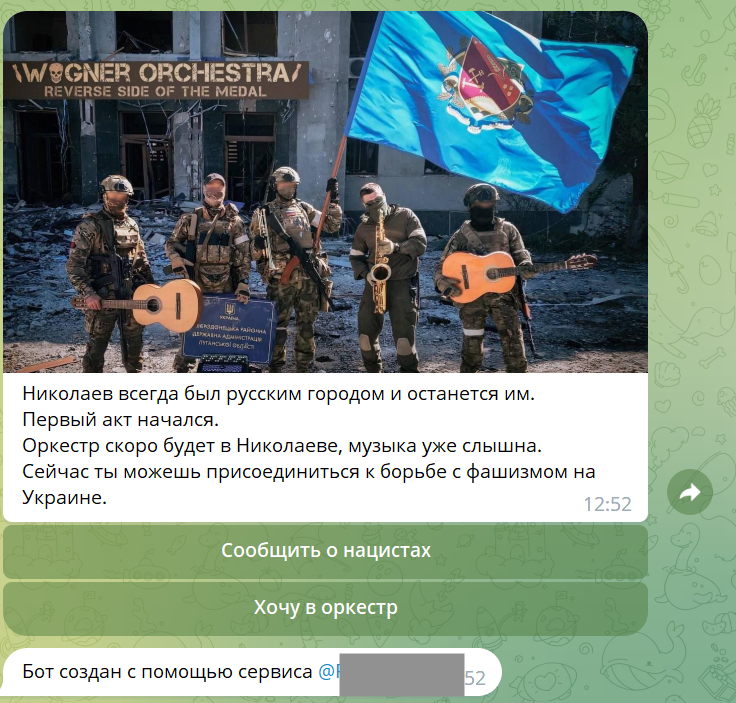
In addition to this, ISD identified a profile that posted a link to a pro-Wagner Telegram bot (an automated programme that can send and receive messages and show users different commands) in two groups targeting Ukrainians. The identical posts called for “sharing information with our friends” with a Telegram bot. The bot claims to belong to “Wagner South” and offers two options: to join Wagner or to share information about locations of “Ukrainian Nazis” (a pro-Kremlin codeword for Ukrainian forces) and “accomplices of Nazis” (a codeword for any pro-Ukrainian person) on the territories occupied by Russia.
While all the identified posts with information on how to join Wagner were published on Facebook prior to the mutiny, ISD noticed that individual users became particularly interested in the group after the news about the insurrection broke out. ISD identified numerous posts and comments in which users appeared to be sincerely trying to get information about joining the mercenary group.
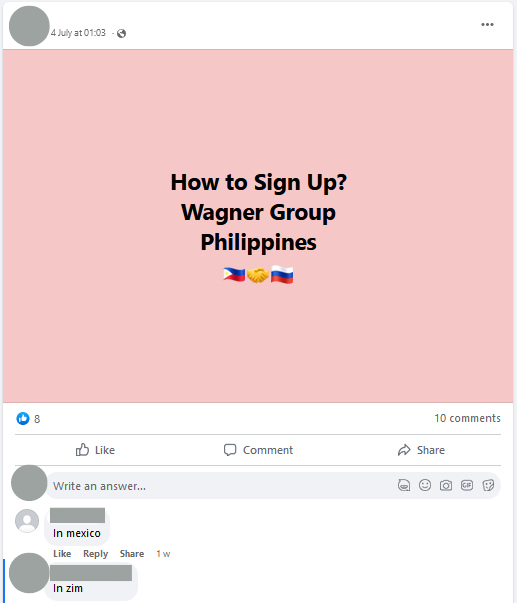
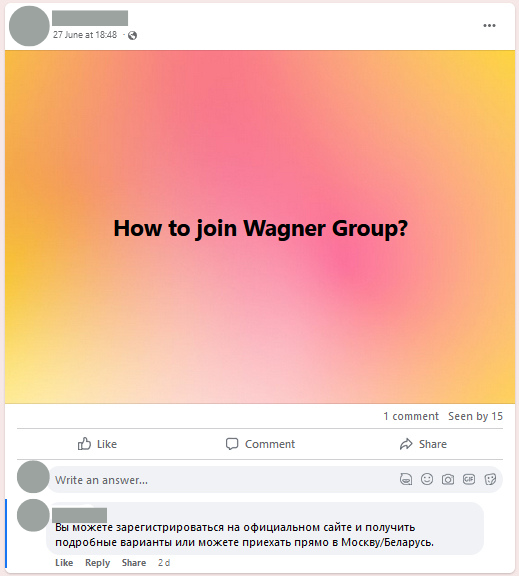
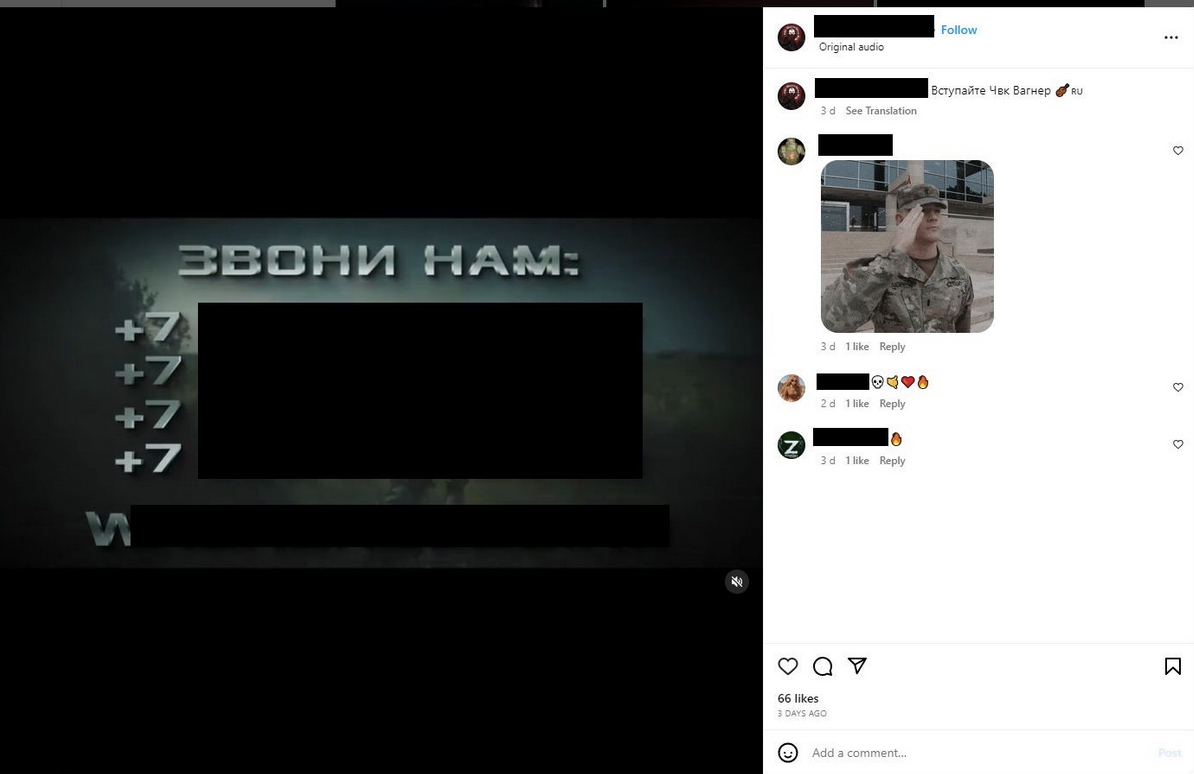
On Instagram, our investigation uncovered three accounts posting content containing information and contacts related to joining the Wagner group. One of these accounts featured a recruitment advert showcasing a Wagner soldier in Bakhmut. In the video, the soldier reveals that he had no prior military experience and had not served in the army before joining the group. He passionately describes the group as a “big family” and assures prospective recruits that they will receive thorough training and a warm welcome upon joining.
The video concludes with a list of phone numbers and a website where interested individuals can sign up to join the group. The other two accounts, which post in English, also offer assistance in joining the group, providing different phone numbers and separate contact accounts for those interested in enlisting.
Glorification of Wagner Group Activities
On Facebook, ISD identified 54 pages, groups and individual profiles that either posed as Wagner or glorified the group and its mercenaries. The content posted by these pages, groups and profiles was produced in at least 13 languages: English, French, German, Italian, Spanish, Portuguese, Arabic, Macedonian, Polish, Romanian, Indonesian, Vietnamese, and Russian.
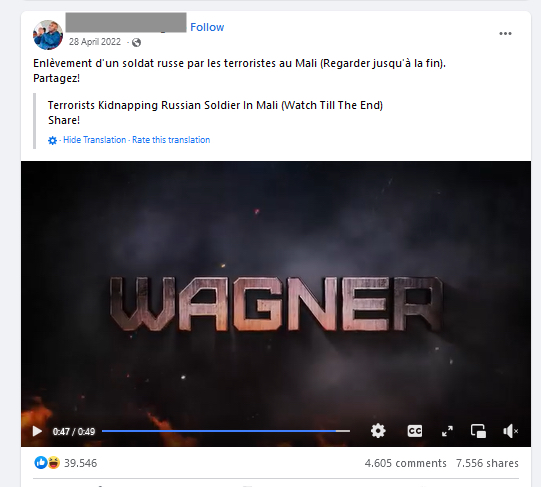
As with accounts posting recruitment content, ISD could not find any credible evidence for affiliation of these pages, groups and profiles with Wagner, however they did have sizeable audiences; 15 of pages and groups had more than 10,000 followers or members. Those pages did not focus exclusively on pro-Wagner content but were typically pro-Kremlin. The most popular page in the data set was one supporting Koudou Laurent Gbagbo, former President of Côte d’Ivoire, with an audience of more than 313,000 followers. This page posted a video of a staged scene in which a Wagner fighter supposedly ‘escapes kidnapping by terrorists’ and praises the soldier’s bravery – it received almost 40,000 reactions and over 7,500 shares.
The identified pages, profiles and groups published numerous posts glorifying the Wagner Group both prior to the mutiny and after it – this means there has been a consistent presence of pro-Wagner content on Facebook for some time.
Posts from these accounts included videos, many of which were previously published by Russian state media or Russian-language pro-Wagner or pro-Kremlin Telegram channels and contained their watermarks. The videos typically show Wagner mercenaries fighting in Ukraine, with battle scenes sometimes accompanied by pro-Wagner songs. One of the videos shared by several pages features a Wagner fighter raising the Russian flag in the ruins of the Ukrainian town of Bakhmut and shouting obscenities about Ukrainians. The months-long battle of Bakhmut earlier this year has come to be known as one of Europe’s bloodiest infantry battles since the Second World War. Russian forces stand accused of war crimes in the town, including the use of white phosphorous in civilian areas.
Another video shared by several pages was a song praising Wagner in Arabic with an Iraqi accent and with Arabic and Russian subtitles. The song was initially published by Sabreen News, an outlet linked to pro-Iranian militias in Iraq that regularly echoes Kremlin propaganda lines. The song glorifies Wagner fighters as heroes and calls them “Shrougi” – thus framing them as belonging to Shia from Southern Iraq. The song was accompanied by war footage and pictures showing the Wagner group’s founder Yevgeny Prigozhin together with Vladimir Putin.
Other content glorifying Wagner included numerous pictures of mercenaries posing with weapons, often accompanied by heart emojis, emojis of musical instruments (an allusion to the Wagner Group being unofficially called “orchestra” or “musicians”) and comments calling Wagner “heroes” or “most feared Russian warriors”. Several pictures inc
ISD Contributors