Digital Dispatches
January 20, 2026

ISD UK
Recommender Systems and Algorithms, Tech Accountability and Safety
Men, algorithms and how YouTube shapes media consumption
20 January 2026
Executive summary
This research project explores the topics and content YouTube’s algorithm recommends to young male users. Research shows that YouTube is a key information source for young men: 88 percent of American men aged 18-29 use the platform, and four in five users spend at least two hours per day on the platform.[1] To fully understand how young men consume online content requires investigating YouTube’s opaque recommender algorithm.
ISD examined recommendations served over a two-week period to three test accounts coded as 29–30-year-old US-based men who showed interest in one of three topics: cryptocurrencies, male stand-up comedians or the video game Minecraft. These topics are among the most popular content genres for young men (gaming and comedy)[2] or rapidly gaining popularity in growing, gendered content ecosystems (cryptocurrency).[3]
ISD found that content on the designated topics comprised roughly half of all recommendations. The remainder consisted of videos on topics on traditionally masculine hobbies, news and politics, celebrity culture and entertainment, and health and lifestyle. Notably, we did not find any discernable ideological bias in the recommended news and political content. This study also did not uncover a tendency for the algorithm to recommend a significant amount of extremist or otherwise harmful content, despite prior ISD studies finding that users mimicking teenagers were recommended such content.
Key findings
- During the period of study, most video recommendations were connected to each account’s core interest. Between 49 and 62 percent of recommendations were directly related to cryptocurrency, Minecraft or male stand-up comedy or featured adjacent topics (e.g. other video games or sketch comedy).
- YouTube recommended a minority of videos on other stereotypically masculine hobbies. Between 5 and 12 percent of recommendations related to topics deemed ‘traditionally masculine’ including cars, guns, gambling and sports. Finance and gaming videos were also recommended to accounts with these demonstrated interests.
- YouTube recommended ideologically mixed news and politics content. Between 3 and 8 percent of recommendations featured news and politics content from traditional and alternative sources across the ideological spectrum. This finding is in line with existing research challenging repeated claims that the platform’s algorithm is ideologically biased.[4]
Introduction
YouTube remains the dominant online platform for young American men: a large majority of whom use it regularly, often for several hours per day.[5] In a recent survey, a majority of teen boys (aged 12-17) said they do not understand the algorithm but want more control over how it recommends content.[6] Presently, the algorithm drives 70 percent of the platform’s views.[7] Previous reports show how YouTube’s recommendation algorithm may direct users toward extremist political content[8] or misinformation.[9]
In 2022, ISD conducted a qualitative study on the videos YouTube recommended to Australian boys and young men,[10]training accounts on content from ideologically diverse right-wing actors. Two control accounts only watched videos recommended by YouTube. The study found that all accounts were recommended content that led to ‘Manosphere’[11] and Incel creators.[12] In 2024, ISD studied YouTube using accounts mimicking teenagers who engaged with content on specific interests for an average of 19 minutes per day over a five-day period. The YouTube algorithm served these accounts a mix of harmful material including“sexualized gaming videos, misogynistic content, and videos related to self-harm and suicide.”[13]
This study takes a different methodological approach; it examines a broader period of watch time than the 2024 study and employs digital analysis tools rather than human coding. In contrast to the 2022 study, our test accounts did not engage with content explicitly linked to a political ideology. Unlike both previous studies, our users did not subscribe to any YouTube channels.
Previous research indicates the potential harms young users might face while using YouTube, but there is limited research on how the platform’s algorithm shapes the media diet of its most prolific users: young men. This analysis aims to investigate how the YouTube algorithm builds an interest profile for young, male users with limited data inputs.
Methodology
ISD’s investigation sought to examine YouTube’s functionality and recommendation algorithm based on newly created test accounts expressing interest in only one male-centric hobby.
‘Persona’ building and training
Analysts created three completely new Google accounts or ‘personae.’ For consistency, when signing up for a Google account, each persona indicated they were a man born in 1995 or 1996 and located in the US.
After creating new YouTube accounts, analysts watched at least 150 videos aligned with each persona’s assigned interest, chosen based on preliminary research of the most popular channels.
Analysts viewed the 150 videos in full and ‘liked’ each video, automatically adding each one to a personal playlist. This method allowed analysts to track each video watched by a persona. Once personae reached at least 150 videos, analysts watched the full playlist of liked videos three times.
As discussed above, Persona 1 watched videos on general cryptocurrency topics. These videos included influencers discussing cryptocurrencies, news reports on cryptocurrencies and channels that cover trading strategies. Persona 2watched videos related to Minecraft, a sandbox video game where players build and explore a digital 3D world.[14]Persona 3 watched stand-up comedy content delivered exclusively by male comedians.
Analysis of recommendations
ISD then used a browser automation tool to record the recommendations served to each persona via the YouTube homepage, which took place every 15 minutes over two weeks. The tool recorded both full-length videos and YouTube Shorts.
This process yielded 9,538 videos recommended to the gaming persona, 7,089 for the comedy persona and 7,895 for the crypto persona. Researchers then used automated analysis to identify patterns across the content.
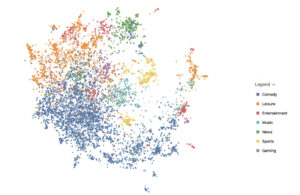
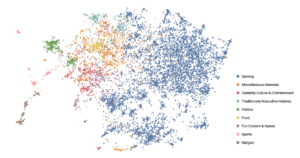
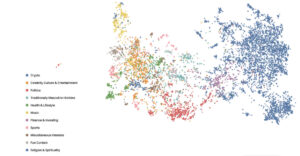
Analysts generated transcriptions for all videos using OpenAI’s Whisper transcription tool. They then processed each video’s title and resulting transcript with Nomic Atlas, which clustered content by linguistic similarity.
This process produced hundreds of semantically similar clusters for each persona corresponding to specific video topics. Analysts manually reviewed a sample of 20 videos from each cluster to verify and label the cluster’s specific topic.
After labeling the individual clusters, analysts grouped them into broader thematic categories. For example, focused clusters labeled “bitcoin,” “stablecoins” and “ethereum” were combined into a broader “cryptocurrency” category, while “automotives,” “guns” and “outdoor survival” were grouped under “traditionally masculine hobbies.”
Some clusters lacked coherent themes, either due to transcription limitations or the absence of a single clear topic within the embedding process. These clusters were excluded from analysis. This filtering resulted in 8,218 videos for the gaming persona, 6,036 for the comedy persona, and 7,161 for the crypto persona, organized into no more than 12 broad thematic categories per persona.
Using Nomic Atlas’ interactive visualization tools, analysts examined how these broader themes evolved throughout each persona’s viewing trajectory, tracking the prominence of topics over time.
While this methodology provides insights into YouTube’s recommendation patterns, it has inherent limitations. It is impossible to replicate authentic user behavior in a controlled research setting. Without direct access to YouTube’s internal data and algorithms, ISD’s findings represent observed patterns rather than definitive conclusions about how the platform’s recommendation system operates.
Findings
During the period of study, the most prominent category of recommendations featured content related to each persona’s stated area of interest, either directly or indirectly. As reflected in the chart below, ISD found that between 49 and 68 percent of recommendations were about the training interest over the period.
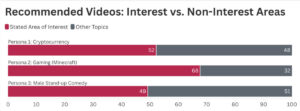
While YouTube predominantly recommended videos about each persona’s training interest, the proportion of interest-aligned recommendations varied across the accounts and varied over time for each account throughout the study. The gaming persona’s recommendations were the most homogenous: 68 percent of recommended videos were related to gaming. YouTube’s algorithm seems to assume a user interested in gaming is less likely to be interested in other topics, at least as compared to users interested in cryptocurrency or comedy.
Videos within the training interest never dropped below 30 percent of the total number of recommendations on any given day throughout the study period despite some fluctuations. The lowest dips occurred near the midway point of the observation period, suggesting that the algorithm reverted to videos directly related to the original areas of interest.
The findings indicate that while the algorithm will recommend content on a range of unrelated topics, without user engagement signals (i.e., clicking on and watching videos), the recommendation algorithm will not significantly alter the overall content recommendation mix. These findings indicate that YouTube’s algorithm recommends approximately 50 percent thematic content based on users’ interests and then makes informed assumptions about adjacent topics that might entice the user to watch. Although users were recommended content adjacent to the initial topic of interest, YouTube consistently reinforced already established interests.
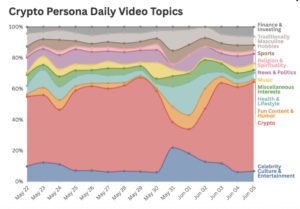
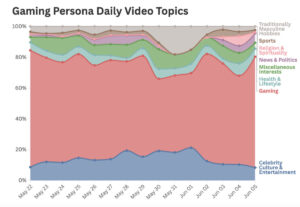
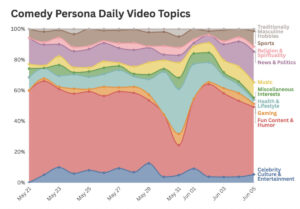
YouTube recommended a diverse range of videos to each persona outside the training topics including videos on traditionally masculine hobbies and religious content.
Recommended content included videos on areas of general interest, like entertainment (movies, TV and celebrity videos), music and news. Between 5 and 12 percent of recommendations across the three personae also included stereotypically masculine content including videos on topics such as cars, gambling, guns, sports, investing and gaming.
Between 1 and 2 percent of recommended videos covered religion and/or spirituality. These included videos onChristianity and Islam, the history of religion and on spirituality generally.
YouTube recommended ideologically mixed news and political content
Recommendations for all three accounts included ideologically diverse news and politics videos from both mainstream and alternative media sources. YouTube recommended videos from Fox News, MSNBC and Forbes to all three personae. Each persona’s recommendations also included videos from MeidasTouch, a liberal digital-first outlet founded in 2020; two also had recommendations featuring Brian Tyler Cohen, a self-described “independent progressive.” The comedy persona’s recommendations included Democracy Now!, a left-leaning news outlet, and the channel for the HBO satirical news show, Last Week Tonight with John Oliver.[15]
Conclusion
These findings shed light on YouTube’s recommendation algorithm’s assumptions about the topics young men on the platform are likely to be interested in. Although our research did not replicate real user behavior, the findings suggest that YouTube does not consistently push men interested in stereotypically masculine hobbies toward harmful content unless they signal to the platform that they are interested in the subject. We also found that over time, YouTube may suggest videos on other male-centric topics and ideologically mixed news and politics content, but ultimately returns to the interests it already knows the user engages with.
The research found that YouTube did not draw our test accounts down ‘rabbit holes’ or recommend purely homogenous content. Instead, the findings suggest there is fertile ground for optimizing content to enter the feeds of users with narrow watch histories. Media producers and other practitioners interested in reaching young men on YouTube should consider using the adjacent, algorithmically linked topics identified by this research as entry points to reaching their target audience.
[3] YMRI October 2025 Base Sample
[4] For more on the nuances of this debate, see Prithvi Iyer, “New Study Suggests Right-Wing Bias in YouTube Recommendation Algorithm,” Tech Policy Press, December 7, 2023, https://www.techpolicy.press/new-study-suggests-rightwing-bias-in-youtube-recommendation-algorithm/.
[5] https://www.pewresearch.org/journalism/fact-sheet/social-media-and-news-fact-sheet/
[6] https://movember.com/uploads/files/2025/Movember%20-%20Young%20Men%E2%80%99s%20Media%20Landscaping%20Report.pdf
[7] https://www.technologyreview.com/2022/09/20/1059709/youtube-algorithm-recommendations/
[8] https://www.ucdavis.edu/curiosity/news/youtube-video-recommendations-lead-more-extremist-content-right-leaning-users-researchers ; https://www.techpolicy.press/perhaps-youtube-fixed-its-algorithm-it-did-not-fix-its-extremism-problem/
[9] https://www.politico.eu/article/mozilla-firefox-report-youtube-algorithm-pushes-hateful-content-misinformation/
[10] https://www.isdglobal.org/wp-content/uploads/2022/04/Algorithms-as-a-weapon-against-women-ISD-RESET.pdf
[11] For more on the Manosphere, see ISD’s explainer: https://www.isdglobal.org/explainers/the-manosphere-explainer/
[12] For more on Incels, see ISD’s explainer: https://www.isdglobal.org/explainers/incels/
[13] https://www.isdglobal.org/isd-publications/pulling-back-the-curtain-an-exploration-of-youtubes-recommendation-algorithm/
[14] https://www.minecraft.net/en-us/article/what-minecraft
[15] For more on the journalism of Last Week Tonight, see: https://variety.com/2018/tv/news/john-oliver-journalist-hbo-last-week-tonight-1202702144/.