Digital Dispatches
October 30, 2025

ISD Germany
Democratic Integrity, Foreign Information Manipulation and Interference
From Bucharest to Prague: The spread of the ‘Romanian Scenario’ conspiracy theory in Czechia’s elections
By: Richard Kuchta, Jonáš Syrovátka
30 October 2025
Summary
False claims of electoral interference in Czechia’s 2025 parliamentary election had circulated for more than a year by the time polls opened on 3 October. Narratives ranged from misleading claims about postal voting to allegations of a ‘deep state’ effort to rig the elections (referred to as the ‘Romanian scenario’, referencing the annulment of the first round of Romania’s presidential election in December 2024).
The impact of such claims was underscored by Czech President Petr Pavel’s unprecedented public address just three days before the elections, reassuring citizens of the integrity of the process. Even two weeks after Andrej Babiš and his ANO party (populist party) declared victory, a Russia-affiliated Telegram channel began spreading a conspiracy theory that the Czech army was collecting discrediting material against the opposition.
Analysis from ISD based on qualitative observations and data from the platform X identifies the evolution and overlap of narratives over a one-year period. We also tracked the actors involved in spreading these narratives: these included opposition figures from the far-right and the far-left of the Czech political spectrum, alternative media and influencers. ISD research shows how narratives can quickly evolve and foster distrust towards democratic institutions and processes.
Key Findings
- ISD analysis found an evolving and interconnected series of claims targeting the Czech parliamentary elections from summer 2024 until the vote took place in October 2025. From December 2024 onwards, the most prominent narrative revolved around the “Romanian scenario”: the belief that the Czech intelligence service, government, and/or the EU planned to manipulate the elections.
- The ‘Romanian scenario’ refers to the decision of the Romanian Constitutional Court to cancel the second round of voting after intelligence documents (later declassified) suggested Russian interference in the process. However, the “Romanian scenario” has evolved into a broader conspiracy theory claiming that the EU annulled Romania’s December 2024 elections because the results were not favourable to its interests.
- Actors who spread these claims included opposition figures from both far-right and far-left parties, fringe voices, alternative media, and influencers, including some aligned with Russian state media. A post from one such actor about the Romanian scenario reached approximately 93,000 users.
- The Romanian scenario was also linked to more specific misleading claims concerning the launch of the EU’s Rapid Response System (RSS), which is designed to help member states share information about disinformation campaigns. Conspiracy theories also surrounded the decision of the constitutional court about whether the far-left party Stačilo! and the far-right party SPD should be treated as a coalition or individual parties in elections.
- Claims around electoral fraud had a transnational element. ISD found that similar accusations and conspiratorial narratives also appeared in the presidential election campaign in Poland in May and were spread by Russian-language Telegram channels. These narratives were also used by Czech actors to suggest election interference in other elections, such as the Croatian presidential elections last December.
Methodology
For this analysis, ISD employed a mixed methodology approach, beginning with a manual observation of online Czech spaces, including both mainstream social media platforms and websites. This helped identify salient narratives, such as the ‘Romanian scenario’ and other terms related to alleged election manipulation and fraud. ISD also incorporated findings from election monitoring with Czech and international civil society organisations researching disinformation and foreign information manipulation interference (FIMI).
Facebook is the primary platform in Czechia (used by 67.8 percent of the population in June 2022), but data access through the Meta Content Library is limited to posts from pages with more than 15,000 followers. ISD instead collected data from X (formerly Twitter) using the social media listening tool Brandwatch.
ISD built two lists of keywords based on subject matter expertise and observations. The first focused on election interference in general, while the second specifically considered the ‘Romanian scenario’ narrative. After collecting posts that contained one or more of these keywords, ISD analysed the use of these terms over the last 18 months, noting their intersection with other conspiracy theories and allegations.
Mapping the ‘Romanian Scenario’ Narrative on Social Media
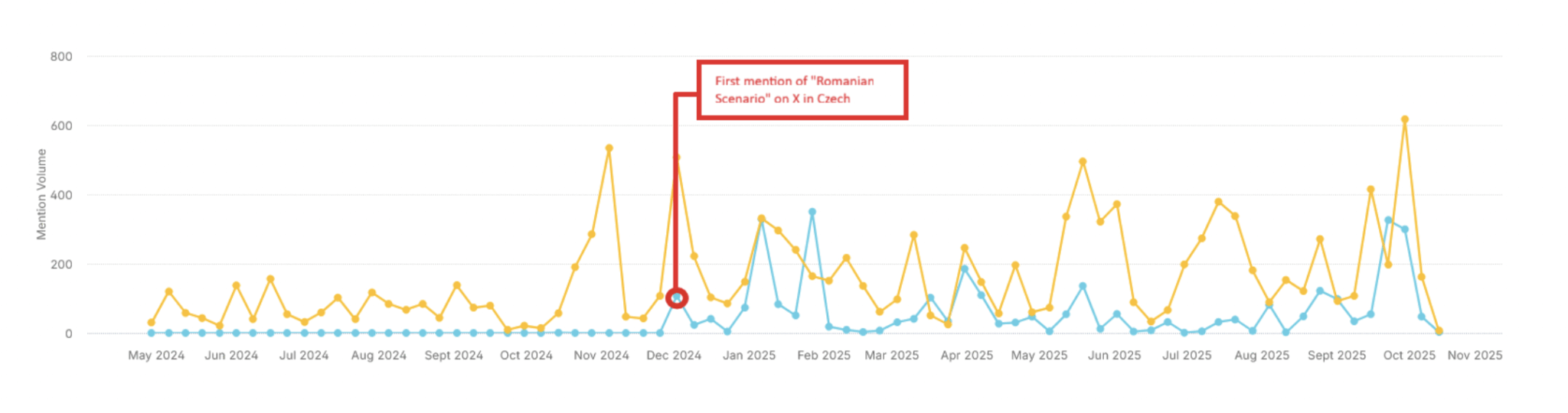
Our analysis showed that claims about election interference and integrity rose and fell over a period of more than a year. Minor spikes in summer 2024 appear to have been driven by claims from opposition parties and fringe online actors that postal votes from abroad would increase the risk of electoral fraud. However, as the election drew closer, this narrative did gain the expected prominence.
Posts featuring mentions of election manipulation remained relatively low until early November 2024, when Czech users began discussing election fraud in the context of the US presidential elections. An additional spike appeared on 6 December, when the first round of the Romanian presidential elections was annulled after the Romanian constitutional court cited declassified intelligence documents pointing to a large scale inauthentic social media operation boosting nationalist candidate Calin Georgescu. On 7 December 2024, ISD identified the first mention of the ‘Romanian scenario’: a fictitious plot involving a conspiracy between courts, intelligence agencies and EU actors to rig the Czech elections using the precedent set in Romania. Mentions of the ‘Romanian scenario’ also spiked in January and February 2025, then again during election week, with smaller upticks throughout the months in between.
Actors
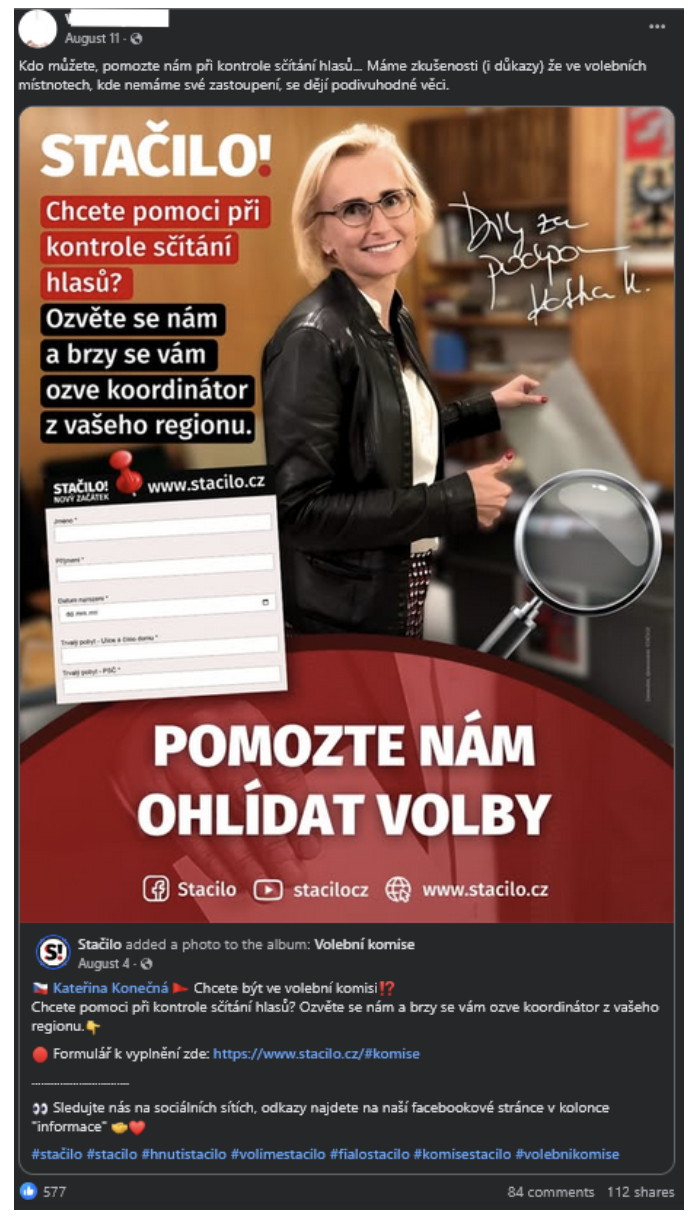
A range of actors adopted the ‘Romanian scenario’ narrative. From March 2025, ISD found political activists of groups from across the Czech political spectrum including the far-right SPD and far-left Stačilo! party using this terminology in election-related conversations online. In response to calls for these parties to be treated as an official coalition (which would set a higher vote threshold), their party leaders explicitly referred to such a move as a step toward a ‘Romanian scenario’, even suggesting the EU might appoint the next government. Although the Czech Constitutional Court ultimately ruled in their favour, the controversy reinforced the narrative of institutional manipulation. It also demonstrated how legal procedures can be reframed as political warfare in a climate of distrust.
The narrative was also echoed by more influential public figures, including former Czech President Miloš Zeman, who expressed his concerns about potential election manipulation by the country’s Constitutional Court or the Czech Intelligence Service (BIS). A post by former finance minister Miroslav Kalousek shortly after the election, suggesting that people would riot if the election favoured the incumbent coalition, led to a spike in mentions of election manipulation during the week of the elections. Despite ridiculing the election manipulation accusations, Kalousek’s post demonstrates that narratives about ‘manipulated elections’ reached the Czech mainstream.
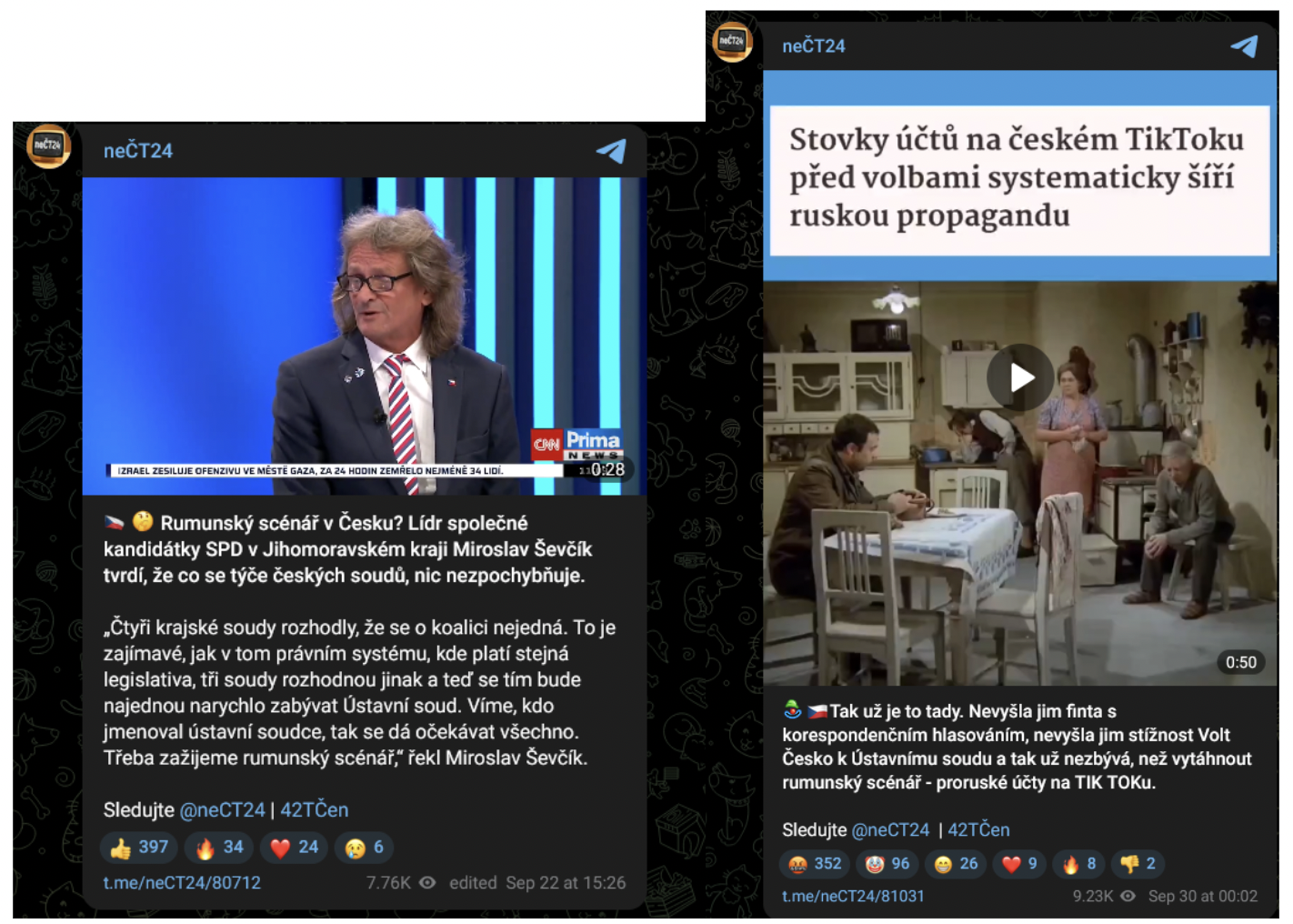
The so-called ‘Romanian scenario’ was further amplified by Czech alternative media outlets with ties to the Kremlin. Telegram channel neČT24 (32,200 subscribers), viewed by the Czech intelligence agency BIS as a “successor to the Russian state-media outlet Sputnik”, used the narrative in a post which received nearly 8,000 views. About two weeks after the elections, this channel amplified another false claim that the Czech army was collecting compromising material against the opposition.
Some Czech users also used the term to allege election manipulation in other countries, including the December 2024 presidential elections in Croatia. A similar trend was also reported from Poland leading up to the country’s presidential elections in May 2025: incumbent President Andrzej Duda alleged EU interference in the Romanian elections and expressed concerns about a similar occurrence in Poland.
The same conspiratorial framing of a ‘Romanian scenario’ (sometimes called a ‘Romanian scheme’) was also observed among Russian Telegram channels throughout 2025, peaking in May after the elections in Romania were repeated. This presence points to the term ’Romanian scenario’ establishing itself across geographies and in pro-Kremlin propaganda. This indicates the potential for similar narratives to resurface in upcoming elections in other EU member states.
Narratives proliferate
Opposition voices and Russian-affiliated channels both also sought to portray the use of the EU’s Rapid Response System (RRS) in Czechia as ‘an EU censorship tool’. The RRS is intended to strengthen cooperation and communication among organisations including online platforms, civil society groups, and relevant national and international institutions under the EU’s Code of Practice on Disinformation. However, Russian state-affiliated Telegram channel neČT24 repeatedly suggested it was designed to silence dissent. The channel also amplified a statement made by a right-wing SPD candidate claiming his Facebook was blocked after he criticised the RRS.
These claims fed into broader fears of elite control and foreign interference, aligning with the ‘Romanian scenario’ narrative. Both the use of the RRS and the Constitutional Court decision about thresholds for party coalitions running in elections appear to have played a prominent role in election manipulation claims on social media. These events coincided with an increase in X posts mentioning ‘Romanian scenario’ (326 posts in total) in the week of elections, the third highest peak of Czech-language use of the term throughout the course of the year.
Just before the election, researchers from the Centre for Research of Online Risks reported a coordinated network of approximately 286 anonymous TikTok accounts promoting Czech opposition figures. These accounts had previously shared pro-Russian content, raising suspicions of foreign involvement. A few days later, the Czech intelligence service found 400 TikTok accounts they believe attempted to interfere with the elections.
These findings were once again reframed by conspiratorial voices as a ‘false flag’ operation staged by the Czech intelligence services to create a pretext to annul the election results. They were combined with the existing narrative about the ‘Romanian scenario’ and other claims: the majority of the 327 Czech-language X posts which mentioned election manipulation during the week of the elections in early October discussed the decision of the constitutional court, the RRS, and uncovering of the coordinated TikTok network, all framed as part of the ‘Romanian scenario’.
Conclusion
The ‘Romanian scenario’ narrative illustrates how electoral distrust can be strategically constructed and amplified, evolving into a full-fledged conspiracy theory involving courts, intelligence services, the EU and digital platforms. In Czechia, this narrative was promoted by opposition politicians, former officials and foreign-linked actors, gaining traction in public discourse ahead of the 2025 parliamentary elections.
Notably, no claims of a ‘stolen vote’ or a ‘Romanian scenario’ were made after the election by Stačilo! or the SPD, despite their low level of success. While this suggests that the was narrative mainly used as a tool for voter mobilisation, other actors involved in spreading such claims may continue to foster distrust in the Czech information space – in particular targeting the EU’s efforts to protect the integrity of electoral processes in other member states. The widespread use of the ‘Romanian scenario’ narrative, and the way it connects domestic legal debates, foreign events, and alleged digital censorship, has left a noticeable mark on Czech political discourse. Similar patterns can be observed in other democracies, where comparable narratives appear regularly.
The sole responsibility for any content supported by the European Media and Information Fund lies with the author(s) and it may not necessarily reflect the positions of the EMIF and the Fund Partners, the Calouste Gulbenkian Foundation and the European University Institute.