Digital Dispatches
November 12, 2026

ISD-US
Hybrid Extremism and Nihilistic Violence, Kids Online Safety, Recommender Systems and Algorithms, Tech Accountability and Safety, Threat Detection and Analysis
TikTok and the mainstreaming of the True Crime Community
Since October 2025, the True Crime Community has been linked to at least 18 successful or disrupted attacks—nearly as many as researchers identified during the entire period from January 2024 to October 2025. This surge in violence coincides with the True Crime Community’s migration from Tumblr to TikTok, where platform features have enabled content glorifying mass shooters to reach wider audiences. This migration highlights the risks posed by algorithmic amplification of harmful content to vulnerable youth. Addressing this requires more consistent enforcement responses and greater transparency from algorithmically amplified platforms such as TikTok.
Introduction
In October 2025, ISD research on the True Crime Community (TCC) identified the online fandom of mass killers as “one of the most significant contributors to acts of public violence in the United States.” That report identified at least 15 TCC-linked successful or disrupted attacks in the US since the beginning of 2024. In the last year, that number has more than doubled to 33. This surge in violence coincides with recent enforcement measures on smaller platforms like Tumblr that spurred the migration of a large portion of the TCC to TikTok, where algorithmically driven engagement has supercharged its spread. Unlike Tumblr, where the fandom is largely isolated, TikTok actively works to expose users to new content through its algorithm, resulting in TCC videos being served to a much larger audience.
Attackers linked to the TCC take inspiration from previous attacks while attempting to cultivate their own aesthetic that can be mimicked by future attackers. The very nature of this process is intrinsically linked to the digital platforms on which TCC participants congregate, share content and broadcast their desire to commit violence. The structure of Tumblr lent itself well to the creation of a close-knit community, but its comparatively limited audience constrained its influence. By contrast, TikTok’s design and features create an environment that enables content to reach beyond its own niche community. This Dispatch will examine the impact of TCC’s migration on youth radicalization, the limitations facing researchers seeking to understand harms on TikTok, and the implications for policymakers and social media platforms.
The Migration
Tumblr has been the primary online home of TCCers for the last decade.[1] The platform’s limited popularity constrained the reach of TCC content, while its reliance on hashtags and lack of algorithmic amplification made it difficult for average users to stumble upon TCC content unintentionally. These characteristics, along with more recent platform enforcement actions, kept the community largely insular.
In January 2026, Tumblr conducted a ‘ban wave’[2] of TCC accounts and hashtags and researchers observed a large-scale migration of many TCC users to TikTok. This drastically changed the reach of TCC content. While TikTok does not provide sufficient data to conduct a comprehensive analysis of activity on its platform, evidence suggests that TCC content is garnering significantly more reach on TikTok.
Figure 1 further illustrates the differences in engagement between the two platforms: Two similar posts of TCC content from users with comparable follower counts, published on the same day in June. Both posts were made by TCC-linked users with fewer than 100 followers and did not include in-depth research or original artwork—both of which are prized by the community and can generate high levels of engagement. The first—a picture of a mass shooter posted on Tumblr—received 14 comments, 2 shares and 16 likes (Tumblr does not display view counts). The second—an AI-generated video of a different mass shooter dancing, posted on TikTok—received nearly 65,000 likes, over 1,000 comments, and nearly 875,000 views.
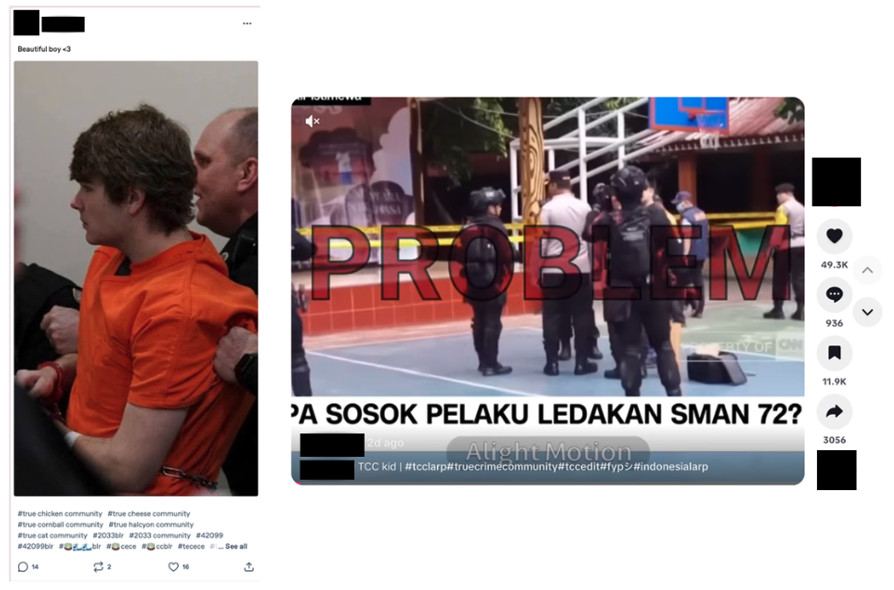
The migration to TikTok means that TCC posts and the glorification of violence inherent in aspects of TCC culture are reaching a wider audience. On Tumblr, posts were generally only visible to users who either followed a TCC-linked account or searched for a specific hashtag. As a result, the platform’s structure created a relatively high barrier to entry into TCC. It would be difficult for an ordinary user—or even a member of another violent online network or group—to stumble upon TCC content on Tumblr. Conversely, TikTok is an algorithmically driven platform that seeks to expose its users to new content that aligns with their interests. TikTok’s ‘For You feed’ serves a mixture of content intended to “introduce [users] to new creators and content.” The type of content is determined by the user’s previous interactions, their expressed preferences and the predictions of TikTok’s ‘recommender system.’ While TikTok claims to not recommend or limit the recommendation of “certain categories of content that may not be suitable for a general audience,” researchers have identified numerous instances in which TCC content appears to have been served to users outside the community, outlined below.
The Impact
Algorithmic Spread
The migration from Tumblr to TikTok appears to have accelerated the spread of TCC culture to the wider universe of radicalized online youth as well as mainstream audiences. As previously noted, the lack of application programming interface (API) access on TikTok prevents researchers from compiling comprehensive data on TCC content, limiting analysis to a subset of manually identified posts. This is compounded by broader data restrictions: Tumblr does not display view counts or other broad engagement statistics, while TikTok restricts researcher access to APIs, forcing reliance on third-party tools that crawl the platform to collect what content they can. While these tools are useful, they capture only a small fraction of the material hosted on the platform.
Despite these limitations, researchers identified over 70 TCC-linked TikTok posts that received more than 100,000 views in the last 90 days by searching a series of eight keywords commonly used by TCC users. These posts averaged nearly 200,000 views, with four receiving over 500,000. While this sample is unlikely to capture the full reach of TCC content on TikTok, it suggests that hundreds of thousands of users are viewing TCC videos on the platform. These findings suggest that TCC content is not only reaching larger audiences than it did on Tumblr but also being served to individuals who were likely not seeking it and may not have been exposed to it elsewhere.
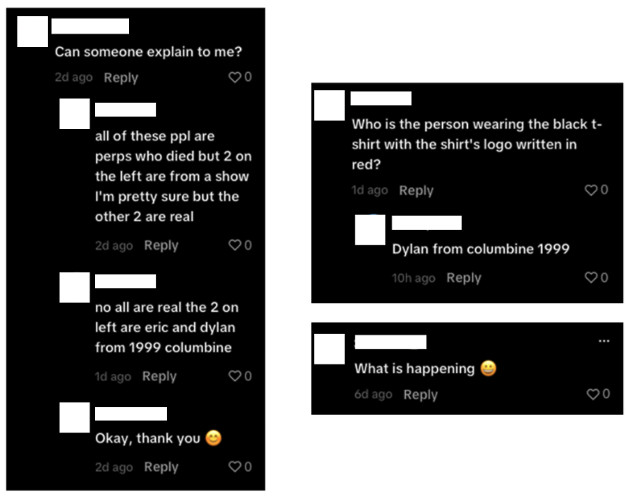
Beyond the sheer number of views, there are indications that many of the users who viewed the posts were not previously exposed to TCC content. A review of the 183 comments on a randomly selected TCC post on TikTok with slightly over 100,000 views revealed multiple indications that the content was being served to users outside of the community. The video, posted on May 22, 2026, depicts the corpses of four very recognizable TCC figures: The two Columbine attackers, the Sandy Hook shooter and a Russian school shooter.
Despite this, four commenters indicated that they were unfamiliar with what they were viewing (see Figure 2). There are also indications that this video served as a gateway into TCC content. On June 8, 2026, a Spanish-speaking TikTok user commented (translated) “can somebody explain to me” and received explanations from several other users. A review of hundreds of reposts from that user over nearly a year showed no previous interaction with TCC or other violent content. However, since commenting on that video, 8 of their 15 reposts contained TCC content.
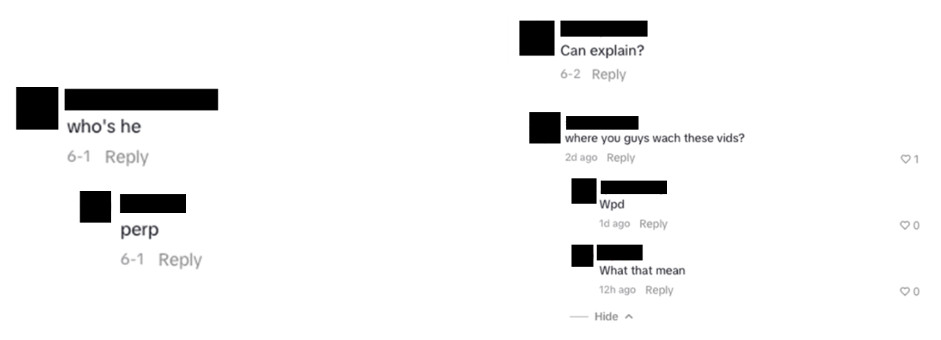
A video posted on May 30, 2026, depicts an edited clip of surveillance footage from a 2022 school shooting. The commenters indicated a similar lack of familiarity (see Figure 3). One commenter did not know the identity of the shooter—again a well-known TCC figure—while another simply asked “can explain?” A third asked where videos of mass shootings could be found, and a fourth commenter seemed unfamiliar with “WPD” or WatchPeopleDie, a video hosting platform popular and well-known to TCC users.
Some TCCers appear to be intentionally harnessing TikTok’s features to accelerate the spread of their content. Of 1,000 randomly selected TikTok posts featuring the eight TCC-linked keywords described above, 432 included the terms ‘fyp,’ ‘foryoupage,’ or ‘news’ which are keywords intended to ensure that the TikTok algorithm serves their content to users outside of their existing followers. Due to the lack of meaningful API access, researchers conducted manual searches and identified multiple instances of users indicating that they either first encountered TCC content on their “For You Page” or that initial engagements with TCC content resulted in a high volume of algorithmically served TCC posts. On May 31, a user wrote: “Im not really into TCC but this popped up in my fyp.” On May 26, another stated: “my fyp thinks i like tcc.” On June 12, one user posted: “I posted on[e] tcc joke and now my fyp think I’m a dork.”
Similarly, researchers reviewed the comments on the high-engagement posts referenced above. Of the 149 visible top-level comments on one TikTok post, five users used ‘fyp’ or a similar phrase. While it is possible that these users were using the phrase ironically or were TCCers attempting to influence their own recommendation algorithm, it is also likely that a significant portion of them were communicating that they found this content via their ‘For You Page.’
Reduced Protective Factors
The migration to TikTok also significantly reduced the influence of Tumblr-based TCCers who discouraged the use of violence. While counterintuitive for a community obsessed with mass killers, the bulk of the TCC fandom on Tumblr does not outwardly or explicitly encourage violence from their compatriots. Researchers regularly observe TCCers on Tumblr discouraging others who give indications of attack or suicide plotting, often citing concerns that such acts will lead to further social media bans and increased law enforcement scrutiny. This discouragement has not been observed on TikTok, suggesting that those users largely remained on Tumblr, that their posts are lost in the high volume of other comments, or both. While focusing on these last-minute entreaties ignores the impact that those very same users had by creating an environment in which violence is glorified and past attackers are deified, it is important to note that the community does play a small deterrent role.
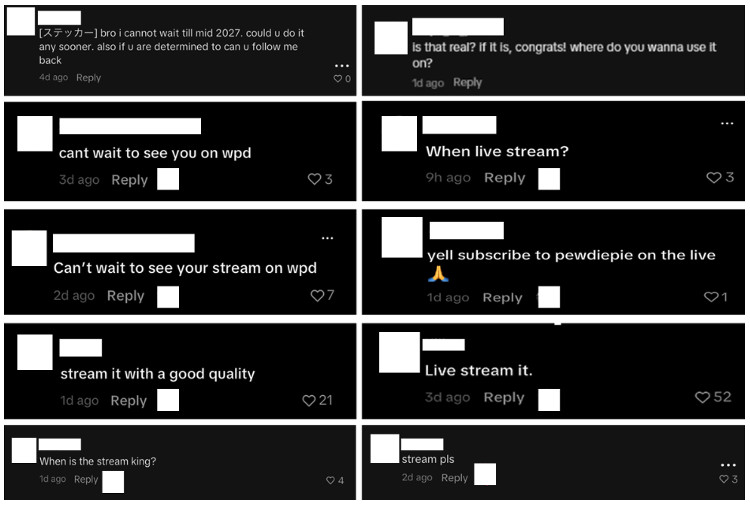
That deterrent appears completely absent from the community on TikTok. For example, in late April, a TikTok user posted a video, captioned with a vague reference to future violence, of himself wearing a trench coat and a tactical helmet. Commenters immediately responded with encouragement, calling on the original poster to livestream the attack (see Figure 4).
During our digital monitoring, ISD reports actionable threats of violence to relevant authorities. In 2025, ISD shared reports with authorities concerning 21 TCC-linked social media users who made statements indicating that they were planning an attack, planning an act of self-harm, or planning to commit an illegal activity. Of those reports, 13 were found on Tumblr, 4 on TikTok and 4 from other platforms. By contrast, researchers have submitted 57 reports about TCC-linked TikTok users thus far in 2026, one of which was cited in criminal charges against an Ohio man who threatened to allegedly attack a mosque in imitation of the Christchurch attacker and several of which led to disruptions in other countries. Only nine reports have concerned TCC-linked Tumblr users so far this year.
Influence of Other Violent Online Networks
The migration of TCCers coincided with the adoption of TCC tactics by other violent online networks such as Com/764 and militant accelerationists. Researchers have increasingly observed ideologically motivated attackers engaging with TCC spaces online, broadcasting their intent before carrying out attacks, mimicking the behaviors and target selection of previous attackers, and developing post-attack messaging strategies intended to ensure that their acts are remembered by their online associates. One example is the May 2026 attack on a San Diego Mosque, in which two suspects—teenagers linked to TCC—livestreamed a shooting, imitating many aspects of the Christchurch attack while broadcasting their neo-Nazi accelerationist views.
While TCC networks have long overlapped with other subcultures centered on nihilistic violence and ideologically motivated extremist groups, these interactions were generally limited to individuals on the fringes of the fandom. Significant participation by outsiders in TCC’s primary gathering spaces on Tumblr was, and remains, uncommon. The move to TikTok eliminated those barriers, and it is likely TikTok’s algorithm is accelerating the engagement between these groups as members of other violent online networks are served TCC-linked posts in the same manner as other TikTok users.
This shift builds upon previous efforts by ideologically motivated groups to harness the desire for notoriety among young, radicalized individuals, such as those associated with Saints Culture. While the Christchurch attack inspired a deadly wave of White supremacist attacks, including the 2019 shootings in El Paso, Texas, and Poway, California, as well as the May 2026 San Diego attack, its influence remained largely confined to White supremacist and accelerationist circles until recently.
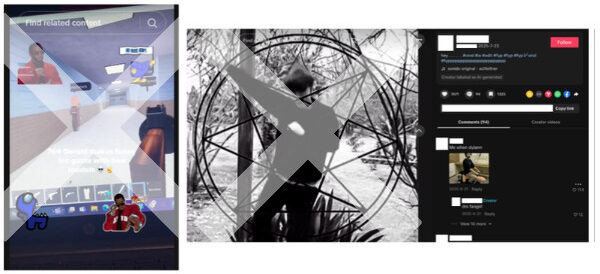
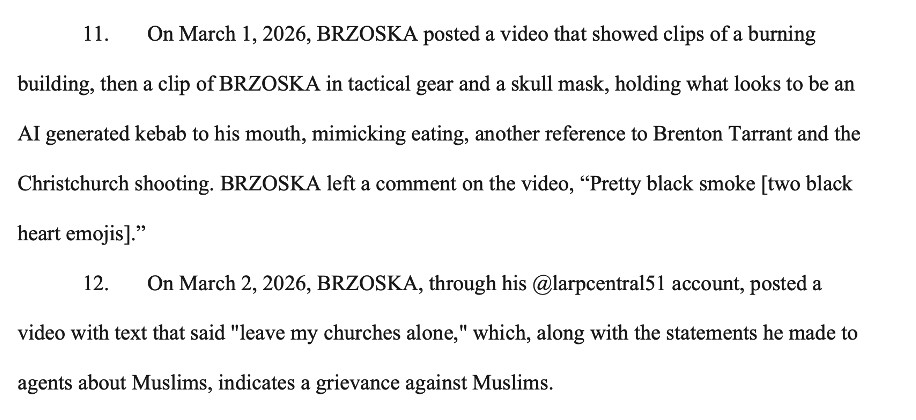
The Ohio case referenced above also highlights the degree to which TCC tactics and culture have influenced other violent online networks. On his TikTok account, the Ohio man tagged his posts with TCC hashtags, engaged with TCC fans, created TCC-style videos and was found broadcasting intent to carry out a violent act in the same manner popularized by TCC (see Figure 6). However, a closer analysis of the case reveals that he was likely motivated by an ideological cause rather than the notoriety and inwardly focused drivers indicative of nihilistic violence subcultures. When assessing the motivations of violent actors, the choice of target is often the most revealing piece of evidence. The Ohio suspect allegedly planned to attack a mosque not only because he sought to imitate the Christchurch shooter; according to court documents, he specifically stated that he was motivated by antipathy toward Muslims and his concern that churches were being converted to mosques.

Policy and Platform Recommendations
The risk of radicalization on TikTok is distinct from that on platforms like Tumblr and Reddit, which are oriented around discrete communities that largely insulate their members from contact with mainstream users. Alongside its considerably larger and younger user base, TikTok is built upon recommender systems that serve to push content regardless of user intent (for example, through a user’s stated preferences or specific accounts the user follows), a risk that previous ISD research has shown particularly affects younger users being exposed to hateful and violent content.
Algorithmically driven platforms must take stronger steps to ensure that content associated with such harmful networks is not amplified to users, to reduce its ability to reach wider audiences and to provide researchers with the transparency needed to examine and identify harms on their platforms. As argued in a recent ISD paper for the Global Internet Forum to Counter Terrorism (GIFCT), mitigating this evolving threat also requires dedicated and coordinated action both by and between social media platforms. Banning individual accounts from specific social media platforms and pushing well-established communities with strong social bonds from one online platform to another are unlikely to degrade the network itself or decrease the threat posed by its members. Without effective coordination, the wide-ranging bans on Tumblr did little to disrupt the community itself and instead allowed TCCers to reconstitute on TikTok.
Robust content moderation efforts aimed at banning accounts linked to violent activity are essential but must be accompanied by more strategic network disruption efforts that recognize the highly regenerative nature of these harmful networks. This will require deep subject-matter expertise (including from outside the industry) around the evolving threat across platforms. Cross-sectoral disruption efforts like Europol’s strategic action days against radicalization in gaming spaces and Islamic Revolutionary Guard Corps (IRGC) cross‑platform networks could serve as a model for coordinated ecosystem-level responses.
Finally, platforms also have an important role to play in ensuring the safety of their users and connecting vulnerable users with appropriate support services, particularly those related to mental health, self-harm and eating disorders, which frequently intersect with TCC communities. Such a preventive approach can serve to boost protective factors and address the potential drivers of violence within online communities that can precipitate real-world harm.
Without further action, violent online networks will continue to exploit recommendation systems to amplify violent content and target vulnerable young people. While robust law enforcement efforts have succeeded in disrupting a significant number of plots and saving numerous lives, action is needed upstream to prevent the initial exposure and disrupt radicalization.
End Notes
[1] Researchers note that while Tumblr was the most popular platform, TCC participants can be found on nearly every social media platform.
[2] A “ban wave” refers to coordinated action by a social media platform to ban or restrict a large swatch of a community during a short period of time.
In the media
ISD Contributors